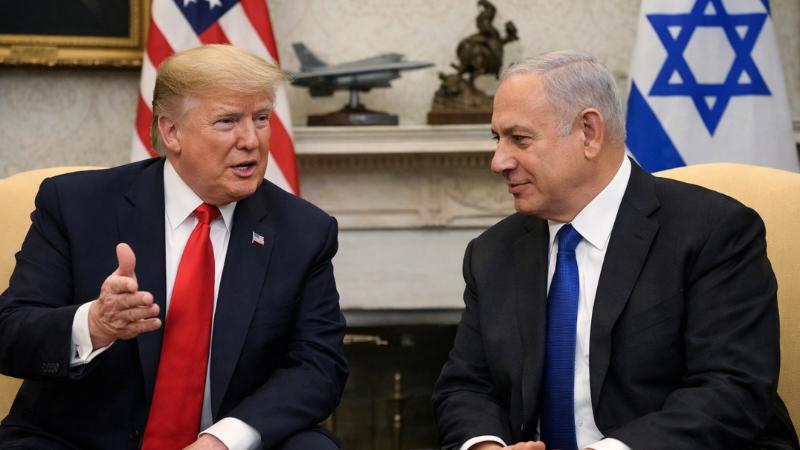
US President Donald Trump met Israeli Prime Minister Benjamin Netanyahu on Wednesday to discuss a range of strategic issues, with the Iran nuclear deal emerging as a central topic of conversation. The meeting, held amid heightened regional tensions, underscored ongoing diplomatic efforts and disagreements surrounding Tehran’s nuclear programme and its broader military capabilities.
Following the talks, Trump took to Truth Social to reiterate his administration’s position on negotiations with Iran. He said he had emphasized the importance of continuing diplomatic engagement to determine whether a deal could be finalized. According to the president, reaching an agreement would be preferable, but he warned that failure to secure a deal could carry consequences. Trump referenced a previous episode in which Iran declined to move forward with negotiations, resulting in what he described as a forceful response. He expressed hope that Tehran would adopt what he termed a more reasonable and responsible approach in the current round of discussions.
The US president also noted progress in Gaza and the broader Middle East, describing the regional situation as moving toward greater stability. He suggested that developments in Gaza and diplomatic engagement across the region were contributing to improved prospects for peace. While offering few specifics, Trump characterized the current climate as one in which peace efforts were gaining momentum.
In a separate interview earlier in the week, Trump described it as a “no-brainer” that any agreement with Iran must address its nuclear programme. He further indicated that discussions could extend beyond nuclear issues to include Iran’s ballistic missile stockpiles. The potential inclusion of ballistic missiles in negotiations has long been a point of contention, particularly among regional allies concerned about Tehran’s expanding missile capabilities.
When asked about Netanyahu’s perspective on the prospective US-Iran negotiations, Trump dismissed suggestions of unease on the part of the Israeli leader. He stated that Netanyahu supports the pursuit of a deal, provided it meets security standards. According to Trump, both leaders are aligned in seeking what he described as a “good deal” that would ensure regional stability and prevent further escalation.
Trump also asserted that Iran appears more serious about negotiations than in previous rounds, attributing this shift to credible military pressure. He alluded to past US actions targeting Iranian nuclear facilities, suggesting that Tehran’s earlier calculations had proven misguided. In his remarks, the president maintained that a combination of diplomacy and deterrence had influenced Iran’s renewed engagement.
However, Tehran has drawn a clear line regarding the scope of any potential agreement. Iran’s Foreign Minister Abbas Araghchi stated that the country’s missile programme is not open to negotiation and would not be included in any talks. He emphasized that Iran considers its ballistic missiles a matter of national defense and sovereignty, rejecting any suggestion of compromise in that domain.
The divergence highlights the complexity of reviving or reshaping an Iran deal that satisfies all stakeholders. While Washington and its regional partners continue to press for broader limitations on Tehran’s military capabilities, Iranian officials have consistently resisted efforts to expand the framework beyond nuclear-related restrictions.
The discussions between Trump and Netanyahu reflect the continued importance of US-Israel coordination on issues affecting Middle East security. As diplomacy unfolds, the interplay between negotiations, military deterrence, and regional alliances will likely shape the trajectory of future talks with Tehran. Whether a comprehensive agreement can be achieved remains uncertain, but both Washington and Jerusalem appear intent on maintaining pressure while keeping channels of diplomacy open.