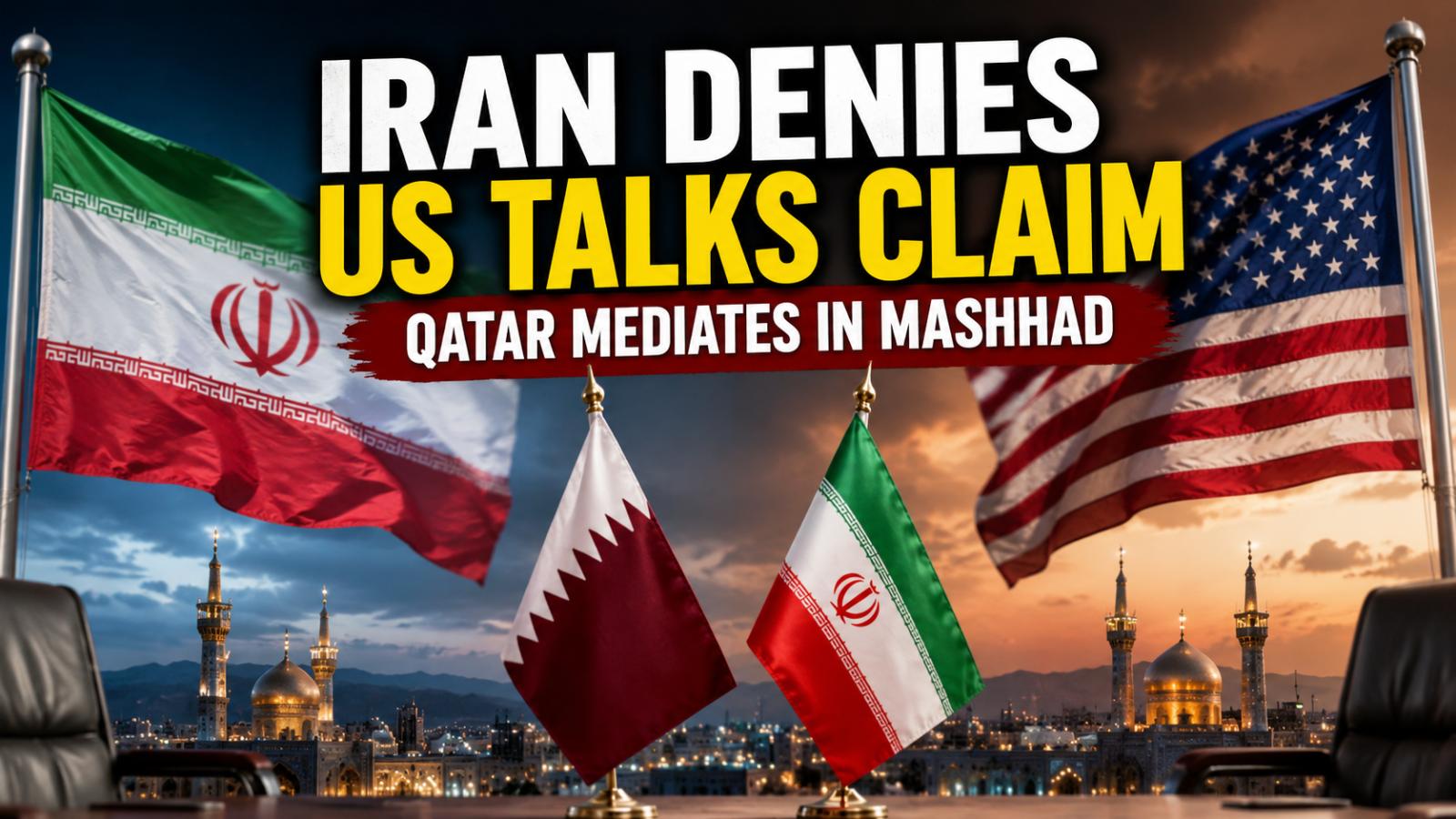
Iran has denied requesting negotiations with the United States, although officials confirmed that a Qatari mediator visited Mashhad to discuss regional tensions. The statement highlights Tehran’s cautious diplomatic stance and its continuing distrust of Washington.
Iran US talks denied by Tehran
Iran said it had not approached the United States seeking fresh negotiations, challenging reports that Tehran and Washington were preparing to resume formal diplomatic discussions.
Foreign Ministry spokesperson Esmail Baghaei said Iran had merely accepted a request from a regional mediator who wanted to visit the country and discuss recent developments. He stressed that accepting the visit should not be interpreted as an Iranian request for negotiations with Washington.
Baghaei’s statement reflects the careful language Tehran frequently uses when addressing indirect talks. Iran has repeatedly distinguished between receiving messages through regional governments and entering negotiations directly with US officials.
Qatar mediation leads to Mashhad visit
According to Baghaei, a Qatari mediator visited the northeastern Iranian city of Mashhad on Friday, July 10. Iranian representatives used the meeting to communicate Tehran’s positions and concerns to the Qatari side.
The Iranian Foreign Ministry did not disclose the mediator’s identity or provide a detailed account of the issues discussed. However, Qatar has played a significant mediation role during recent efforts to reduce tensions between Iran and the United States.
A Qatari delegation visited Iran as part of Doha’s wider attempt to encourage de-escalation and create conditions for broader diplomatic engagement. Regional governments have intensified these efforts amid renewed military tensions and uncertainty surrounding earlier understandings between Tehran and Washington.
Tehran maintains a cautious diplomatic stance
Baghaei’s comments came as conflicting accounts emerged about whether Iran and the United States intended to continue talks. Washington has suggested that diplomatic communication could continue despite recent hostilities, while Tehran has publicly rejected claims that it initiated a new round of negotiations.
The disagreement does not necessarily mean that all diplomatic contact has stopped. Messages can still pass through countries such as Qatar without direct meetings between Iranian and American officials.
Recent discussions have focused on regional security, Iran’s nuclear programme, frozen Iranian assets and navigation through the Strait of Hormuz. However, military confrontations and accusations from both sides have weakened trust and made any lasting agreement more difficult.
Mottaki accuses US of diplomatic deception
Former Iranian foreign minister Manouchehr Mottaki offered a harsher assessment of Washington’s intentions. Speaking to Iranian state television, he described earlier Islamabad talks as part of a wider American strategy designed to mislead Iranian officials.
Mottaki claimed the United States expected to achieve its political goals within days and sought to weaken or end the Islamic Republic. He said the plan had failed and urged Iranian negotiators to remain alert to what he viewed as Washington’s broader regime-change objective.
His allegations represent his political assessment and have not been independently established as fact. However, the remarks illustrate the deep suspicion that continues to shape Iranian debate over engagement with the United States.
Regional tensions limit chances of progress
Qatar and other regional governments continue to promote dialogue because a wider confrontation could threaten Gulf security, energy supplies and international shipping. Yet mediation alone may not be enough to produce a stable agreement.
Iran’s denial shows that Tehran wants to avoid appearing as though it is seeking negotiations under pressure. At the same time, its decision to receive the Qatari mediator indicates that Iranian officials have not completely closed diplomatic channels.
For meaningful progress, both sides would need to clarify the status of indirect talks, reduce military escalation and provide clear commitments that can be verified. Until then, Qatar’s mediation may keep communication open without guaranteeing formal Iran US talks.