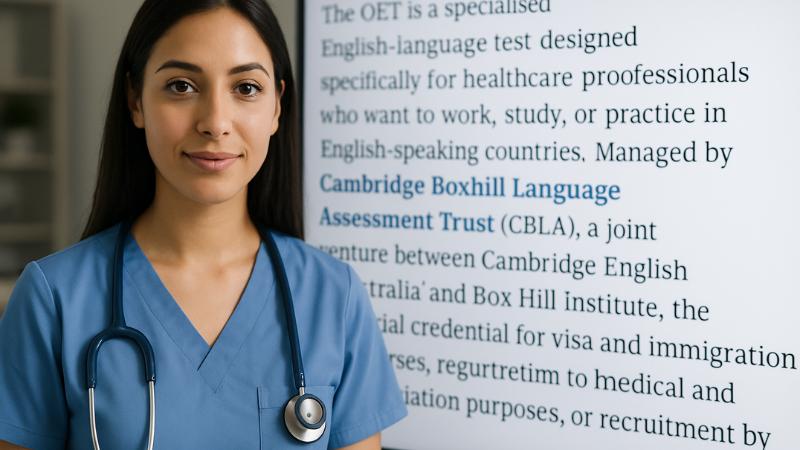
The Occupational English Test, widely known as OET, has become one of the most recognised English-language examinations for healthcare professionals aiming to work, study or qualify in English-speaking countries. Designed specifically for the medical and health sectors, the test evaluates candidates on the type of language skills they will need in real clinical environments rather than in general communication. Managed by the Cambridge Boxhill Language Assessment Trust, a collaboration between Cambridge English in Australia and Box Hill Institute, the OET has earned credibility among regulatory bodies and medical institutions worldwide.
The test is targeted at 12 healthcare professions, including medicine, nursing, dentistry, pharmacy, physiotherapy and several allied health fields. Its structure reflects the realities of workplace communication, ensuring that candidates are assessed on tasks they are likely to encounter while treating patients or interacting with colleagues. Listening and reading sections are shared by all candidates and include scenarios such as consultations, medical reports and informational texts. Writing and speaking, however, are profession-specific. A candidate may be required to compose a referral or discharge letter relevant to their discipline or participate in a role-play involving a simulated patient interaction.
The exam is available in paper-based, computer-based and remotely administered formats, giving candidates flexibility based on their location and convenience. Regardless of the format chosen, the content and level of difficulty remain consistent. This approach has helped the OET maintain reliability and fairness across test centres and testing modes.
Acceptance of the OET continues to expand across major English-speaking regions, including the United Kingdom, the United States, Australia, New Zealand, Ireland and Singapore. In many of these destinations, healthcare regulatory bodies, licensing authorities, hospitals and immigration agencies recognise the OET as evidence of English proficiency. For professionals hoping to register with medical councils, secure skilled-worker visas or apply to health-related education programs, the test provides a crucial credential. Its alignment with clinical communication makes it particularly valuable for medical institutions that seek staff capable of functioning confidently in real-world patient settings.
Each of the four sub-tests—Listening, Reading, Writing and Speaking—is scored on a numerical scale from zero to 500. These scores are then converted into letter grades ranging from A to E. Although the OET does not define a universal passing score, most authorities require at least 350 in each sub-test for licensing, visa applications or professional registration. Applicants are advised to verify the specific requirements of the country or organisation they intend to apply to, as standards may vary.
Candidates can access their results online once released and share them directly with institutions that request verification. To support test-takers, the OET administrators provide a range of preparation materials, including free sample tests, official practice resources and profession-focused courses designed to familiarise healthcare workers with exam conditions and skill expectations. A directory of verified trainers is also available for those seeking guided preparation, especially individuals transitioning from general English training to medical-English contexts.
Because the OET is tailored to workplace communication, preparation extends beyond exam readiness. It helps candidates build confidence in practical skills such as writing clinical letters, engaging with patients, understanding healthcare instructions and interpreting professional literature. This makes the OET a preferred choice for healthcare workers trained outside English-speaking regions who plan to work abroad. Many choose the exam to ensure that their English proficiency is evaluated within meaningful medical settings rather than through general language tests.
With its global recognition and healthcare-specific structure, the OET serves not only as a language certification but also as an indicator of how prepared a professional is for real clinical communication. As international mobility in the healthcare workforce continues to grow, the test remains an important gateway for those seeking careers, education or professional registration in English-speaking countries.