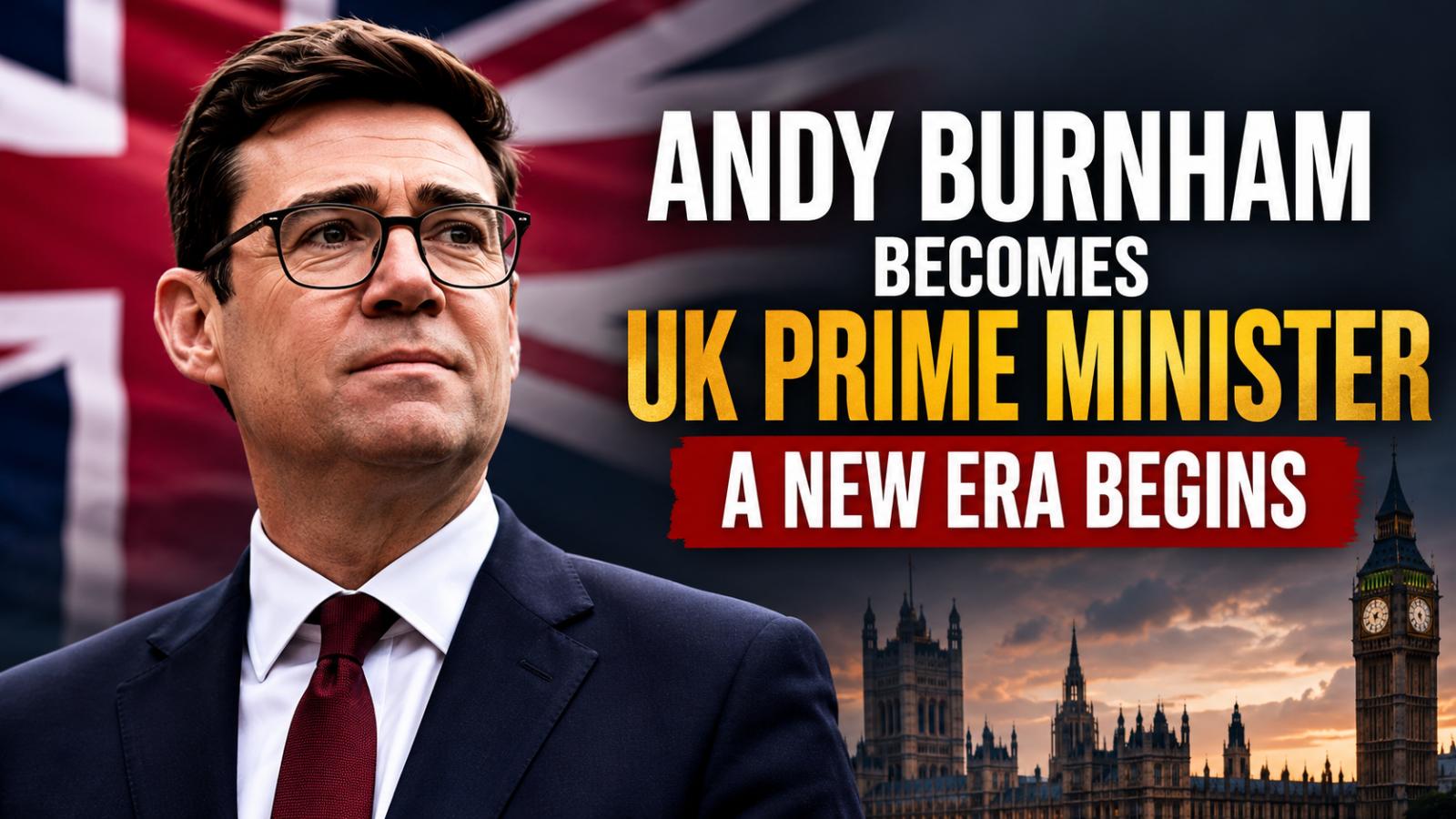
Andy Burnham has formally become the United Kingdom’s new prime minister after King Charles III invited him to form a government. The former Greater Manchester mayor enters Downing Street as investors assess his economic plans, energy policy and proposals for public services.
Burnham takes office after Starmer’s departure
Burnham succeeds Keir Starmer, who resigned after two years in office following internal Labour pressure, declining public support and damaging local election results. Burnham became Labour leader without facing a rival after securing overwhelming support among the party’s members of Parliament.
His appointment makes him Britain’s seventh prime minister since 2016, underlining a decade of political instability. After meeting the King at Buckingham Palace, Burnham was expected to enter Downing Street, begin appointing his Cabinet and outline his priorities in his first speech as prime minister.
Burnham recently returned to Parliament after winning the Makerfield by-election. Before that, he served for nearly a decade as mayor of Greater Manchester and previously held Cabinet roles under Labour prime ministers Tony Blair and Gordon Brown.
Burnham policy agenda faces early scrutiny
Burnham has promised to address major structural problems, including social care, housing, regional inequality and the management of essential public services. He has argued that political power became too concentrated in Westminster while economic control shifted away from local communities.
His emerging agenda includes stronger public involvement in energy, transport and water, as well as a major expansion of council housing. Reports suggest his government may also consider changes to inheritance tax and council tax, although the details have not yet been formally announced.
Burnham has said economic growth will be essential to fund his plans. However, investors want clarity on whether large infrastructure and public-service programmes will require higher taxation, additional borrowing or greater issuance of UK government bonds.
UK bond markets watch spending plans
Financial markets previously showed concern that Burnham could pursue a more expansionary fiscal programme than Starmer. Those fears have eased, but gilt investors remain focused on whether the new government will continue Labour’s existing fiscal rules.
The main uncertainty surrounds how Burnham would finance public ownership, housebuilding and social-care reforms. Higher borrowing could increase pressure on government bond yields and complicate efforts to control public debt.
Markets are therefore likely to examine Burnham’s first Budget, spending review and Cabinet appointments for evidence of whether he will follow a cautious fiscal approach or move toward substantially higher public spending.
North Sea oil policy draws Trump’s attention
U.S. President Donald Trump has publicly praised reports that Burnham could accelerate oil and gas development in the North Sea. Trump described the region’s energy resources as valuable and argued that greater production could strengthen the British economy.
However, Burnham is expected to maintain Labour’s ban on issuing new exploration licences. His government may instead support faster development of projects that already hold licences, including possible tieback drilling connected to existing fields. This distinction is important because it does not amount to opening the entire North Sea to unrestricted new exploration.
New prime minister must provide policy clarity
Burnham enters office with broad ambitions but limited detail on how his programme will be funded. His immediate challenge will be convincing voters that he can improve living standards while reassuring investors that public borrowing will remain under control.
His first speech, Cabinet choices and upcoming fiscal announcements should provide a clearer picture of his approach. Until then, questions over taxation, nationalisation, housing investment, energy development and government spending will remain central to the UK’s political and economic debate.


 Joyful
0%
Joyful
0%
 Cool
0%
Cool
0%
 Thrilled
0%
Thrilled
0%
 Upset
0%
Upset
0%
 Unhappy
0%
Unhappy
0%