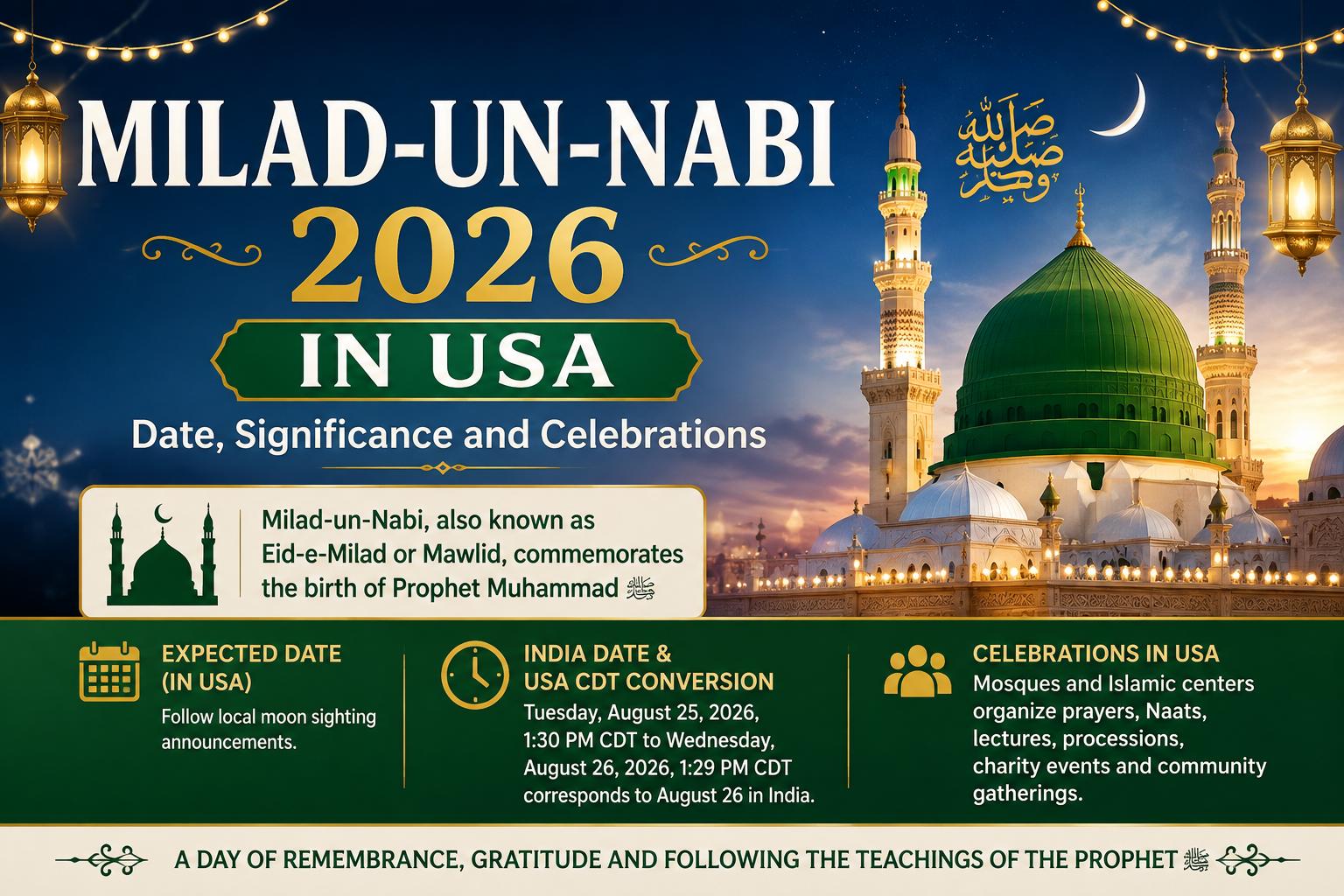
Milad-un-Nabi, also known as Eid-e-Milad or Mawlid, is listed for observance in India on Wednesday, August 26, 2026. The occasion commemorates the birth of Prophet Muhammad and is observed by many Muslim communities through prayers, religious gatherings, devotional recitations, charity and acts of community service.
The date is included in India’s Central Government holiday calendar and the Reserve Bank of India calendar. However, because the Islamic calendar follows the lunar cycle, the actual observance may differ by a day in some regions depending on local moon sightings and announcements from religious authorities.
Milad-un-Nabi 2026 Date in India and USA CDT
Milad-un-Nabi is traditionally observed on the 12th day of Rabi al-Awwal, the third month of the Islamic lunar calendar. In India, Wednesday, August 26, 2026, is listed as the reference date for the occasion.
For readers in the U.S. Central Daylight Time zone, the corresponding India calendar-day period is:
USA CDT: Tuesday, August 25, 2026, 1:30 PM CDT to Wednesday, August 26, 2026, 1:29 PM CDT.
This is only a time-zone conversion for the August 26 date in India and should not be treated as a fixed religious observance time. Muslims in the United States should follow announcements from local mosques and Islamic organizations for the confirmed date and schedule in their area.
In India too, local mosque committees and religious authorities may confirm the final observance according to established moon-sighting practices.
History of Milad-un-Nabi and the Mawlid Tradition
The observance of Mawlid developed gradually over several centuries in different parts of the Islamic world. Historical accounts associate some of the earliest organized commemorations with the Fatimid period in Egypt.
The tradition later spread across regions including the Middle East, Turkey, South Asia and parts of Africa, with communities developing different customs for marking the occasion.
One of the earliest widely documented large public Mawlid celebrations took place in Erbil during the early 13th century under Muzaffar al-Din Gökböri, a ruler associated with the period of Salahuddin Ayyubi.
Over time, Milad-un-Nabi came to be observed in different ways. Some communities organize large gatherings and processions, while others prefer prayer, religious study, charitable activities and smaller family events.
Although customs differ, the central theme for those who observe the occasion remains remembrance of Prophet Muhammad’s life, character and teachings.
Why Milad-un-Nabi Is Significant
Milad-un-Nabi is a time of spiritual reflection for Muslims who observe the occasion. Religious programs often focus on the Prophet’s teachings about compassion, patience, humility, generosity, justice and care for people in need.
Scholars and speakers may deliver talks about his life and character, encouraging people to reflect on how these values can be practiced in everyday life.
The occasion is also used as an opportunity to strengthen community bonds, promote charitable service and teach younger generations about Islamic history and religious traditions.
For many families, the day carries both spiritual and social importance, bringing relatives, neighbors and community members together for prayer and remembrance.
How Milad-un-Nabi Is Celebrated in India
Celebrations vary widely across India. In many places, mosques and neighborhoods are decorated with lights, banners and green flags, while special religious programs are organized throughout the day.
Common observances may include Quran recitations, Naats, devotional prayers, religious speeches and gatherings focused on the life and teachings of Prophet Muhammad.
Processions, often called Julus, are also held in some cities and towns. Participants may recite devotional poetry, offer prayers and take part in organized community events.
Local authorities and organizers may introduce traffic diversions, crowd-control measures and other arrangements in areas where large gatherings or processions are expected.
Charity and Community Service During Eid-e-Milad
Charity is an important part of Milad-un-Nabi observances for many communities. Families, mosques and voluntary groups may distribute meals, sweets, clothing and essential supplies to those in need.
Community kitchens and food-distribution programs are also organized in some places, reflecting the emphasis on compassion, generosity and service.
Some families choose to mark the occasion at home by inviting relatives and neighbors for prayers, devotional recitations and shared meals.
These activities help make Milad-un-Nabi a day not only of religious remembrance but also of community participation and support for people facing hardship.
Milad-un-Nabi 2026 Holiday and Local Observance
People planning bank visits, government work or travel around August 26 should check local holiday notifications in advance. Bank closures and government holidays can vary by state, city and institution.
The nationally listed date provides a reference for the observance, but local moon-sighting announcements remain important for determining when religious programs will actually take place.
As Milad-un-Nabi 2026 approaches, Muslim communities in India and around the world are expected to mark the occasion through prayer, remembrance, charity and peaceful gatherings centered on the teachings and values associated with Prophet Muhammad.