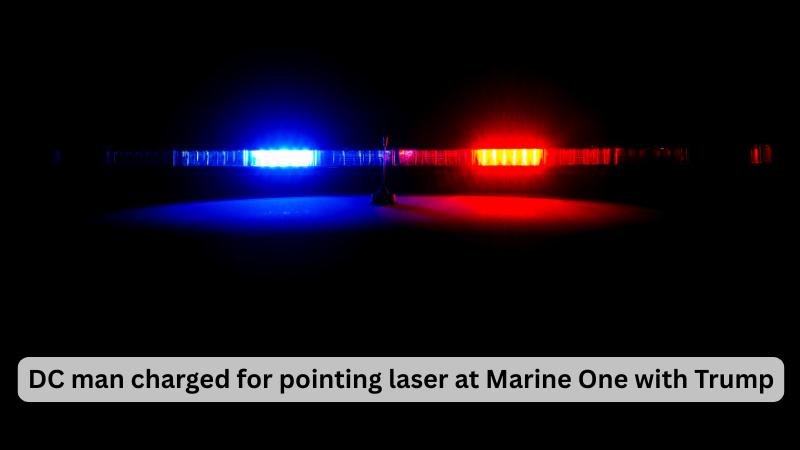
Washington — A man from Washington, D.C., has been charged with a federal felony after allegedly pointing a laser pointer at Marine One while President Donald Trump was onboard. The accused, identified as Jacob Samuel Winckler, now faces one count of aiming a laser pointer at an aircraft, a serious charge that carries a maximum sentence of five years in prison if convicted. The incident occurred on Saturday evening near the White House and led to Winckler’s immediate arrest by a U.S. Secret Service officer who was on duty in the area.
According to charging documents, Secret Service Officer Diego Santiago was monitoring the White House grounds as Marine One prepared for departure with the president aboard. During this time, he noticed Winckler walking shirtless along Constitution Avenue while loudly talking to himself. Santiago shined a flashlight in his direction to get a clearer look, and in response, Winckler allegedly aimed a red laser pointer directly into the officer’s eyes. This act alone could have posed a risk to the officer’s vision, but the situation quickly escalated. As the officer approached, Winckler reportedly turned the laser upward and aimed it at Marine One, which had just taken off and was still flying low above the White House.
The affidavit submitted in court highlights the potential danger caused by this action. Santiago stated that Winckler’s behavior posed a serious risk of flash blindness and pilot disorientation, particularly during the low-level flight when Marine One was still in close proximity to other helicopters and landmarks such as the Washington Monument. Pilots have long expressed concern about the risks posed by handheld laser pointers. A direct beam can momentarily blind or distract a pilot, potentially leading to accidents during critical phases of flight such as takeoff or landing.
The Federal Aviation Administration has repeatedly warned about the dangers of laser strikes against aircraft, noting that pilots have reported more than 12,000 incidents nationwide in the past year alone. In Washington, D.C., more than 60 laser strikes have already been reported in 2025, reflecting the growing frequency of such incidents despite the fact that they are federal offenses. These reports underline why authorities consider laser strikes against aircraft to be a major aviation safety hazard.
When Winckler was confronted and placed under arrest, he reportedly dropped to his knees and began apologizing, saying, “I should apologize to Donald Trump.” According to officers, he also claimed that he did not realize pointing the laser at Marine One was against the law. He explained to authorities that he routinely pointed the laser at a variety of objects without understanding the consequences. His explanation did little to reduce the seriousness of the incident, especially given the potential risks posed to the aircraft carrying the president of the United States.
Winckler was taken into custody immediately and booked on federal charges. Prosecutors noted that pointing a laser at an aircraft is not only illegal but also highly dangerous, especially in restricted airspace around Washington, D.C., where multiple federal agencies operate aircraft in close coordination. Aviation safety experts have long warned that even a brief distraction for a pilot can result in catastrophic consequences, making such acts unacceptable.
The case also reflects ongoing challenges faced by law enforcement in deterring and prosecuting laser strike incidents. While many may perceive pointing a laser as a harmless act, authorities stress that the reality is far more severe. A laser can cause temporary blindness, retinal damage, or long-lasting visual impairment for a pilot, and in the confined and high-risk environment of flight, even a momentary distraction could lead to tragedy. In this case, the fact that the incident occurred while Marine One was carrying the sitting president only heightened the seriousness of the offense.
Winckler made his initial appearance before a federal magistrate judge on Monday afternoon. Prosecutors are expected to push for strict accountability in order to send a message about the dangers of interfering with aircraft. If convicted, he could face up to five years in federal prison, though the final outcome will depend on the court proceedings. Legal experts note that while defendants sometimes claim ignorance, the law makes clear that such actions are punishable regardless of intent, particularly when they threaten public safety.
The incident serves as another reminder of the importance of aviation safety enforcement in the nation’s capital. With the increasing number of reported laser strikes nationwide, federal agencies continue to urge the public to understand the gravity of misusing laser devices. As this case moves forward in court, authorities hope it will highlight the risks and legal consequences associated with laser strikes against aircraft, sending a strong deterrent message to prevent future incidents.