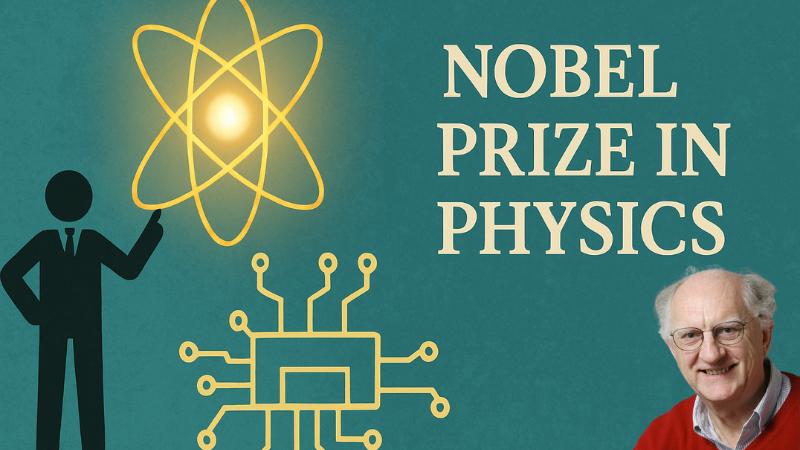
A UC Berkeley physicist has joined the ranks of Nobel laureates after being recognized for groundbreaking work that expanded the frontiers of quantum mechanics. John Clarke, an emeritus professor of physics at the University of California, Berkeley, has been awarded the Nobel Prize in Physics for his pioneering experiments that reshaped the scientific understanding of how particles behave on a macroscopic level. Clarke shares the honor with Michel H. Devoret and John M. Martinis of the University of California, Santa Barbara. Together, the trio’s research has helped unlock new pathways in the field of quantum science, leading to the development of transformative technologies such as quantum computers and sensors.
The Nobel Committee recognized the three scientists for their exploration of quantum tunneling, a phenomenon in which particles pass through energy barriers that classical physics deems impenetrable. Clarke and his colleagues took this abstract quantum effect and demonstrated it in a tangible way by using superconducting circuits. Their experiments proved that quantum tunneling can be observed and manipulated at scales large enough to have practical applications, opening the door to a new era of quantum engineering.
The ability to use superconducting materials to control quantum behavior was a revolutionary step for modern physics. It has since become a foundation for many of today’s most promising quantum technologies, particularly in quantum computing, where such circuits allow bits of information to exist in multiple states simultaneously. These findings not only deepened humanity’s grasp of the laws of nature but also accelerated the global race toward the next generation of computational power.
John Clarke’s recognition represents decades of dedication to experimental physics and scientific curiosity. Throughout his career, Clarke has been widely respected for his precision, creativity, and ability to connect theory with experimental validation. His research consistently pushed the boundaries of what could be measured and observed, inspiring generations of physicists and engineers. The Nobel Committee’s acknowledgment underscores both the scientific impact and technological relevance of his contributions.
When the award was announced, Clarke expressed his astonishment and gratitude, calling the moment “the surprise of my life.” For the professor, who has spent much of his professional life teaching and researching at Berkeley, the Nobel honor is both a personal triumph and a proud moment for the university’s storied physics department. His work continues a long tradition of Nobel-level research emerging from UC Berkeley, which has produced numerous laureates across scientific disciplines.
The shared Nobel Prize, worth more than one million dollars, symbolizes the collective nature of modern scientific discovery. Clarke, Devoret, and Martinis’s work highlights how collaboration between universities and research teams can drive major advances that benefit the world far beyond academic circles. Their experiments not only validated quantum principles but also inspired a host of subsequent research into practical quantum systems, from ultra-sensitive magnetic sensors to emerging quantum processors.
John M. Martinis, one of Clarke’s co-recipients, previously taught at Berkeley before joining UC Santa Barbara, reflecting the interconnected community of researchers who have advanced the field over the years. Together with Devoret, they represent a generation of physicists who bridged theoretical physics and engineering, turning quantum mechanics into an applied science. Their achievement underscores how curiosity-driven research often leads to breakthroughs that redefine the limits of technology.
Clarke’s Nobel Prize marks another milestone in the story of American scientific innovation and the continuing evolution of quantum physics. It serves as a reminder that today’s most complex scientific challenges are often conquered not by solitary genius but by collaboration, patience, and the relentless pursuit of knowledge. As quantum computing and sensing technologies continue to advance, the discoveries made by Clarke and his colleagues will remain a cornerstone of future innovation, shaping the scientific landscape for decades to come.