Federal immigration enforcement operations across Chicago and its suburbs over the past week have drawn sharp scrutiny, as multiple incidents involving U.S. Border Patrol and Immigration and Customs Enforcement (ICE) agents have raised questions about potential violations of a federal court order and the agencies’ own use-of-force guidelines.
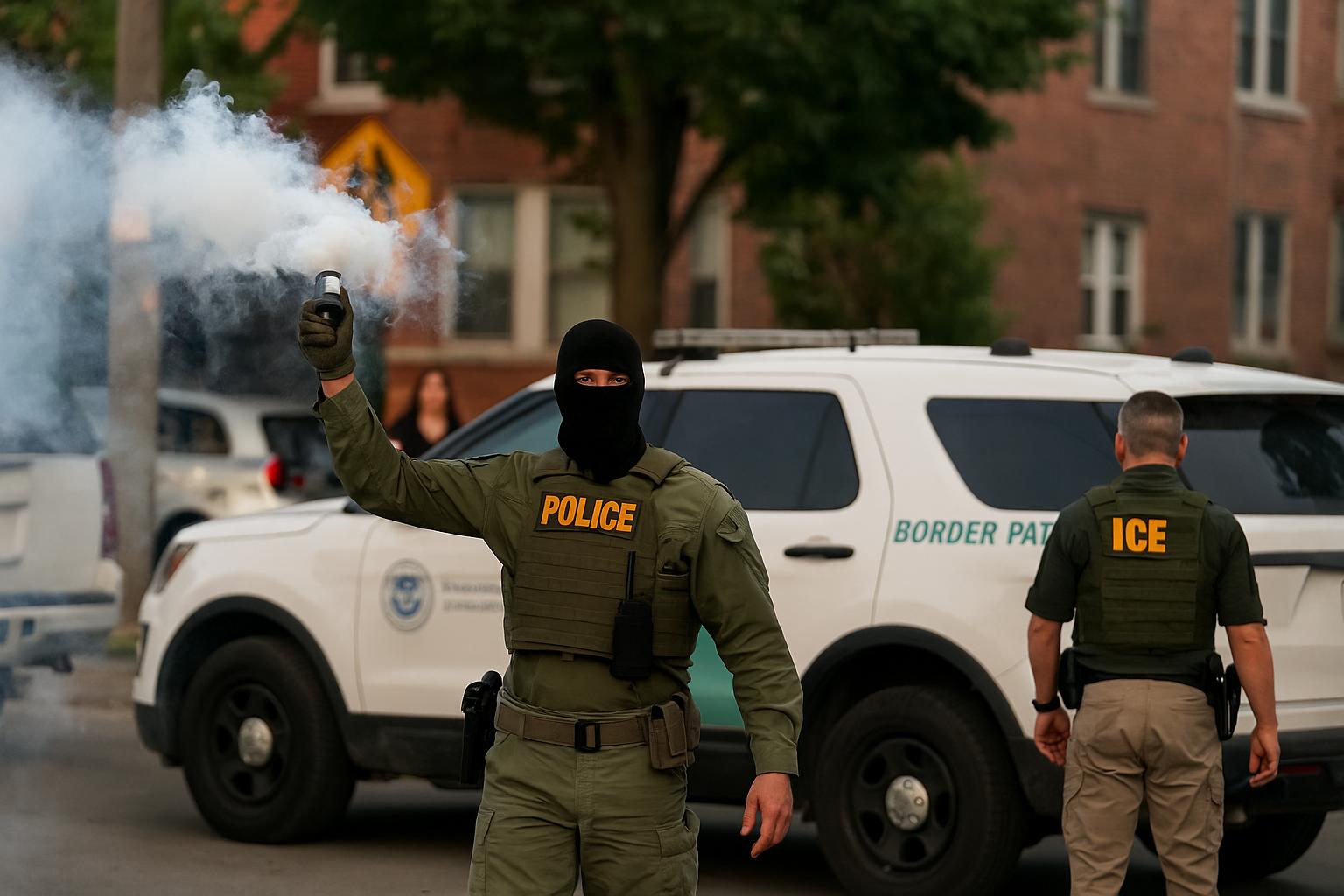
In one of the most widely circulated incidents, a video recorded Saturday in Chicago’s Irving Park neighborhood showed a masked federal agent deploying tear gas into a crowd of civilians. Witnesses described the confrontation as chaotic and alarming. “This is absurd. Something has to give,” one bystander said following the clash, which spread rapidly across social media platforms.
Responding to mounting public concern, Department of Homeland Security (DHS) assistant secretary Tricia McLaughlin stated that agents in the area had been “surrounded and boxed in by a group of agitators.” According to her statement, agents issued “multiple lawful commands and verbal warnings” before using crowd-control measures to disperse the gathering. DHS maintained that the use of tear gas was a necessary response to ensure the agents’ safety.
Just a day later, in suburban Addison, another video surfaced showing federal agents surrounding a car in a grocery store parking lot. One agent was seen breaking a car window with a baton before unlocking the door and removing several individuals from inside. Addison Mayor Tom Hundley addressed community fears in an open letter, assuring residents that their “safety and dignity matter” while acknowledging the unease caused by recent federal actions.
The Addison Police Department had already issued a public statement noting that it had not received any notification from ICE or Border Patrol regarding planned operations in the area. The department said it typically learns of federal activity “at the same time as the public,” emphasizing a lack of coordination between local and federal authorities.
These incidents follow similar confrontations in Chicago’s South and West Sides earlier in the week, where residents reported the use of tear gas and pepper balls by federal agents. One Chicago elementary school temporarily entered a “soft lockdown” on Friday after reports circulated that ICE agents were nearby.
The controversy has now entered the courtroom. U.S. Border Patrol Commander Gregory Bovino is scheduled to appear before U.S. District Judge Sara Ellis, after attorneys for protesters, journalists, and clergy alleged that federal officers had ignored a temporary restraining order prohibiting the use of chemical agents against non-threatening crowds. Court filings cite video evidence purportedly showing Bovino throwing a chemical canister toward a group in the Little Village neighborhood.
Judge Ellis has previously expressed concern that her order was not being followed, referencing earlier incidents in the Albany Park and East Side neighborhoods where chemical irritants were reportedly deployed despite the injunction. She directed that Bovino appear in person to address the allegations.
Similar tensions have also been reported near an ICE processing facility in Broadview, where activists and federal agents clashed during several days of demonstrations. Civil rights attorneys argue that these repeated confrontations suggest a pattern of excessive force and disregard for judicial oversight.
When asked about whether the recent events violated internal use-of-force policies, DHS provided a detailed written response but declined to address specific incidents. The agency reiterated that “the First Amendment protects speech and peaceful assembly – not rioting,” adding that ICE and Border Patrol agents “are trained to use the minimum amount of force necessary to resolve dangerous situations.” DHS emphasized that agents face a significant rise in assaults, citing a “nearly 1000% increase” in attacks on officers, and defended the actions taken as “reasonable and constitutional measures to uphold the rule of law.”
The statement further warned that even peaceful protesters and journalists should exercise caution near active enforcement zones, asserting that “being near unlawful activities in the field does come with risks.” DHS maintained that officers are “highly trained in de-escalation tactics” but will act decisively “to ensure their own safety and that of bystanders.”
As legal proceedings begin this week, the spotlight remains on whether federal immigration agencies operated within lawful boundaries and respected the judicial order issued earlier this month. For many Chicago residents, the recent confrontations have intensified concerns about the transparency, accountability, and oversight of federal operations taking place in their communities.
The unfolding legal case involving Commander Bovino is expected to test not only DHS’s defense of its field operations but also the judiciary’s ability to enforce limitations on federal use of force amid escalating tensions over immigration enforcement in major U.S. cities.