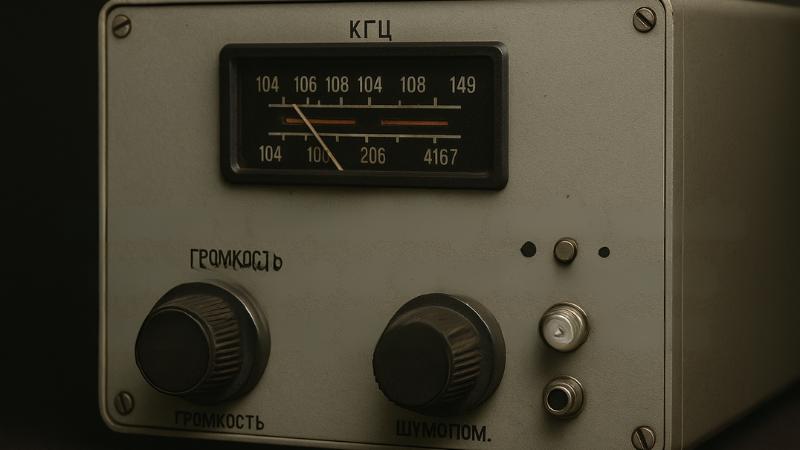
Russia’s mysterious shortwave radio station known as UVB-76, often referred to as the “Doomsday Radio” or “The Buzzer,” transmitted an unusually high number of cryptic messages this week, drawing renewed attention from military analysts and security observers across Europe. The rare surge in activity included three transmissions on Monday, eight more on Wednesday, and an extended broadcast combining faint music with long sequences of Morse code, an operational pattern that has not been seen in years.
Under normal circumstances, UVB-76 emits a steady buzzing tone and transmits coded messages only once or twice a month. Historically, increased activity on the frequency has coincided with moments of heightened geopolitical tension. The last time the station broadcast multiple messages in a single week was in February 2022, during the opening days of Russia’s full-scale invasion of Ukraine. That precedent has intensified speculation over the meaning of the latest signals.
The most significant transmission occurred early Wednesday morning, when the station broadcast continuously for more than three hours, beginning at 1:07 a.m. Eastern Time and ending around 4:26 a.m. During this period, a series of seemingly random phrases were transmitted, including words such as “pepper shaker,” “transfer,” “pabodoll,” “spinobaz,” “frigoria,” “opalny,” “snopovy,” and “myuonosvod.” None of these terms have any widely recognized meaning, and their purpose remains unclear, adding to the unease surrounding the broadcast.
Concern intensified after reports earlier in the month that the UVB-76 signal briefly went silent following alleged drone strikes on power infrastructure near the station’s suspected location. Shortly after those reports emerged, transmissions resumed with renewed frequency. One message broadcast on November 17 reportedly included the word “Latvia,” a NATO member state, alongside strings of numbers and repeated code phrases. That reference has raised alarm among European security officials and analysts monitoring Russian military signaling.
Latvia’s NATO membership is central to the growing anxiety. Under Article 5 of the alliance, an attack on one member is considered an attack on all, obligating collective defense by countries including the United Kingdom, France, Germany, and the United States. Any escalation involving a NATO state would carry the risk of a broader conflict, with the potential to spiral into a nuclear confrontation.
One long-standing theory suggests that UVB-76 is linked to Russia’s Soviet-era “Perimeter” system, sometimes referred to as the “Dead Hand.” This nuclear fail-safe mechanism was designed to ensure a retaliatory strike if Russia’s leadership were incapacitated during a nuclear attack. While the existence and current status of such a system have never been officially confirmed, the theory has contributed to the ominous reputation of the broadcast.
The renewed activity comes amid increasingly stark rhetoric from European and NATO leaders. Recent warnings have emphasized that the continent faces its most serious security threat in decades, with officials cautioning that large-scale conflict can no longer be ruled out. While there is no confirmation that the UVB-76 messages signal imminent military action, their timing has reinforced fears that Europe is entering a period of sustained instability.
For now, the true purpose of the latest transmissions remains unknown. However, the rare intensity of the broadcasts, combined with rising tensions between Russia and NATO, has ensured that the “Doomsday Radio” is once again being closely watched as a potential indicator of deeper strategic developments.