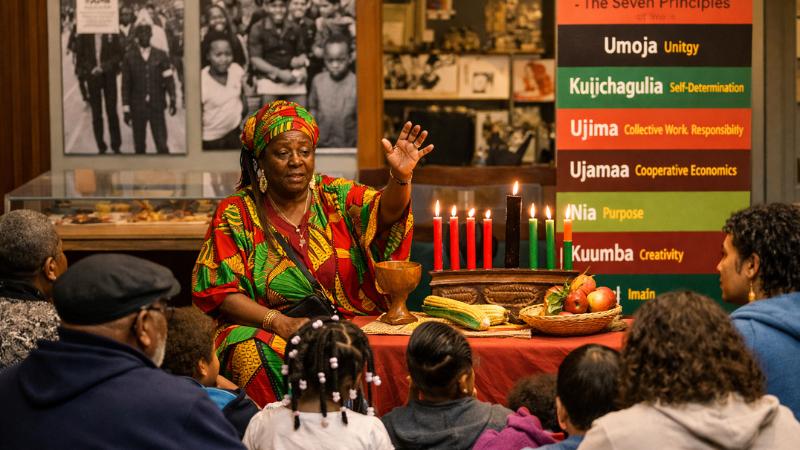
WASHINGTON — The first day of Kwanzaa was observed in Southeast Washington with a gathering that brought together multiple generations to reflect on culture, history, and community. Nearly 150 people filled two rooms of the Anacostia Community Museum as families assembled to mark the start of the weeklong celebration, which runs from December 26 through January 1.
The event centered on storytelling led by Mama Ayo, a longtime cultural educator who has spent decades teaching the principles and meaning of Kwanzaa. As children, parents, and grandparents moved through the museum’s exhibits, they paused to listen and engage with the stories that emphasized shared identity and collective responsibility. The atmosphere reflected the holiday’s focus on togetherness rather than spectacle, offering an opportunity for conversation and learning across generations.
Kwanzaa was created in 1966 by scholar and activist Dr. Maulana Karenga during a period of social change in the United States. The holiday was designed to address a sense of cultural disconnection among African Americans by encouraging reflection on heritage, values, and community life. Rather than focusing on religious or individual figures, Kwanzaa places emphasis on people, shared history, and cultural continuity.
At the heart of the observance are the seven core principles known as the Nguzo Saba. Each day of Kwanzaa is dedicated to one principle, beginning with Umoja, or unity. The opening day highlights the importance of maintaining harmony within families, communities, and the broader society. During the gathering, this theme was woven into stories and discussions that encouraged participants to see unity as both a personal responsibility and a collective goal.
Mama Ayo, who has observed Kwanzaa since the early 1970s and has taught about the holiday for more than three decades, spoke about the enduring relevance of its lessons. Now in her seventies, she said her commitment to cultural education has deepened over time, particularly as debates over history and representation continue across the country. For her, Kwanzaa serves as a reminder that communities must actively preserve and celebrate their own narratives.
Throughout the museum, families explored exhibits while discussing how the principles of Kwanzaa apply to modern life. Parents used the occasion to introduce younger children to ideas of cooperation and respect, while elders shared personal experiences that connected past struggles with present opportunities. The setting allowed for informal learning, reinforcing the idea that culture is transmitted not only through formal education but also through shared experiences.
Organizers and participants alike described the gathering as both a celebration and a call to reflection. By bringing people together in a space dedicated to African American history and creativity, the event underscored the role of cultural institutions in fostering dialogue and understanding. As the week of Kwanzaa continues, the focus will shift to the remaining principles, each offering a different lens through which to view community life.
The opening day’s emphasis on unity set a tone of inclusion and continuity, reminding those in attendance that Kwanzaa is not only about honoring the past but also about shaping the future. Through storytelling, shared space, and collective reflection, the celebration highlighted the enduring significance of culture and community in the nation’s capital.