Indian Space Startups Strengthen NavIC Push With Eyes And Ears In Orbit
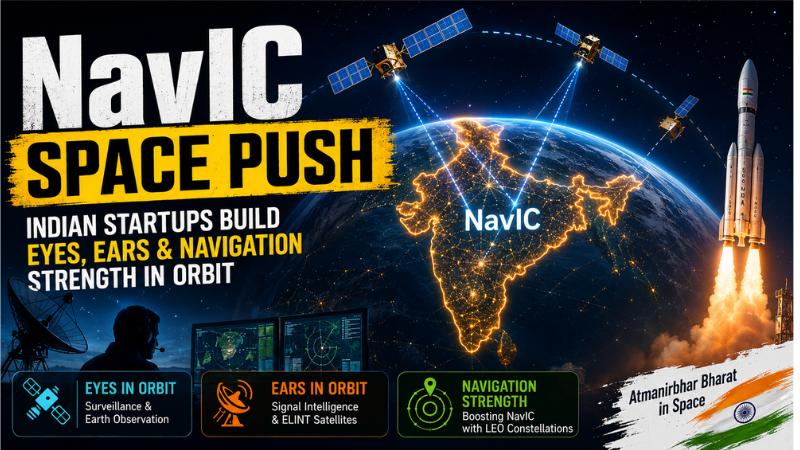
India’s private space companies are no longer just supporting Isro — they are building satellites that could help the country watch borders, track signals, and strengthen NavIC.
At the India Space Congress 2026 in New Delhi, several Indian firms showcased satellite technologies focused on surveillance, signal intelligence, and navigation support. Their larger goal is to reduce India’s dependence on foreign-controlled systems and build a stronger, self-reliant space ecosystem.
The companies are not positioning themselves as replacements for Isro’s NavIC. Instead, they are aiming to add extra layers of accuracy, backup, and resilience to India’s own navigation and defence capabilities.
Private Firms Enter Strategic Space Technology
For many years, India’s most sensitive space-based work was handled mainly by government agencies and the armed forces. That is now changing as private companies move into areas such as Earth observation, electronic intelligence, and low Earth orbit navigation.
These technologies can help India monitor borders, track radio signals, support disaster response, and improve defence readiness. The growing role of startups also shows how India’s space sector is moving beyond launch support and satellite components into full strategic systems.
Ananth Technologies Plans Surveillance Satellite Fleet
Hyderabad-based Ananth Technologies has outlined plans for a layered fleet of small satellites. These may include optical imaging satellites, synthetic aperture radar satellites, and hyperspectral sensors.
Optical cameras can capture clear ground images, while radar satellites can observe areas even at night or through clouds. Hyperspectral sensors can identify details that normal cameras cannot easily detect, making them useful for agriculture, environmental monitoring, and strategic surveillance.
The company’s proposed system could support border monitoring, intelligence gathering, and reconnaissance. This makes it one of the key examples of how Indian private firms are entering high-value space technology.
ULOOK Builds Satellites That Can Hear Signals
Bengaluru-based startup ULOOK is working on satellites designed for electronic intelligence, also known as ELINT. These satellites do not focus on taking pictures. Instead, they detect radio signals from ships, radars, transmitters, and communication devices.
The technology can help identify where a signal is coming from and understand the unique pattern of a transmitter. This can be important for coastal security, maritime monitoring, and defence operations.
In simple terms, if a device is transmitting a signal, such satellites may be able to locate it. This gives India a new way to track activity from space without depending only on visual images.
VyomIC Looks To Add Strength To NavIC
Navigation is another major focus area for Indian startups. India already has NavIC, its own regional navigation system, but private firms are now working on additional layers that can support accuracy and reliability.
Bengaluru-based VyomIC is planning a low Earth orbit satellite constellation that can work alongside systems such as NavIC. Since low Earth orbit satellites are closer to the ground, their signals can be stronger and harder to jam or spoof.
The company is also working on compact atomic clock technology. Atomic clocks are important for satellite navigation because even a tiny timing error can affect location accuracy.
VyomIC’s planned system could be useful for defence, drones, autonomous vehicles, telecom networks, power grids, data centres and financial markets. All these sectors depend on accurate timing and reliable positioning.
Why Sovereign Navigation Matters For India
Navigation systems are no longer used only for mobile maps. They are closely linked to national security, aviation, shipping, disaster response, stock exchanges, power grids, and military operations.
India still uses foreign-owned systems like GPS in many areas. However, such signals can be jammed, spoofed, or restricted during conflict. This is why India’s own navigation capability is important.
NavIC gives India a strong domestic foundation. Private satellite networks can strengthen that foundation by adding more accuracy, backup, and protection against signal disruption.
Defence And Civilian Uses Go Hand In Hand
The technologies being developed by Indian space startups are useful for both defence and civilian needs.
Earth observation satellites can help during floods, landslides, and crop monitoring. Signal intelligence satellites can improve coastal and border awareness. Navigation support systems can help fishermen, emergency vehicles, telecom networks, and transport services.
This dual-use nature makes the private space sector important for India’s security as well as public services.
India’s Space Sector Enters A New Phase
The rise of companies such as Ananth Technologies, ULOOK, VyomIC, and XDLINX Space Labs shows that India’s space sector is entering a new phase. Startups are no longer limited to supplying parts or providing support services. They are now building full satellite systems with strategic value.
As India looks to become more self-reliant in space, private companies are expected to play a larger role in surveillance, navigation, communication, and defence technology.
The message from India Space Congress 2026 is clear: India’s future in space will not depend only on Isro. A growing network of Indian private companies is preparing to build new eyes, ears, and navigation strength in orbit.