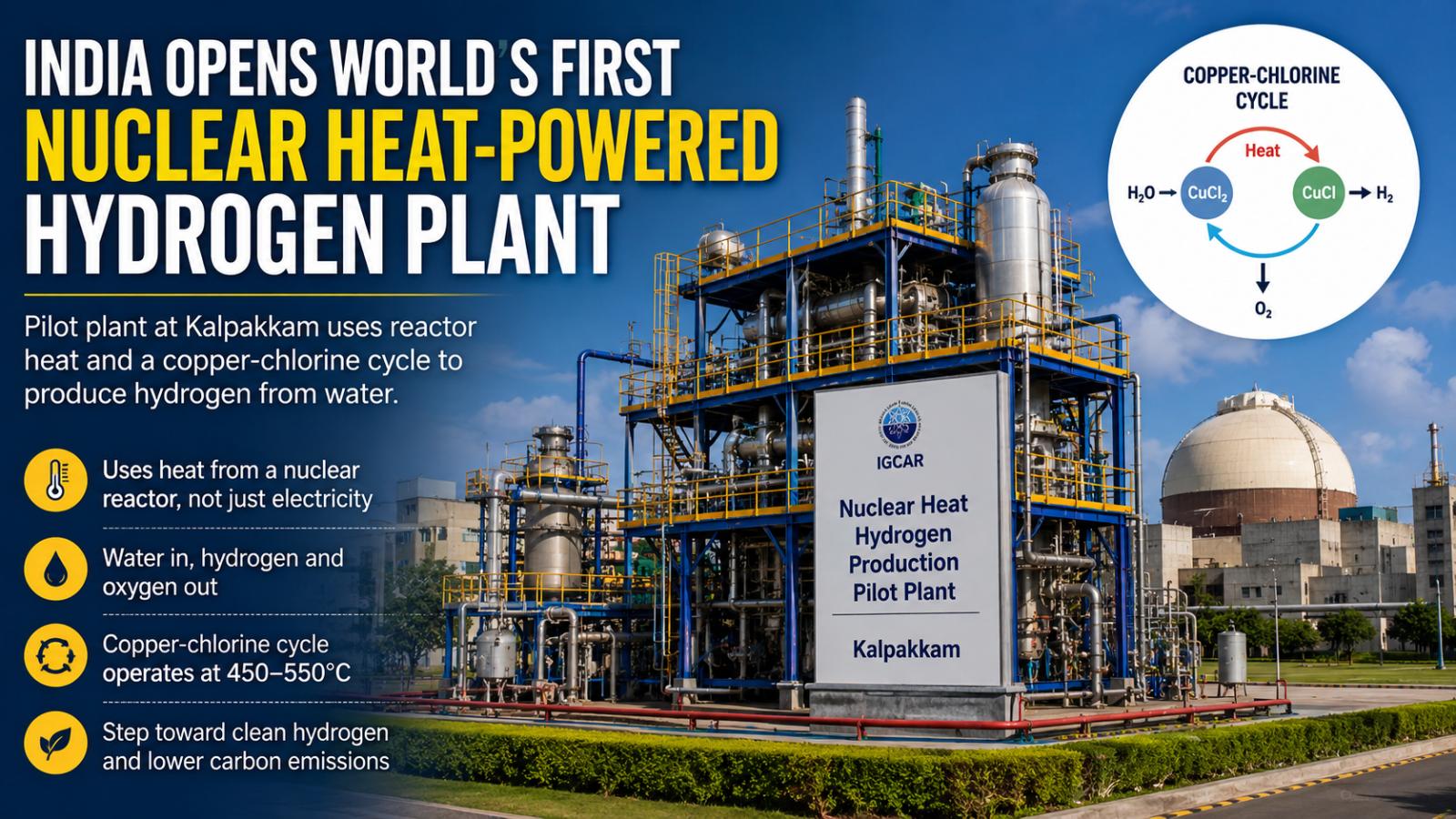
India has launched a pilot facility for nuclear heat hydrogen production at Kalpakkam in Tamil Nadu. The Department of Atomic Energy inaugurated the technology demonstrator on Friday, June 26, 2026, at the Indira Gandhi Centre for Atomic Research.
The department described the project as the first hydrogen facility to use heat drawn directly from a nuclear reactor rather than depending mainly on electricity. The plant remains a scientific demonstration and is not designed for large-scale commercial fuel production.
How nuclear heat hydrogen production works
The Kalpakkam plant uses the copper-chlorine cycle, a thermochemical method that separates water into hydrogen and oxygen through several chemical reactions.
Instead of relying on a large electrical charge, as conventional electrolysis does, the system uses reactor-generated heat for most of the process.
Copper and chlorine compounds help drive the reactions and are regenerated for reuse. Across the complete cycle, water is consumed while hydrogen and oxygen are produced.
A smaller electrical step is still required, but the process relies more heavily on heat than standard electrolysis.
Why the copper-chlorine cycle matters
Published research cited in the project context places the operating range of the copper-chlorine cycle at about 450 to 550 degrees Celsius. Other thermochemical hydrogen-production methods may require temperatures of 800 degrees Celsius or higher.
Because nuclear reactors already produce large amounts of heat, directing part of that thermal energy toward hydrogen production could reduce the electricity required by the process.
Hydrogen produces no carbon dioxide at the point of use, although its overall climate benefit depends on the energy and industrial processes used to manufacture it.
The Kalpakkam project will allow researchers to test whether reactor heat can support hydrogen production under operating conditions. Its significance lies in demonstrating the process at pilot scale before any potential expansion for industrial use.