Researchers completed testing of a 582-tonne superconducting magnet designed to support the development of future fusion reactors.
China Artificial Sun Programme Reaches Major Magnet Milestone
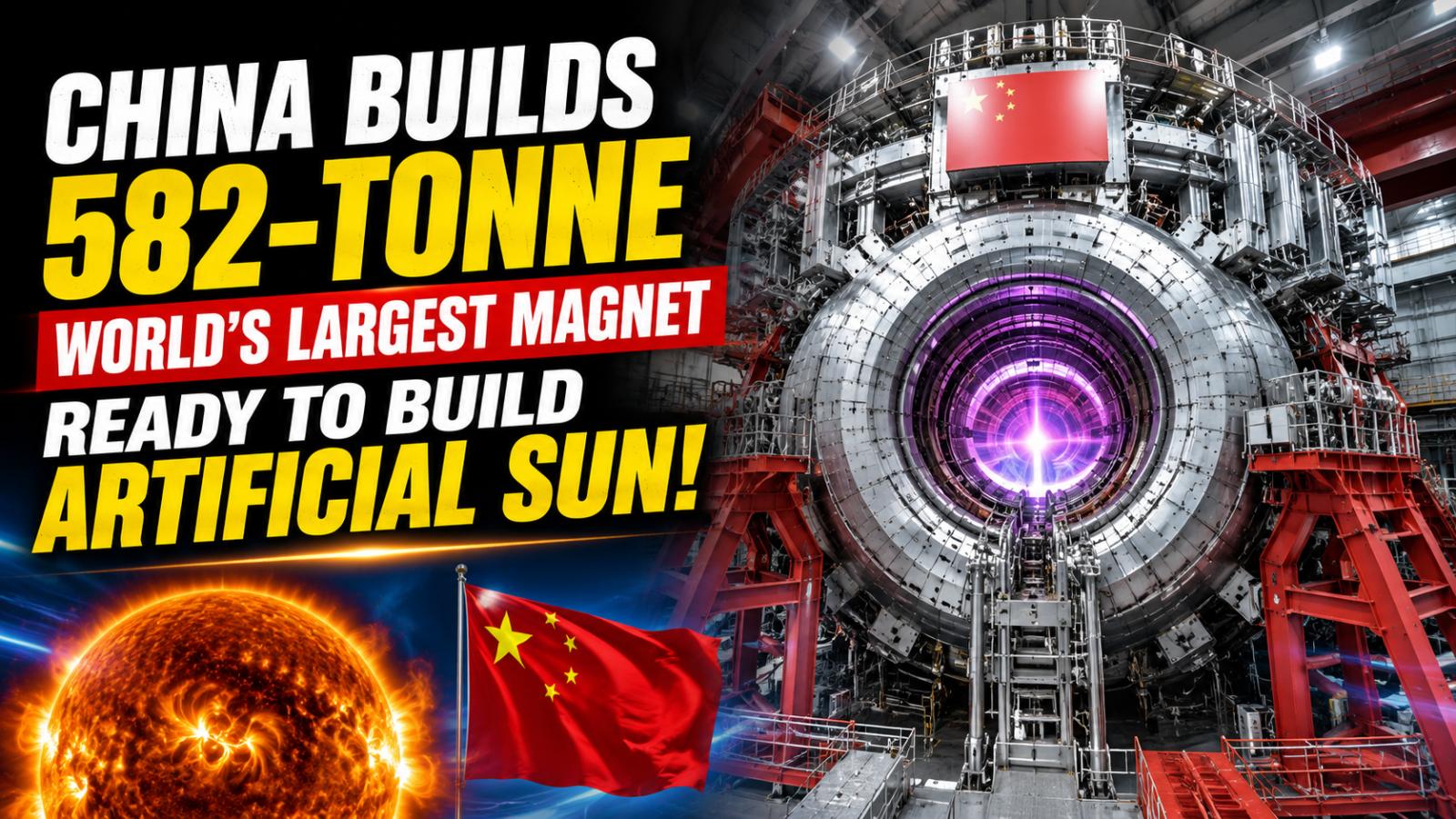
China has completed the development and testing of a massive superconducting magnet intended to advance its nuclear fusion research programme, popularly described as the country’s artificial Sun project.
Developed by the Institute of Plasma Physics under the Chinese Academy of Sciences in Hefei, the toroidal field magnet weighs about 582 tonnes. The D-shaped structure measures approximately 21 metres long, 12 metres wide and 3.3 metres high.
The institute said the system is currently the world’s largest superconducting magnet developed for a fusion reactor. It completed internal testing and expert acceptance on June 27, 2026, alongside a high-temperature superconducting central solenoid coil.
China Artificial Sun Magnet Will Control Superheated Plasma
Fusion reactors attempt to reproduce the process that powers the Sun by combining light atomic nuclei and releasing large quantities of energy. In a tokamak reactor, fuel must be transformed into plasma and heated to temperatures exceeding 100 million degrees Celsius.
Because no physical material can directly contain plasma at such temperatures, powerful magnetic fields are used to keep it suspended away from the reactor walls.
The toroidal field magnet creates the magnetic cage needed to control the plasma, while the central solenoid generates and helps maintain the electrical current flowing through it. Both systems are therefore critical to achieving stable and sustained fusion reactions.
According to the Chinese research team, the new toroidal magnet has about 1.3 times the volume and three times the stored energy of a comparable ITER toroidal field magnet. Researchers also said its essential technologies and manufacturing processes were developed domestically.
China Artificial Sun Roadmap Targets Fusion Demonstration
The magnet was developed under the Comprehensive Research Facility for Fusion Technology, or CRAFT, which is designed to test key components and engineering systems required for future Chinese fusion reactors.
China is also constructing the Burning Plasma Experimental Superconducting Tokamak, known as BEST. The device is expected to be completed by the end of 2027 and is intended to conduct deuterium-tritium plasma experiments while pursuing net fusion-energy gain.
Chinese researchers have discussed demonstrating fusion power generation around 2030. However, this should not be interpreted as a guarantee that commercial fusion electricity will be widely available by that year. A successful demonstration would still need to be followed by further engineering, regulatory and power-plant development.
China Artificial Sun Still Faces Difficult Technical Challenges
The latest magnet is a significant engineering achievement, but it does not mean a complete commercial fusion reactor is ready for operation. Scientists must still demonstrate long-duration plasma stability, reliable tritium production, materials capable of surviving intense neutron exposure and a reactor that consistently produces more usable energy than the entire facility consumes.
China’s EAST tokamak previously maintained steady-state high-confinement plasma for 1,066 seconds in January 2025, setting a record for that type of operation. EAST is an experimental research device and does not generate commercial electricity.
The 582-tonne magnet nevertheless strengthens China’s ability to manufacture and test some of the most demanding equipment required for future fusion machines. Its completion moves the country closer to building advanced experimental reactors, while the larger goal of affordable and continuous fusion electricity remains scientifically and commercially unproven.