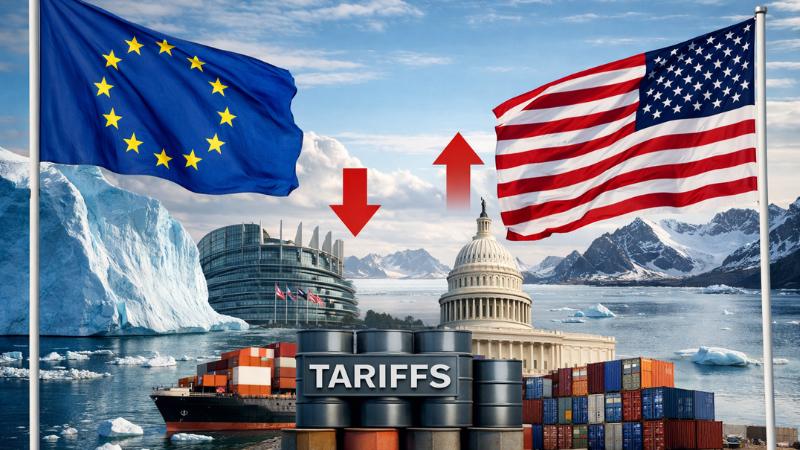
European Union lawmakers have decided to postpone the ratification of a recently concluded trade agreement with the United States following new tariff threats issued by President Donald Trump in connection with Greenland. The European Parliament, the bloc’s main political institution, had been scheduled to vote in the coming week on measures that would remove tariffs on selected US exports under the agreement. That plan has now been put on hold as tensions between Washington and several European capitals intensify.
The delay comes amid a broader deterioration in transatlantic trade relations triggered by President Trump’s remarks linking tariffs to European opposition to his stated objective of acquiring Greenland. According to officials familiar with the discussions, lawmakers expressed concern that moving ahead with the trade deal under current circumstances could weaken the European Union’s negotiating position and undermine the bloc’s response to what it views as economic pressure.
US Treasury Secretary Scott Bessent sought to ease concerns earlier this week, urging European governments to avoid escalating the dispute. He cautioned that retaliatory measures could further destabilize global trade, pointing to last year’s tariff confrontation between Washington and Beijing, which intensified after reciprocal duties were imposed by both sides. Bessent argued that restraint would be critical to preventing a similar cycle of escalation between the United States and its European partners.
The current standoff intensified after President Trump announced sweeping tariffs targeting several European Union member states and the United Kingdom. Under the plan outlined by the White House, a 10 percent tariff is set to take effect on February 1 against countries including Denmark, Norway, Sweden, France, Germany, the United Kingdom, the Netherlands, and Finland. Trump further stated that the tariff rate would rise to 25 percent by June 1, 2026, remaining in place until an agreement is reached for what he described as the complete purchase of Greenland.
European leaders have strongly rejected any suggestion of territorial acquisition, stressing the importance of respecting Denmark’s sovereignty over Greenland. Several governments have characterized the tariff threats as an attempt at economic coercion. In response, French President Emmanuel Macron has called on the European Union to consider deploying its anti-coercion instrument, a mechanism designed to counter trade pressure from third countries if tariffs are imposed.
Despite the backlash, President Trump has reiterated his position, describing Greenland as strategically essential for both national and global security and signaling that he does not intend to retreat from the issue. His comments have added to uncertainty around EU-US relations at a time when both sides are seeking stability in global markets.
Trump also stated on Monday that recent phone conversations with NATO Secretary-General Mark Rutte resulted in an agreement to hold talks involving multiple stakeholders on the Greenland issue. Those discussions are expected to take place on the sidelines of the World Economic Forum in Davos, Switzerland, potentially opening a diplomatic channel to address the growing dispute.
For now, European lawmakers appear determined to proceed cautiously. The postponed vote underscores how geopolitical disagreements are increasingly shaping trade policy, with the future of the EU-US trade deal now closely tied to developments in the Greenland dispute and the broader trajectory of transatlantic relations.