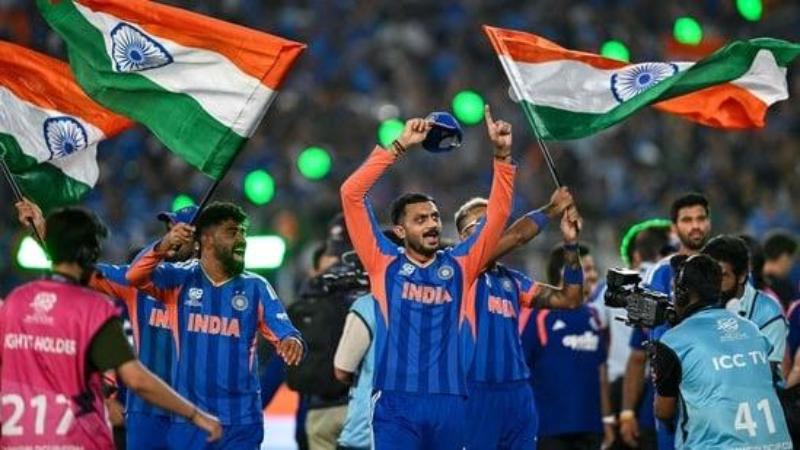
India created history by becoming the first team to successfully defend a T20 World Cup title after securing a dominant 96-run victory over New Zealand in the 2026 final at the Narendra Modi Stadium in Ahmedabad on Sunday. In a match filled with powerful batting and clinical bowling, India delivered a commanding performance to lift the trophy and underline their dominance in the shortest format of the game.
Match Result
Match Result
India won by 96 runs
India – 255/5 (20 overs)
Sanju Samson – 89 (46)
Abhishek Sharma – 52 (21)
Ishan Kishan – 54 (25)
Shivam Dube – 26* (8)
Others – small contributions
New Zealand – 159 all out (19 overs)
Tim Seifert – 52
Mitchell Santner – 43
Other batters – failed to build partnerships
Batting first after New Zealand captain Mitchell Santner won the toss and chose to field, India produced a remarkable display with the bat. The Indian batting lineup maintained an aggressive approach from the start and continued to pile on runs throughout the innings. Sanju Samson led the charge with a brilliant knock of 89 runs, anchoring the innings while also keeping the scoreboard moving at a rapid pace. His innings set the platform for a massive total and put New Zealand under pressure early in the contest.
Samson received strong support from Ishan Kishan and Abhishek Sharma, both of whom struck impressive half centuries. Their contributions ensured India maintained momentum during the middle overs, allowing the team to sustain a high run rate throughout the innings. The New Zealand bowlers struggled to contain the relentless attacking style of the Indian batters as boundaries flowed regularly across the ground.
The final overs of the innings saw India accelerate further. Shivam Dube played an explosive cameo that added crucial runs at the death, helping India finish with a massive 255 for 5 in 20 overs. The total set a new record for the highest score ever posted in a T20 World Cup final and placed enormous pressure on the New Zealand batting lineup heading into the chase.
Chasing a daunting target, New Zealand needed a strong start but quickly found themselves under pressure from India’s disciplined bowling attack. Axar Patel provided the early breakthrough by dismissing Finn Allen, immediately giving India the momentum. Patel continued to trouble the New Zealand middle order and later removed Glenn Phillips and Daryl Mitchell, tightening India’s grip on the contest.
Despite the setbacks, Tim Seifert attempted to keep New Zealand in the hunt with a determined half century. He played a few aggressive shots and tried to rebuild the innings, but the required run rate continued to climb as India’s bowlers maintained tight lines and lengths. Varun Chakaravarthy eventually dismissed Seifert, ending New Zealand’s most promising resistance and leaving the batting side in deeper trouble.
India’s bowling attack continued to strike at regular intervals, preventing any possibility of a late comeback. Jasprit Bumrah delivered one of the most decisive spells of the match. The fast bowler dismantled the lower order by dismissing Jimmy Neesham and Matt Henry in consecutive deliveries before claiming the wicket of Mitchell Santner to register his fourth wicket of the innings. Earlier, Bumrah had also removed Rachin Ravindra, making him one of the standout performers with the ball.
Hardik Pandya also made an important contribution by dismissing Mark Chapman, further weakening New Zealand’s chances of chasing down the massive total. With wickets falling consistently, the pressure proved too much for the New Zealand batting lineup to handle.
By the 18th over, New Zealand had slumped to 154 for 9, leaving the result virtually decided as India moved closer to securing the championship. The disciplined bowling display ensured that the target remained well beyond reach, completing a comprehensive victory for the defending champions.
India’s path to the final had included a brief setback during the Super 8 stage when they suffered a defeat against South Africa. That loss forced the team to regroup and approach the remaining matches with greater focus. The players responded strongly, winning the crucial games that followed and regaining momentum at the right time in the tournament.
The semi final against England turned out to be a high scoring and closely fought encounter. India had posted a massive total of 253 runs in that match and were pushed hard while defending it, eventually securing a narrow seven-run victory. That contest tested the team’s composure and resilience and prepared them well for the pressure of the final.
Under the leadership of Suryakumar Yadav, the Indian side demonstrated remarkable confidence and balance throughout the tournament. Their fearless batting approach combined with a disciplined bowling attack made them one of the most formidable teams in the competition.
The victory in Ahmedabad not only secured back-to-back T20 World Cup titles for India but also highlighted the depth and strength of the squad. The record-breaking total in the final, the relentless bowling performance, and the ability to deliver under pressure combined to produce a memorable triumph that will stand as one of the most significant achievements in India’s T20 cricket history.