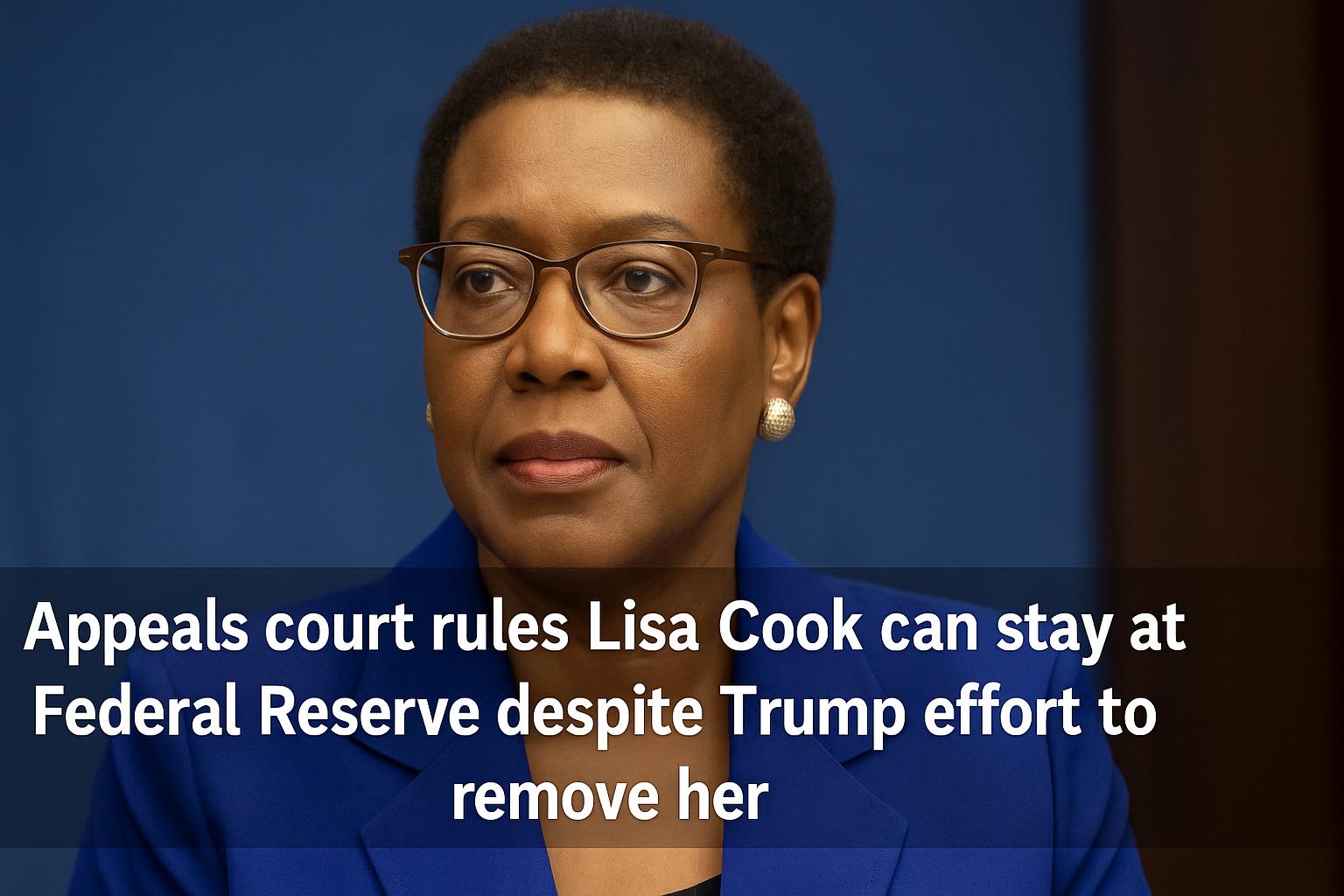
A federal appeals court has ruled that Lisa Cook, a governor at the United States Federal Reserve, will remain in her position for now despite efforts by former President Donald Trump to remove her. The ruling from the US Court of Appeals for the District of Columbia Circuit came just before a major Federal Reserve meeting scheduled to begin on Tuesday, where policymakers are expected to weigh critical decisions on interest rates.
Trump has sought to dismiss Cook from her role, accusing her of involvement in mortgage fraud, but the court’s decision temporarily halts his attempt. By allowing her to continue serving, the court ensures Cook’s participation in the Federal Open Market Committee’s upcoming two-day meeting. This decision underscores the importance of judicial oversight in disputes involving the independence of central banking institutions and political interference in monetary policy.
Cook, who joined the Federal Reserve Board in 2022, has been a significant figure in shaping the bank’s approach to interest rate policy during a period of economic uncertainty marked by inflation concerns, labor market shifts, and global financial pressures. Her position on the board gives her a vote in setting the federal funds rate, the central tool used to guide borrowing costs across the economy. With financial markets closely monitoring the Fed’s decisions this week, her continued presence adds stability to the process at a time when investor confidence is especially sensitive to leadership changes.
The dispute highlights broader tensions between Trump and the Federal Reserve. Trump has long been critical of the institution, often clashing with its leaders during his presidency over interest rate decisions. His push to remove Cook represents an unusual attempt to directly influence the membership of the central bank’s board of governors, raising concerns about the balance between executive authority and the Fed’s independence. The appeals court’s ruling temporarily protects that independence by preventing sudden changes to the board’s composition ahead of a crucial policy meeting.
Legal experts suggest that the case may take time to resolve fully, as courts will need to carefully examine the claims of misconduct against Cook as well as the authority of a former president to pursue her removal. In the meantime, the decision to allow her to remain in office reflects the judiciary’s recognition of the significant consequences that an abrupt change in Federal Reserve leadership could have on economic policy and market stability.
The Federal Reserve’s upcoming meeting is expected to focus on whether to maintain or adjust current interest rates following months of inflationary pressures. Policymakers are weighing data that shows some signs of cooling inflation but continued strength in consumer demand and labor markets. Investors and businesses are awaiting signals from the Fed about the trajectory of borrowing costs heading into the final months of the year. Cook’s ability to vote in this meeting ensures continuity in the board’s decision-making process.
Beyond the immediate policy implications, the case has drawn attention to the broader issues of governance, accountability, and independence in central banking. The Federal Reserve has historically been shielded from direct political control, a design intended to ensure that monetary policy decisions are based on economic conditions rather than partisan interests. Trump’s attempt to remove Cook, however, raises questions about whether future leaders might test the boundaries of executive influence over the institution.
For now, Lisa Cook continues in her role, contributing to decisions that affect borrowing costs for consumers, businesses, and governments across the country. The appeals court ruling provides at least temporary assurance that the Federal Reserve can proceed with its responsibilities without sudden disruption to its leadership. As the legal process unfolds, the case will remain a focal point for both political observers and financial markets, offering a rare intersection of law, politics, and economic policy.
The outcome of the current dispute may set an important precedent for how conflicts between political figures and the Federal Reserve are resolved in the future. While Trump’s allegations against Cook will likely continue to play out in the courts, the immediate concern for markets is the stability and predictability of the Federal Reserve’s policymaking process. With inflation trends, global economic uncertainty, and domestic growth all in flux, ensuring continuity at the Fed remains a top priority.
This latest ruling ensures that Cook will have a say in shaping monetary policy during one of the most closely watched meetings of the year. For now, the Federal Reserve retains its ability to operate without abrupt political interference, though the case underscores how fragile that balance can be in times of political and economic stress.