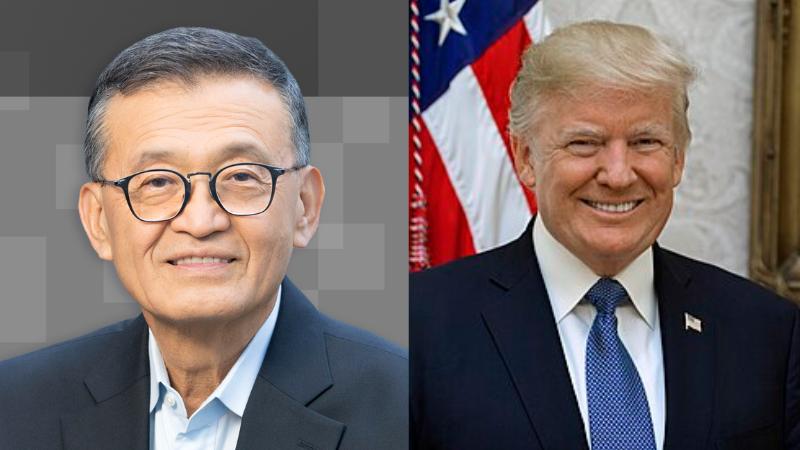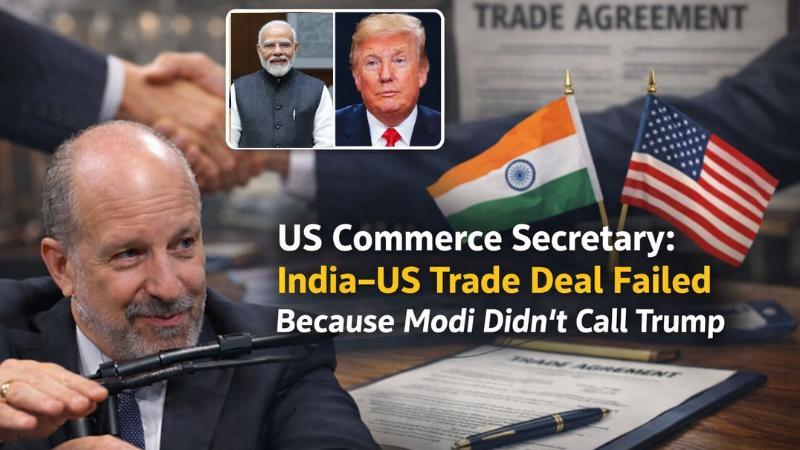
The proposed India–US trade deal failed to materialise because Prime Minister Narendra Modi did not personally call US President Donald Trump, according to claims made by US Commerce Secretary Howard Lutnick. Speaking on a podcast, Lutnick said the final step required to close the agreement was direct communication between the two leaders, which did not happen, leading to the collapse of the negotiations.
Lutnick stated that the framework of the deal had been completed and was ready for closure, but emphasised that President Trump traditionally finalised such agreements personally. According to him, Indian officials were uncomfortable with the requirement of a direct call, and as a result, the expected outreach from Modi never took place. He said that without this step, the agreement could not be concluded.
The commerce secretary explained that US negotiators had assumed India would finalise its agreement before several Southeast Asian nations. Based on this expectation, the United States proceeded to negotiate trade deals with countries such as Indonesia, the Philippines, and Vietnam at higher tariff rates. When those agreements were finalised first, the conditions previously discussed with India were no longer available.
Lutnick said that when India later indicated readiness to proceed, the earlier terms had effectively expired. He likened the situation to missing a departing train, stating that the United States had already moved forward with other trade partners. According to him, Washington is no longer considering the earlier trade arrangement that had been discussed with India.
The breakdown in negotiations occurred last year, after which the Trump administration doubled tariffs on Indian goods to 50 percent in August. These included a 25 percent retaliatory levy linked to India’s continued purchases of Russian oil. The tariff rate became the highest imposed by the United States on any major trading partner.
Lutnick also commented that India is seeking a tariff structure that falls between the rates offered to Britain and Vietnam, but said that the offer previously on the table is no longer valid. The Indian government has not yet responded publicly to Lutnick’s remarks.
His comments came shortly after President Trump approved a bipartisan Russia sanctions bill granting the US president sweeping authority to penalise countries that continue to trade with Moscow. The legislation proposes tariffs of up to 500 percent on imports from nations purchasing Russian oil, petroleum products, or uranium, potentially impacting India, China, and Brazil.
Trump has stated publicly that Prime Minister Modi is aware of Washington’s dissatisfaction over India’s energy purchases from Russia and warned that tariffs could be increased rapidly. At the same time, a US Supreme Court ruling on the legality of Trump-era tariffs is awaited, with potential implications including refunds to importers if the levies are deemed unlawful.
Despite the high tariffs, India’s exports to the United States showed resilience. After two months of negative growth, merchandise exports rose more than 22 percent in November to nearly $7 billion. During the April–November period of the current fiscal year, exports to the US increased over 11 percent, while imports also recorded steady growth.
The tariff threat emerged as the two countries continued negotiations on a bilateral trade agreement. Six rounds of talks have been held so far, focusing on resolving the 50 percent tariff issue. Indian officials have reiterated their commitment to restoring deeper market access for exporters and concluding the agreement at the earliest.
US Deputy Trade Representative Rick Switzer recently visited New Delhi to review the progress of negotiations. The latest round of talks concluded in mid-December, with industry stakeholders closely monitoring developments as high import duties continue to hurt shipments to the US market.
Indian exporters, while exploring alternative destinations, still regard the United States as a critical market, accounting for about 18 percent of India’s total exports. As part of the negotiations, Washington has sought duty concessions on agricultural and industrial products, demands that India has resisted to protect domestic farmers and small enterprises.
In early 2025, leaders of both countries directed officials to pursue a comprehensive trade agreement aimed at more than doubling bilateral trade to $500 billion by 2030. The United States remained India’s largest trading partner for the fourth consecutive year, underlining the economic stakes involved as negotiations continue amid political and policy uncertainties.