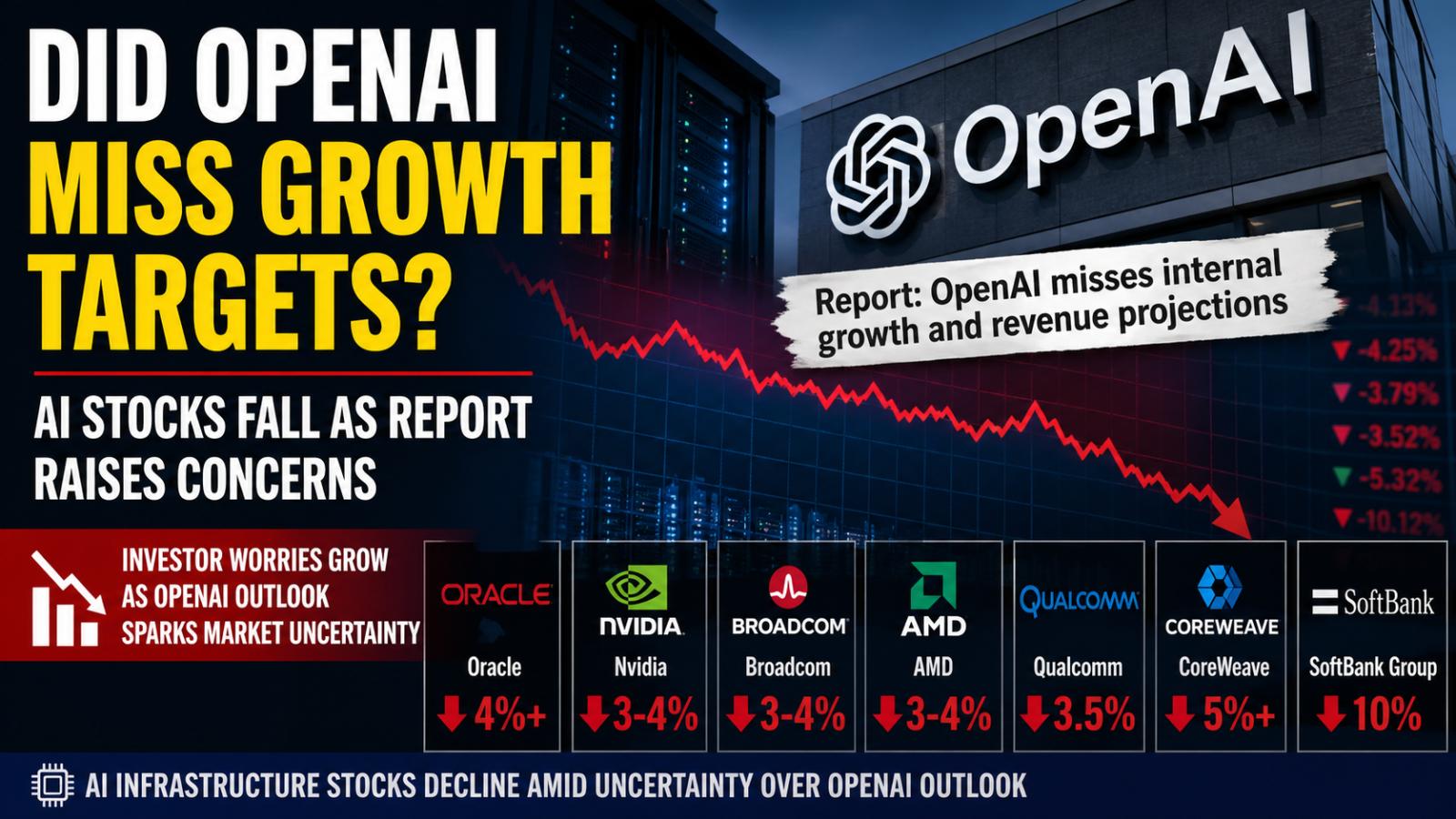
Did OpenAI miss growth targets? AI stocks fall as report raises concerns, triggering a broad pullback across companies tied to artificial intelligence infrastructure on Tuesday. Shares of Oracle fell more than 4% amid its major partnership to provide computing power for OpenAI’s operations. Chipmakers including Nvidia, Broadcom, and Advanced Micro Devices declined between roughly 3% and 4%, while Qualcomm dropped 3.5%.
Global impact reflects investor sensitivity
Losses extended beyond the United States, with SoftBank Group, a major OpenAI investor, falling about 10% in Asian markets. The declines followed a report that OpenAI has not met internal projections for user growth and revenue, raising concerns about its ability to sustain the heavy spending required for data center expansion and long-term compute agreements.
OpenAI response and financial outlook debate
OpenAI pushed back against the claims, stating it remains aligned on expanding compute capacity. The company, which launched ChatGPT in 2022 and helped drive the current AI boom, recently secured a $122 billion funding round at an $852 billion valuation. However, internal discussions reportedly highlighted risks if revenue growth does not accelerate as expected.
Competitive pressures reshape AI landscape
At the same time, competition in enterprise AI continues to intensify. Rivals such as Anthropic and Google’s Gemini models are gaining traction, prompting companies to diversify across multiple providers. Some analysts interpret OpenAI’s slower growth as a shift in market share rather than a broader slowdown in AI adoption.
Investors weigh long-term implications
Despite the market reaction, several investors remain cautious about drawing firm conclusions. Industry experts note that forecasting revenue and capital expenditures in the rapidly evolving AI sector remains highly uncertain. While short-term volatility has affected tech stocks, many view the report as part of a broader adjustment rather than a fundamental change in the long-term trajectory of AI infrastructure spending.