For decades, the United States has presented itself as a global guardian of democracy and international law, drawing legitimacy from its own origins in resistance to unchecked authority. Its constitutional structure was designed to restrain executive power, particularly in decisions involving war and foreign intervention. Yet the conduct of contemporary US foreign policy increasingly reflects a different reality, one in which strategic interests and economic leverage often shape moral language rather than the other way around.
The evolving relationship between the United States, Guyana, and Venezuela offers a clear illustration of this tension. Publicly framed as a principled defense of sovereignty and regional stability, Washington’s engagement reveals how energy resources, geopolitical signaling, and executive authority intersect beneath the rhetoric of democratic values.
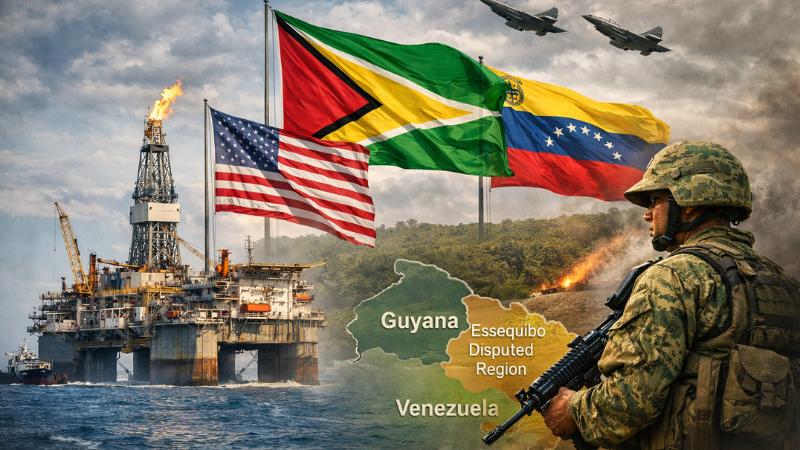
Guyana’s strategic importance was limited for much of its post-independence history. That changed decisively in 2015, when major offshore oil discoveries were confirmed, transforming the country into one of the most significant new energy producers in the world. Estimates of recoverable reserves reaching roughly 11 billion barrels altered Guyana’s economic trajectory and placed it firmly within global energy calculations. This shift also revived a long-standing territorial dispute with Venezuela over the Essequibo region, an area that constitutes the majority of Guyana’s landmass and is believed to hold significant natural resources.
Venezuela has rejected the validity of an 1899 arbitration ruling that awarded the territory to what was then British Guiana, maintaining its claim for more than a century. For decades, the disagreement remained largely diplomatic, attracting limited international attention. The discovery of oil fundamentally changed that balance. As offshore production expanded, the dispute became entwined with multinational corporate interests and US energy considerations, effectively internationalizing a previously regional issue.
American involvement grew increasingly explicit as tensions rose. US officials began framing the Guyana-Venezuela dispute not only as a legal or historical disagreement, but as a broader test of regional order. During a high-profile visit to Guyana, the US secretary of state issued a direct warning that any Venezuelan action against Guyana or oil infrastructure would trigger serious consequences. The message was clear and public, signaling that Washington viewed Guyana’s energy assets as strategically protected interests.
For Guyana, this posture was presented as reassurance and deterrence. For Venezuela, it reinforced perceptions of intimidation and unequal power, suggesting that outcomes were being shaped less by neutral arbitration and more by geopolitical influence. A bilateral territorial dispute was thus recast within the framework of US deterrence, where military reach and corporate protection served as implicit tools of policy rather than multilateral consensus.
This approach cannot be separated from Washington’s broader stance toward Venezuela, which has included extensive sanctions, diplomatic isolation, and repeated challenges to the legitimacy of its government. While these measures stopped short of direct military intervention, they conveyed a consistent message that sovereignty could be treated as conditional when it conflicted with strategic objectives.
The contrast is instructive. Guyana’s sovereignty is defended forcefully, reinforced by energy investment and alignment with US interests. Venezuela’s sovereignty, by contrast, has been persistently constrained through economic pressure and political delegitimization. This disparity reflects not inconsistency but structure, revealing how principles are applied selectively within a hierarchy of interests.
What emerges is a model of influence that relies less on overt force and more on calibrated pressure. Economic leverage, diplomatic signaling, and the protection of corporate assets increasingly achieve outcomes once associated with direct intervention. The language of democracy remains central, but its function has shifted, serving to justify power rather than limit it.
As energy resources reshape regional dynamics, the Guyana-Venezuela case underscores a broader challenge for US foreign policy credibility. If democratic values are to function as genuine constraints, they must be applied consistently, not adjusted to accommodate oil reserves or strategic convenience. Without that consistency, democracy risks becoming not a principle of restraint, but a vocabulary of power.