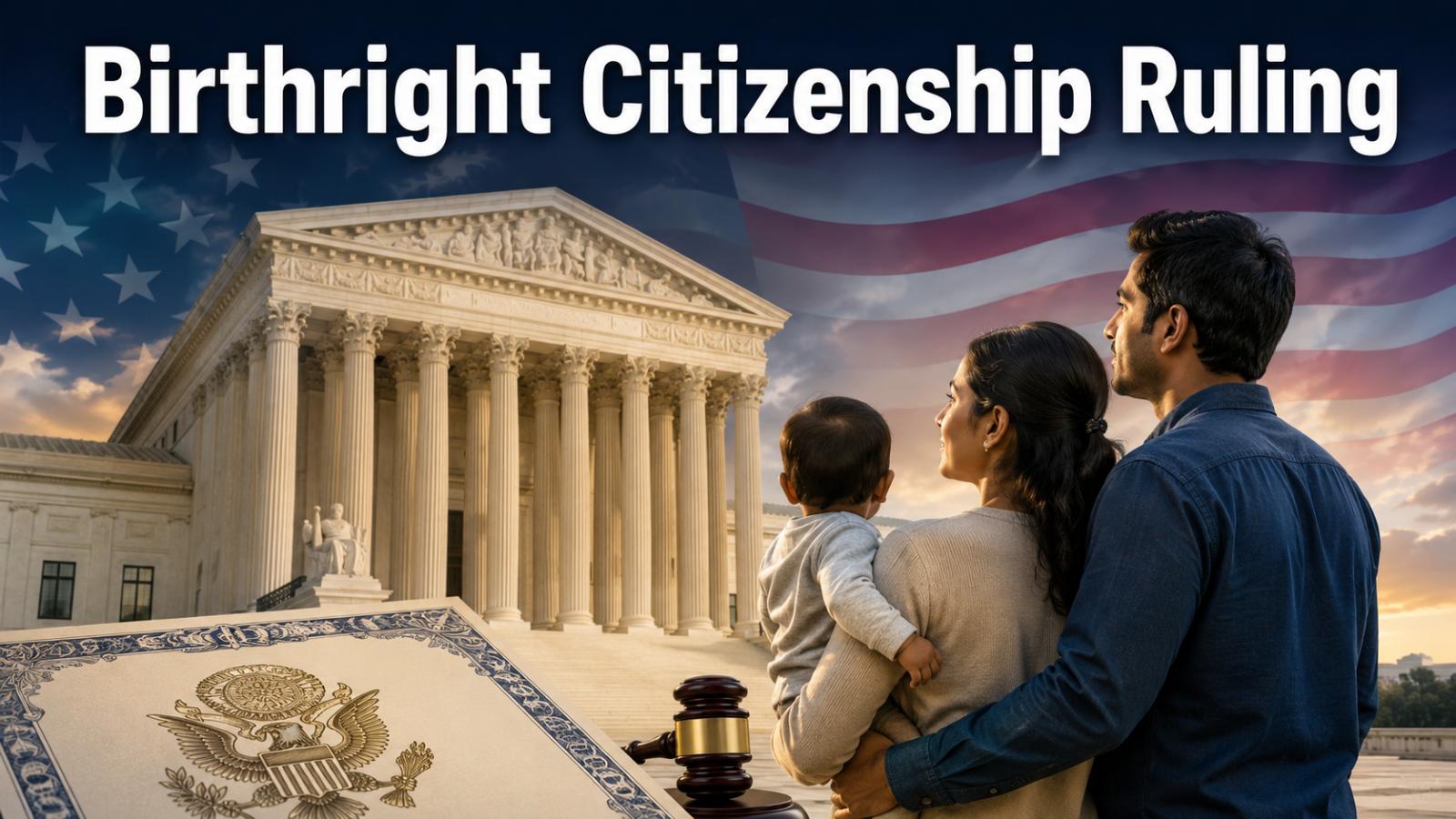
The birthright citizenship ruling issued by the U.S. Supreme Court on Tuesday, June 30, 2026, provides important clarity for families living in the United States on temporary visas. Children born in the country to parents who are lawfully but temporarily present remain U.S. citizens at birth under the 14th Amendment.
For the court’s vote and constitutional reasoning, read NRIPage’s full report on the Trump v. Barbara birthright citizenship ruling.
Birthright Citizenship Ruling Covers Temporary Visa Holders
President Donald Trump’s January 20, 2025, executive order sought to deny citizenship recognition in certain cases when a child’s mother was lawfully but temporarily present on a student, work or tourist visa and the father was neither a U.S. citizen nor a lawful permanent resident.
That language placed families on temporary work and student visas, including H-1B and F-1 households, at the center of the dispute. The Supreme Court rejected the administration’s interpretation and held that children born in the United States to parents who are unlawfully or temporarily present are subject to U.S. jurisdiction and are citizens at birth.
What It Means for H-1B and F-1 Families
The ruling means a parent’s temporary immigration category does not prevent a U.S.-born child from receiving citizenship. The same principle applies to families in other temporary student and employment classifications covered by the court’s decision.
However, the ruling does not change the parents’ visa status, employment authorization, green-card process or permitted period of stay. A child’s U.S. citizenship also does not give the parents immediate lawful status. Under federal immigration rules, a U.S. citizen must generally be at least 21 years old to petition for a parent.
Narrow Exceptions Still Apply
The decision preserves limited exceptions recognized under birthright citizenship law, including children born to accredited foreign diplomats. Those exceptions do not generally apply to ordinary temporary workers, international students or their dependents.
For Indian and other NRI families, the ruling removes uncertainty over whether temporary visa status can be used to deny citizenship to a child born in the United States. It protects the child’s citizenship while leaving the parents’ separate immigration obligations unchanged.