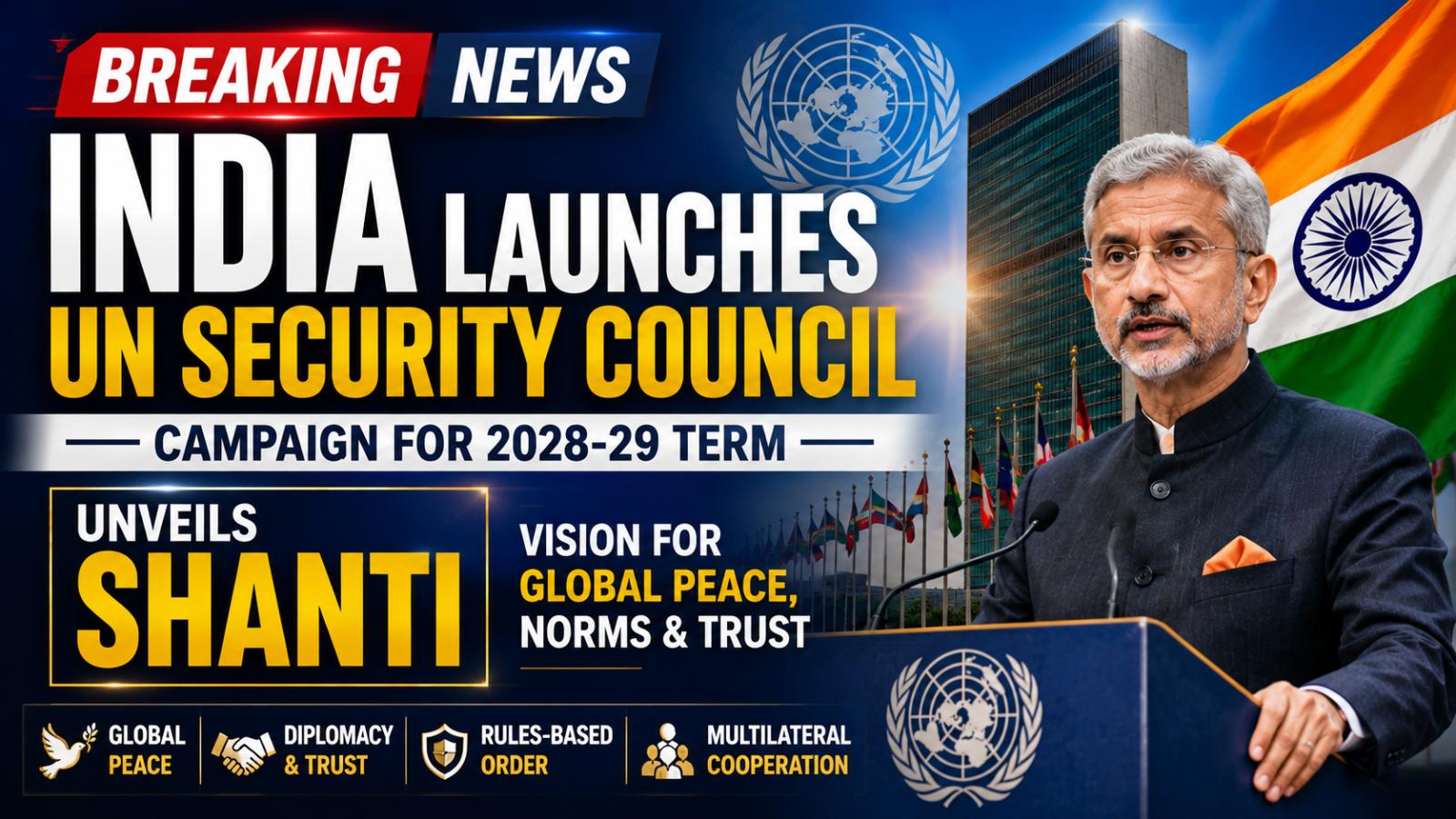
India has officially launched its campaign for a non-permanent seat on the United Nations Security Council (UNSC) for the 2028-29 term, presenting a new diplomatic framework called "SHANTI" as the foundation of its global engagement strategy. The campaign was unveiled by External Affairs Minister S. Jaishankar at the United Nations headquarters in New York, where he highlighted India's experience in peacekeeping, multilateral diplomacy and international cooperation.
India launches UNSC 2028-29 campaign
Addressing diplomats and UN representatives, Jaishankar said India is seeking its ninth term as a non-permanent member of the Security Council at a time when the international community faces growing geopolitical instability, armed conflicts and humanitarian crises. Elections for the 2028-29 term will be held in the 193-member UN General Assembly, where candidates must secure a two-thirds majority to win a seat.
India previously served on the Security Council during the 2021-22 term and now hopes to build on that experience by promoting stronger global cooperation and a rules-based international order.
Jaishankar said the world today faces a contradiction. While technological progress and economic integration have connected nations more than ever before, conflicts and instability continue to threaten international peace and security. He argued that these challenges require collective action rather than isolated national responses.
SHANTI becomes India's diplomatic vision
A central feature of India's campaign is the introduction of the acronym SHANTI, which stands for "Securing Holistic Advancement through Norms, Trust and Integrity."
Rather than describing it as a slogan, Jaishankar presented SHANTI as India's long-term diplomatic philosophy for addressing today's global challenges. According to him, sustainable peace and development can only be achieved when countries respect international norms, build mutual trust and uphold integrity in global governance.
He said recent geopolitical developments demonstrate that prosperity cannot exist in isolation and that international institutions must work together to deliver balanced and inclusive progress.
The minister added that India's foreign policy continues to emphasize dialogue, multilateral cooperation and respect for international law while encouraging reforms that make global institutions more representative of today's world.
India's UN peacekeeping record highlighted
India's campaign also relies heavily on its long-standing contribution to United Nations peacekeeping operations.
Jaishankar noted that nearly 300,000 Indian military personnel have participated in approximately 50 UN peacekeeping missions since the organization's establishment. More than 4,300 Indian peacekeepers are currently deployed across ten active UN missions worldwide, making India one of the organization's most consistent contributors.
He said this record reflects India's commitment to maintaining international peace beyond diplomatic engagement alone. Indian peacekeepers have served in Africa, the Middle East and several conflict-affected regions, earning recognition for their professionalism and humanitarian work.
India seeks broader role in global governance
The minister acknowledged that UN member states would evaluate India's candidacy based not only on its future commitments but also on its past contributions to the international community.
He said India's experience in peacekeeping, development partnerships, disaster relief, climate action and humanitarian assistance demonstrates its ability to contribute constructively to the Security Council.
If elected, India intends to advocate for a stronger multilateral system capable of responding to modern security challenges while supporting equitable global development. The campaign also reinforces India's longstanding call for comprehensive UN reforms, including changes to the Security Council that better reflect current geopolitical realities.
With the SHANTI framework and its established record at the United Nations, India is positioning itself as a candidate focused on consensus-building, international cooperation and practical solutions to global challenges. The coming General Assembly election will determine whether member states endorse India's vision for the Security Council's 2028-29 term.