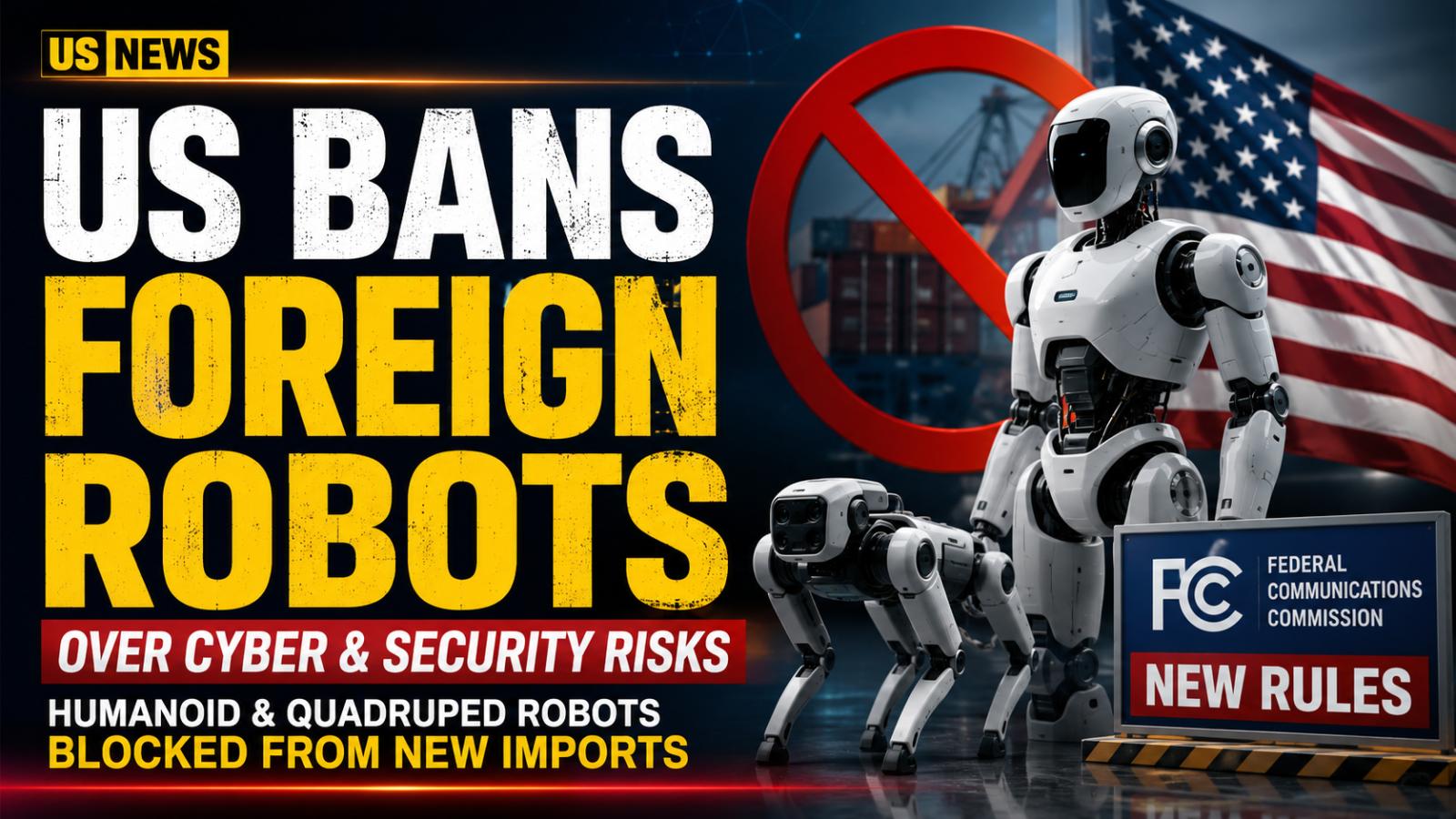
The United States has added foreign-produced humanoid and quadruped robots to the Federal Communications Commission’s Covered List, restricting new models from receiving authorization for the American market. The FCC says connected robots could create cybersecurity, surveillance and supply-chain risks.
FCC rules target foreign-produced robots
The FCC’s Public Safety and Homeland Security Bureau announced the change on July 28, 2026. It added foreign-produced advanced robotic devices and power inverters to a list of equipment considered an unacceptable risk to US national security or public safety.
The decision followed two national security assessments submitted by a White House-convened interagency body on July 27. The FCC said the assessments examined risks linked to foreign manufacturing, network connectivity, remote access and dependence on overseas supply chains.
The restrictions cover advanced mobile robots capable of navigating their surroundings, including humanoid machines that resemble people and quadruped robots designed to move like animals. The policy applies according to where a device is produced rather than targeting only a named manufacturer.
Cyber risks raise surveillance concerns
US officials argue that network-connected robots can collect large amounts of visual, operational and environmental data. Cameras, microphones, location sensors and remote-control systems may expose sensitive information when manufacturers or outside actors can access them.
According to the FCC determination, foreign-produced robots could allow malicious actors to surveil Americans, support foreign intelligence operations or remotely interfere with a robot’s physical movement. Officials also warned that compromised machines deployed in factories, warehouses or infrastructure sites could create physical as well as digital security risks.
However, the government has not shown that every foreign robot is unsafe. The policy instead treats foreign production as a broad supply-chain risk. That approach may strengthen security controls, but it could also reduce competition and raise costs for US universities, laboratories and businesses that depend on affordable imported robots.
Inverter restrictions protect critical infrastructure
The FCC action also covers foreign-produced power inverters. These devices convert direct current from solar panels, batteries and other sources into alternating current used by electrical grids, buildings and data centers.
Officials said remotely connected inverters could be switched off, exploited during cyberattacks or used to collect and transfer operational data. Because large numbers of inverters connect renewable energy systems to the grid, a coordinated disruption could affect energy reliability and critical infrastructure.
The updated Covered List already includes several categories of communications equipment, surveillance technology, foreign-produced drones and products linked to companies such as Huawei and China Telecom. The additions extend the government’s technology restrictions into robotics and energy hardware.
Robot waivers remain available
The policy primarily affects new products that require FCC equipment authorization. Once equipment appears on the Covered List, manufacturers cannot obtain new authorization unless they receive a conditional approval.
Companies producing advanced robots abroad may request an evaluation from the Department of War. Power inverter manufacturers may seek approval from either the Department of War or the Department of Homeland Security. The agencies can recommend an exemption when they determine that a device or product category does not create an unacceptable risk.
Existing authorized products are not automatically removed from homes, laboratories or workplaces under the announcement. The FCC’s decision therefore acts mainly as a barrier to future models rather than an immediate recall of robots already sold in the United States.
US robotics makers may gain ground
The restrictions could benefit companies that manufacture or assemble robots domestically, including Tesla, Figure AI, Agility Robotics and Boston Dynamics. The policy also supports the Trump administration’s wider effort to reduce dependence on foreign technology and strengthen American production of AI-powered equipment.
Still, domestic assembly does not automatically eliminate foreign components or cybersecurity weaknesses. Effective enforcement will require clear manufacturing standards, transparent exemption rules and security testing based on evidence rather than nationality alone.