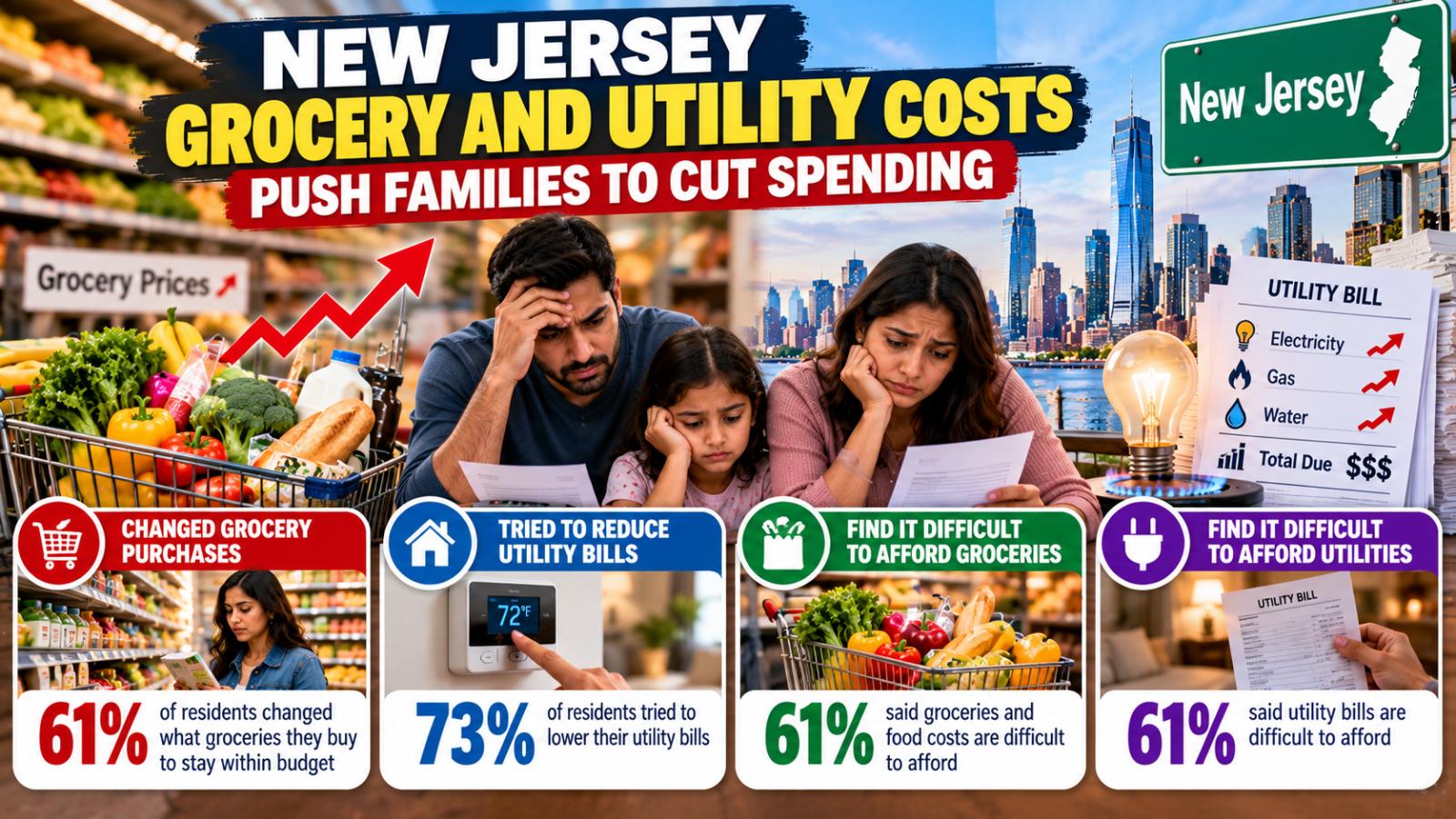
New Jersey grocery and utility costs are reshaping household budgets in 2026. Rutgers polling shows 61% changed what groceries they buy and 73% tried to lower utility bills, while lower-income residents report much greater difficulty affording both essentials.
New Jersey households are adjusting everyday spending as grocery and utility costs continue to strain family budgets.
These everyday expenses are part of a wider affordability problem, which we explain in our guide on why New Jersey is so expensive to live in.
A Rutgers-Eagleton survey released in July 2026 found that 61% of New Jersey residents had changed the groceries they buy to stay within budget, while 73% had tried to reduce their utility bills during the previous three months.
Grocery costs are changing what families buy
To understand how food and utility costs fit into a full household budget, see our guide on how much income you need to live in New Jersey in 2026.
The pressure is especially visible among lower-income households.
Among residents earning less than $50,000, 77% said they had changed their grocery purchases to control expenses. The figure fell to 48% among households earning $150,000 or more.
The latest Rutgers-Eagleton affordability poll, released on October 7, 2026, found that 61% of residents reported difficulty affording groceries and food, including 26% who said those costs were very difficult to afford.
Utility bills remain a major household pressure
Utilities are creating similar strain.
Homeowners facing higher utility bills may also want to review our guide to New Jersey property taxes in 2026, which explains major relief programs and eligibility.
The October poll found that 61% of residents had difficulty paying utility bills, while the share describing them as very difficult to afford rose to 28%.
Among households earning $50,000 or less, 84% reported difficulty affording utilities, one of the highest rates across the expense categories measured.
Electricity costs have climbed sharply
A 2026 New Jersey Board of Public Utilities assessment found that electricity costs recorded the strongest five-year increase among major household expense categories tracked from 2021 through 2026.
Its index shows electricity costs rising by roughly 44% from 2021 levels, compared with about 22% for food and 25% for housing.
Grocery access is also under pressure
New Jersey's food retail sector is facing its own challenges. Rutgers' Bloustein School reported in October that 28 supermarkets had closed across the state over the previous two years, while food prices remained elevated by about 3%.
Transportation adds another recurring expense, and our analysis of New Jersey transportation costs in 2026 looks at gas prices, transit fares and commuting pressure.
For households, the effect is cumulative. Higher grocery bills and utility costs leave less room for housing, transportation, health care and savings.
The result is a broader affordability squeeze in which many New Jersey families are not only paying more, but actively changing what they buy and how they use essential services to stay within budget.
Related Articles
New Jersey Child Care Costs: Why Families Are Feeling the Pressure
See how child care expenses are adding to household budget pressure for New Jersey families.
New Jersey Rent Costs in 2026: How Much Do Renters Need to Earn?
Explore how rental costs and housing-wage requirements affect affordability across the state.
Most Affordable Places to Live in New Jersey in 2026
See which New Jersey cities currently offer lower housing and rental costs than many higher-cost markets.