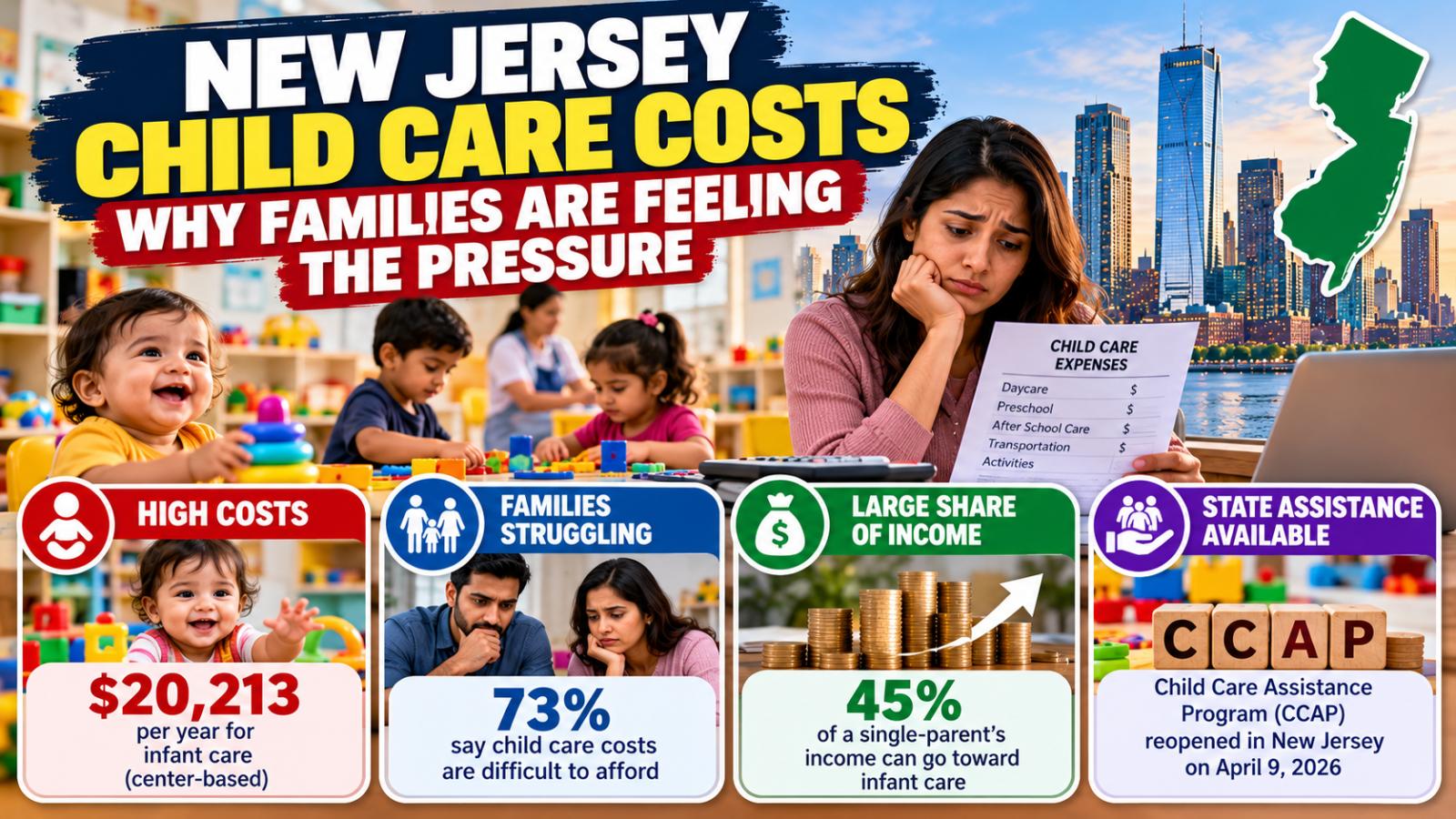
New Jersey child care costs remain a major pressure on working families. Full-time center-based infant care has been priced above $20,000 annually, while an October 2026 Rutgers poll found 73% of applicable households reported difficulty affording child care.
Child care has become another major part of New Jersey's affordability challenge, especially for families with young children who need regular care while parents work.
Child care is only one part of the broader household burden, which we explain in our guide on why New Jersey is so expensive to live in.
An October 7, 2026 Rutgers-Eagleton poll found that 73% of residents for whom child care costs applied said they were difficult to afford, including 46% who described them as very difficult.
Full-time child care can exceed $20,000 a year
To see how child care changes the income families need, our guide on how much income you need to live in New Jersey in 2026 compares budgets for single adults, parents and two-income households.
Child Care Aware of America reported an average annual price of $20,213 for center-based infant care in New Jersey and $19,448 for toddler care.
For a single-parent family with median income of $44,800, center-based infant care represented about 45% of income.
What families actually pay varies
Rutgers research found that families using paid care averaged about 22 hours per week rather than full-time care.
Among families paying for care, average monthly spending was about $749 for children under 3 in center-based care and $733 for children ages 3 to 5. Depending on care type and age, estimated annual spending ranged from roughly $3,927 to $10,010 for the amount of care families actually used.
Lower-income households feel greater pressure
The Rutgers-Eagleton poll found that 82% of households earning below $100,000 said child care was difficult to afford, compared with 60% among households earning more than $100,000.
Families managing child care also face pressure from everyday essentials, and our report on New Jersey grocery and utility costs shows how those expenses are reshaping household budgets.
Rutgers researchers have also found that child care costs can exceed recommended affordability levels across much of New Jersey, with some lower-income households facing particularly heavy burdens.
New Jersey reopened child care assistance
New Jersey fully reopened applications for its Child Care Assistance Program on April 9, 2026. The program helps income-eligible parents who are working, studying or participating in job training pay for care.
The state said it expects the program to serve as many as 77,500 children in fiscal year 2027.
Commuting can add another layer of expense for working parents, as detailed in our analysis of New Jersey transportation costs in 2026.
For families, child care costs are therefore not just an education expense. They can influence whether a parent works full time, reduces hours or leaves the workforce, making child care an important part of New Jersey's broader affordability problem.
Related Articles
New Jersey Rent Costs in 2026: How Much Do Renters Need to Earn?
See how rental costs and housing-wage requirements add to the financial pressure on New Jersey families.
Most Affordable Places to Live in New Jersey in 2026
Explore New Jersey cities where housing costs may be more manageable for families trying to reduce monthly expenses.
New Jersey vs Texas Cost of Living: Which Is Cheaper in 2026?
Compare housing, child-related expenses, income, taxes and overall affordability between New Jersey and Texas.