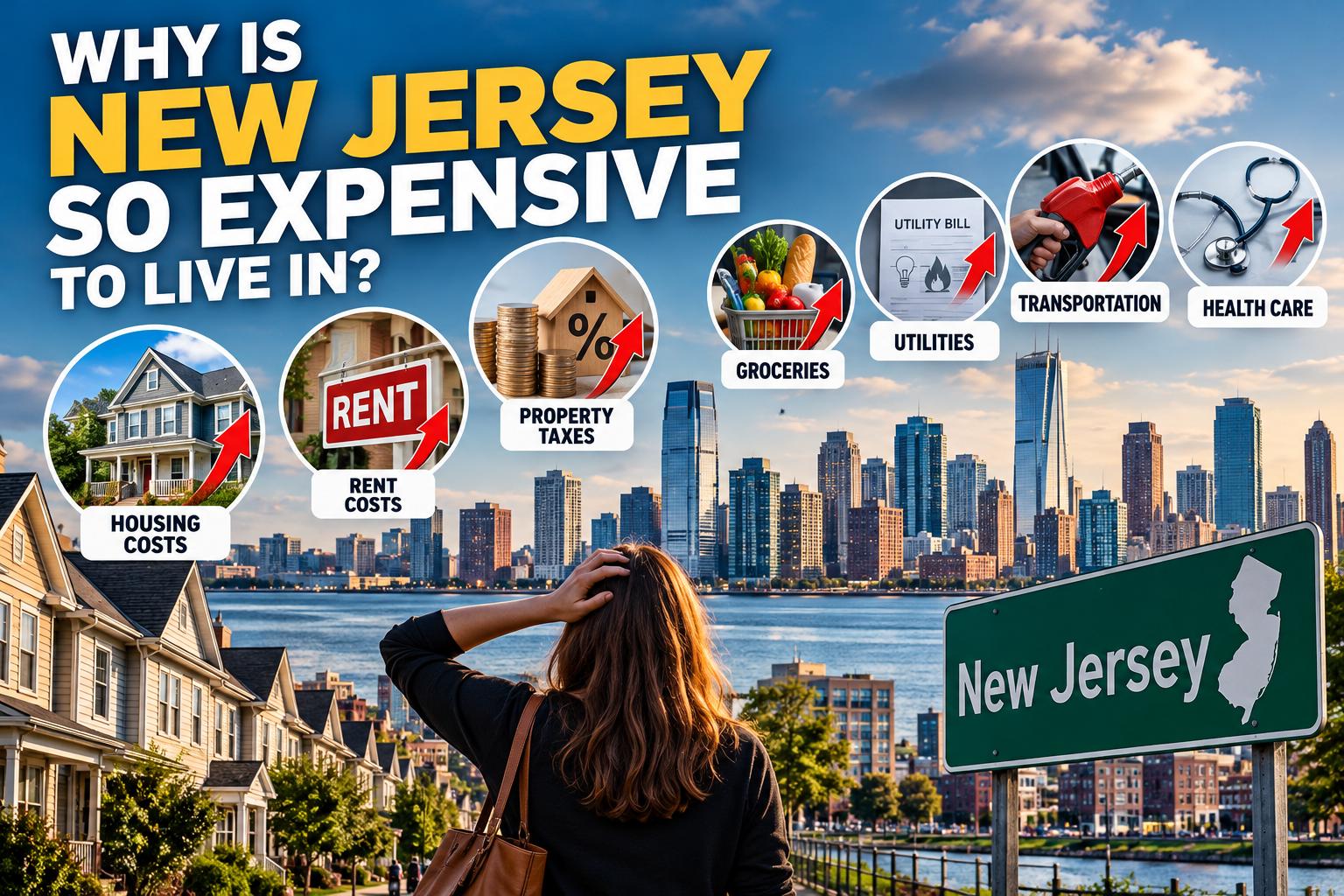
Why is New Jersey so expensive to live in? High housing and rent costs combine with property-related expenses, transportation, groceries, utilities and health care to strain household budgets, while 2026 data shows many residents need substantially higher incomes to cover basic needs.
New Jersey offers access to major job markets, transportation networks and densely developed communities, but living in the state can require a substantial household income. In 2026, housing remains one of the biggest pressures, while transportation, groceries, utilities, health care and other necessities are adding to the burden.
Housing and rent take a large share of income
For a closer look at how much renters now need to earn, see our guide to New Jersey rent costs in 2026, including statewide housing-wage and county-level rent data.
Housing is a major reason New Jersey feels expensive. Census data for 2020-2024 puts median gross rent at $1,720 and median monthly owner costs for homeowners with a mortgage at $2,829.
More recent rental data shows an even sharper affordability gap. The 2026 Out of Reach report estimates that a full-time worker needs to earn $43.89 an hour to afford a modest two-bedroom rental at fair market rent without spending more than 30% of income. The average New Jersey renter earns $24.92 an hour.
Basic expenses require a higher income
The pressure is not caused by rent levels alone; our explainer on why New Jersey rents are so high looks at housing shortages, wage growth, affordable-housing supply and landlord consolidation.
Housing is only part of the equation. MIT's Living Wage Calculator, updated on February 15, 2026, estimates that a single adult with no children needs about $27.35 an hour in New Jersey to cover basic needs. For one adult with one child, the estimate rises to $49.94 an hour.
Those figures include necessities such as housing, food, transportation, medical care and other basic expenses.
Household size changes the calculation significantly, so our breakdown of how much income you need to live in New Jersey in 2026 compares the required earnings for single adults, parents and two-income families.
Everyday costs are adding pressure
The financial strain is also visible in resident surveys. A Rutgers-Eagleton poll released on October 7, 2026 found that about two-thirds of respondents struggled with housing and transportation costs, while roughly six in 10 reported difficulty affording groceries, utilities and health care.
Among residents earning $50,000 or less, 83% reported difficulty affording both housing and groceries, while 84% struggled with utilities.
Property costs remain part of the affordability debate
Homeowners can also review our guide to New Jersey property taxes in 2026, which explains ANCHOR, Senior Freeze, Stay NJ and the current property-tax relief process.
Homeowners face another layer of household expense through property-related costs. New Jersey continues to operate programs including ANCHOR, Senior Freeze and Stay NJ to provide eligible residents with property tax relief.
Taken together, New Jersey's affordability challenge is not driven by one expense alone. High housing requirements combined with transportation, food, utilities, health care and property costs can push the income required for financial stability well above what many households earn. That gap is why affordability remains a significant issue across the state.
Related Articles
New Jersey vs Pennsylvania Cost of Living: Which Is Cheaper in 2026?
Compare housing, rent, income and living-wage differences between New Jersey and neighboring Pennsylvania.
Most Affordable Places to Live in New Jersey in 2026
See which New Jersey cities currently offer lower rents and housing costs than many of the state’s more expensive markets.
New Jersey vs Texas Cost of Living: Which Is Cheaper in 2026?
Compare housing, rent, income, taxes and living-wage requirements between New Jersey and Texas.