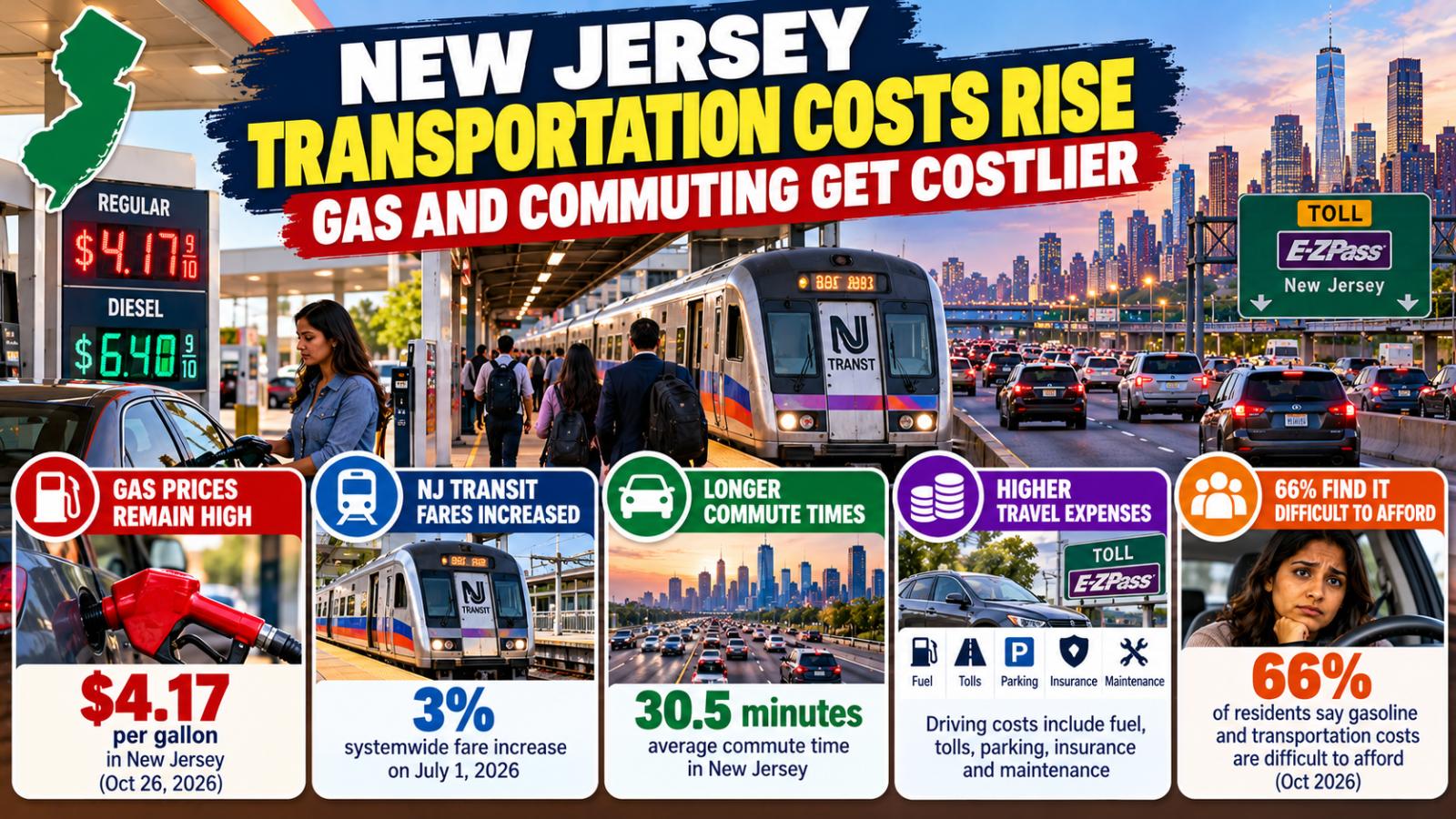
New Jersey transportation costs are putting greater pressure on households in 2026. About two-thirds of residents report difficulty affording gasoline and transportation, while gas remains above $4 a gallon and NJ Transit fares increased again on July 1.
Transportation is becoming a larger affordability challenge for New Jersey households as residents face higher gasoline prices, transit fares and the recurring cost of getting to work.
Transportation is one part of a broader cost-of-living problem, which we explain in our guide on why New Jersey is so expensive to live in.
A Rutgers-Eagleton poll released on October 7, 2026 found that 66% of residents said gasoline and transportation costs were difficult to afford, including 34% who described them as very difficult. The “very difficult” share increased 10 percentage points from March.
Gas prices remain above $4 a gallon
AAA reported New Jersey's average price for regular gasoline at about $4.17 per gallon on October 26, 2026.
To see how commuting fits into a complete household budget, our guide on how much income you need to live in New Jersey in 2026 compares the earnings required for different household types.
That compares with roughly $2.95 a gallon one year earlier, an increase of more than $1.20 per gallon. Diesel averaged about $6.40.
For households driving long distances to work, school or child care, those increases can quickly add to monthly expenses.
Housing remains another major monthly expense, and our report on New Jersey rent costs in 2026 shows how much renters need to earn across the state.
Commuting adds time as well as expense
New Jersey workers have relatively long commutes. Census Bureau data for 2020-2024 shows a statewide mean travel time to work of 30.5 minutes.
For residents considering a move to reduce overall expenses, our guide to the most affordable places to live in New Jersey in 2026 compares several lower-cost housing markets.
For commuters who drive, the financial burden can include fuel, tolls, parking, insurance and vehicle maintenance. Those using public transportation face a different set of recurring expenses.
NJ Transit fares increased in July
NJ Transit implemented another 3% systemwide fare adjustment on July 1, 2026, following the annual fare-adjustment policy approved in 2024.
Current one-way fares vary substantially depending on route and distance, with bus and rail passengers paying different rates based on their journeys.
Transportation pressure is spreading
The affordability problem is not limited to drivers. Rutgers reported in April that 59% of residents were already having difficulty with gasoline and transportation costs, up from 54% in the previous survey. By September, that figure had risen to roughly two-thirds.
Transportation therefore represents another layer of New Jersey's broader cost-of-living challenge. For households already managing high housing, grocery, utility and child care expenses, the cost of simply getting to work or completing daily trips can take an increasingly significant share of the budget.
Related Articles
New Jersey vs Pennsylvania Cost of Living: Which Is Cheaper in 2026?
Compare housing, income, commuting and living-wage requirements between New Jersey and Pennsylvania.
New Jersey Grocery and Utility Costs Push Families to Cut Spending
See how food and utility bills are adding to the same household budget pressure as transportation costs.
New Jersey vs Texas Cost of Living: Which Is Cheaper in 2026?
Compare housing, transportation, income, taxes and overall affordability between New Jersey and Texas.