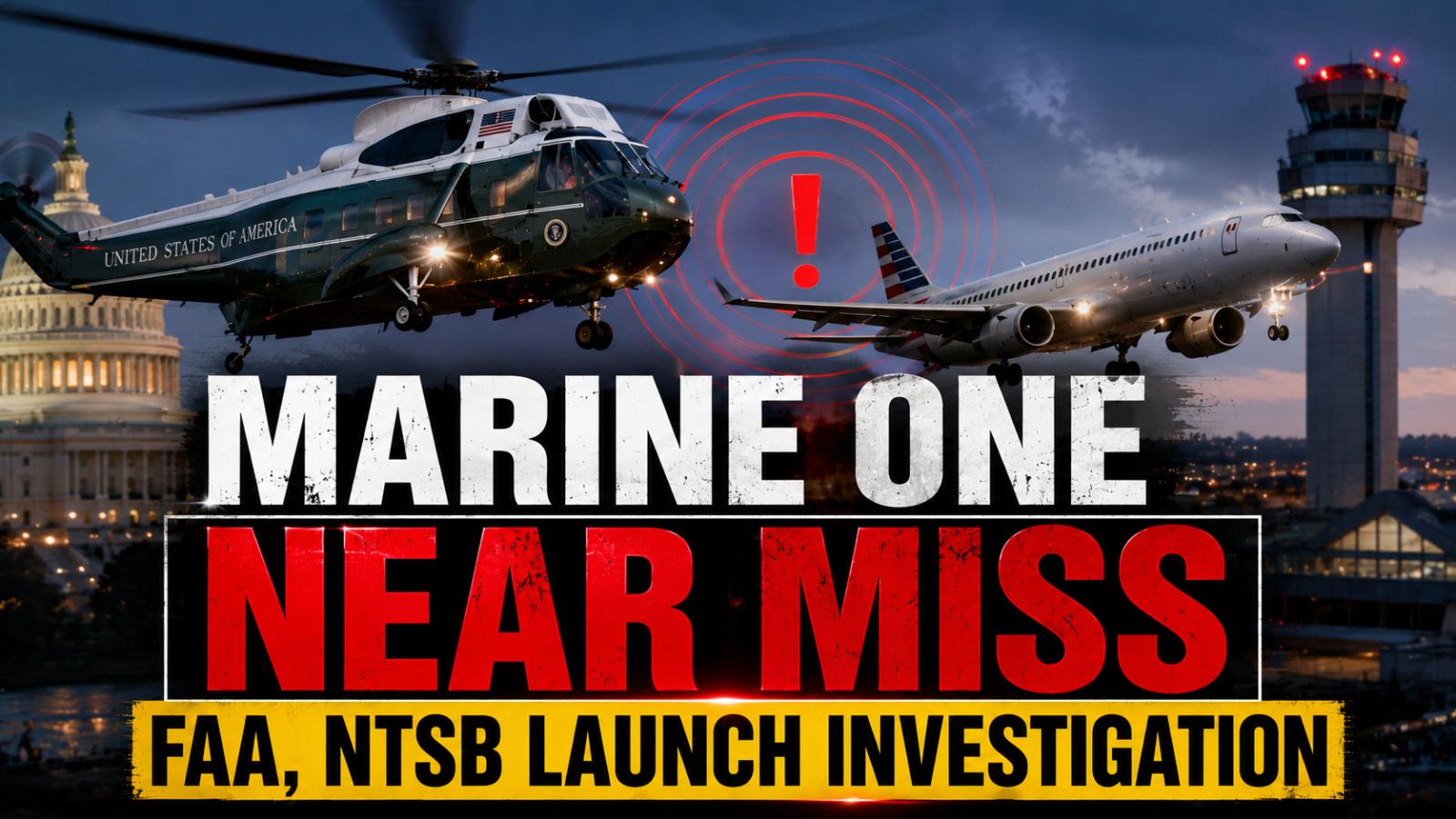
Marine One is under investigation after a reported loss of separation with a commercial passenger aircraft near Ronald Reagan Washington National Airport. Federal aviation authorities say President Donald Trump was never in danger, but the incident has renewed attention on flight safety around Washington’s crowded airspace.
Marine One Near Miss Investigated by FAA and NTSB
The Federal Aviation Administration (FAA) and the National Transportation Safety Board (NTSB) have launched investigations after a safety incident involving Marine One and a commercial passenger aircraft on August 4 near Ronald Reagan Washington National Airport.
President Donald Trump was aboard Marine One while traveling to Joint Base Andrews to board Air Force One for a trip to California. During the flight, a regional passenger jet departing Reagan National Airport experienced what aviation officials described as a "loss of separation" with the presidential helicopter. Both aircraft continued safely without any evasive action or injuries.
Loss of Separation Raises Safety Questions
According to the FAA, air traffic controllers were communicating with both the Marine One crew and the commercial aircraft throughout the event. Preliminary findings indicate the aircraft briefly failed to maintain the minimum separation standards required around busy airports before safely moving farther apart. The FAA said it will conduct a full safety review and implement corrective measures if necessary.
Federal aviation rules generally require aircraft operating in this environment to maintain at least 1.5 miles of horizontal separation and 500 feet of vertical separation. Investigators are now examining why those standards were temporarily not maintained and whether communication issues contributed to the incident.
White House Says Trump Was Never at Risk
The White House dismissed suggestions that the president faced any immediate danger. Spokesperson Kush Desai said Marine One is operated by highly experienced military pilots and emphasized that President Trump "was at no point in harm's way."
The FAA also stated that the aircraft were not on converging flight paths and that the situation did not develop into a collision risk. Officials stressed that the investigation is intended to understand how the procedural lapse occurred rather than respond to an emergency situation.
Reagan National Airspace Remains Under Scrutiny
The incident has drawn attention because it occurred near Ronald Reagan Washington National Airport, one of the busiest and most tightly controlled airspaces in the United States.
Following the fatal January 2025 midair collision between a U.S. Army Black Hawk helicopter and a commercial airliner that killed 67 people, the FAA introduced stricter procedures for helicopter operations around Washington. Those measures include suspending conflicting commercial departures during presidential helicopter movements and increasing mandatory aircraft separation standards.
Early reports indicate that commercial departures were not paused before Marine One departed from the White House, prompting investigators to examine whether communication between air traffic controllers and flight crews contributed to the loss of separation. Officials have not identified any evidence of pilot error by either aircraft.
Investigation Will Review Air Traffic Procedures
The NTSB will work alongside the FAA to reconstruct the sequence of events using radar data, air traffic control recordings and flight communications. Investigators will determine whether existing procedures were followed and whether further operational changes are needed around Reagan National Airport.
Although the White House and aviation authorities agree that President Trump was never in danger, the incident highlights the importance of maintaining strict coordination between military and civilian air traffic operations in one of the country's most congested flight corridors.