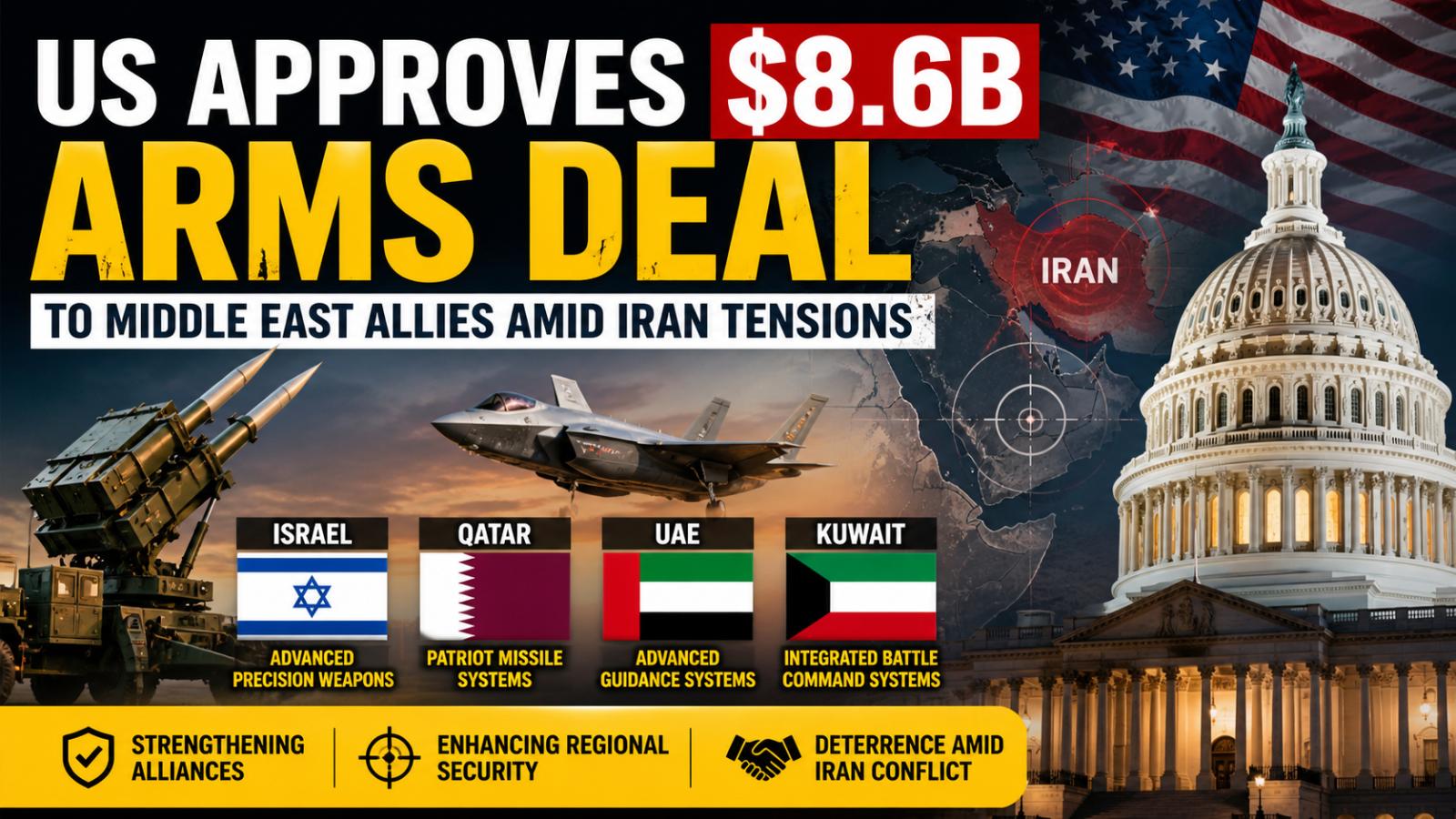
The United States has fast-tracked more than $8.6 billion in arms sales to key Middle East allies, signaling a sharp escalation in its response to rising tensions with Iran. Approved under emergency powers, the move bypasses Congress and reflects Washington’s urgency to strengthen regional defenses as the conflict enters a critical phase.
Emergency Approval Signals Rising Urgency
The decision, issued on Friday, invokes a rarely used emergency provision that allows the US government to skip the standard congressional review process. Officials say the fast-tracked approval was necessary due to the rapidly evolving security situation in the region.
The ongoing conflict involving Iran has now stretched into its ninth week. While a temporary truce is in place, the absence of a long-term agreement continues to fuel uncertainty—prompting the US to act quickly to support its allies.
What Weapons Are Included in the $8.6B Deal?
The arms packages include a mix of advanced defensive and precision-strike systems, aimed at boosting deterrence and readiness across the Middle East.
Key systems include:
- Precision-guided munitions
- Advanced air defense interceptors
- Patriot missile systems
- Integrated battle command technologies
These systems are designed not just for immediate defense—but to shift the strategic balance in the region.
Which Countries Received US Weapons?
The US approvals cover four major allies:
Israel
Israel’s package, worth approximately $992.4 million, includes 10,000 Advanced Precision Kill Weapon System (APKWS-II) rounds. These are designed for highly accurate, low-cost strikes against aerial and ground threats.
Qatar
Qatar received one of the largest allocations:
- $992.4 million in APKWS-II systems
- $4.01 billion in Patriot missile interceptors
These systems are being supplied by major defense firms like Lockheed Martin and RTX Corporation.
United Arab Emirates
The UAE secured 1,500 APKWS-II guidance systems valued at $147.6 million, strengthening its ability to counter aerial threats.
Kuwait
Kuwait’s $2.5 billion package includes Integrated Battle Command Systems, involving contractors such as Northrop Grumman, Lockheed Martin, and RTX Corporation.
Why Did the US Bypass Congress?
Under normal circumstances, arms sales of this scale must undergo congressional review before approval. However, US Secretary of State Marco Rubio stated that an emergency situation justified immediate action.
This move highlights just how seriously Washington views the current threat environment. Emergency approvals are rare—and typically reserved for moments of high geopolitical risk.
What Triggered This Surge in Arms Sales?
The current crisis escalated on February 28, 2026, when the United States and Israel launched coordinated strikes targeting Iran. Tehran responded with retaliatory actions against US-aligned nations, including Qatar, the UAE, and Kuwait.
Although a fragile ceasefire is holding for now, tensions remain high, and the possibility of renewed conflict continues to loom.
Why This Deal Matters for the Middle East
This $8.6 billion deal is more than just a weapons transfer—it represents a strategic shift.
- It strengthens US-aligned defense networks in the region
- It signals a firm stance against Iran’s growing influence
- It boosts deterrence but may also increase escalation risks
Defense analysts note that such rapid military support could reshape the balance of power, especially if hostilities resume.
What Happens Next?
With no permanent peace agreement in place, the region remains on edge. Experts believe:
- More arms deals could follow if tensions persist
- Iran may respond with increased military or proxy activity
- The US could deepen coordination with regional allies
The coming weeks will be critical in determining whether this move helps stabilize the region—or pushes it closer to further confrontation.
Final Take
The US decision to approve $8.6 billion in arms sales under emergency powers underscores the urgency and complexity of the Iran conflict. While the move strengthens allies, it also raises important questions about escalation, diplomacy, and long-term stability in the Middle East.