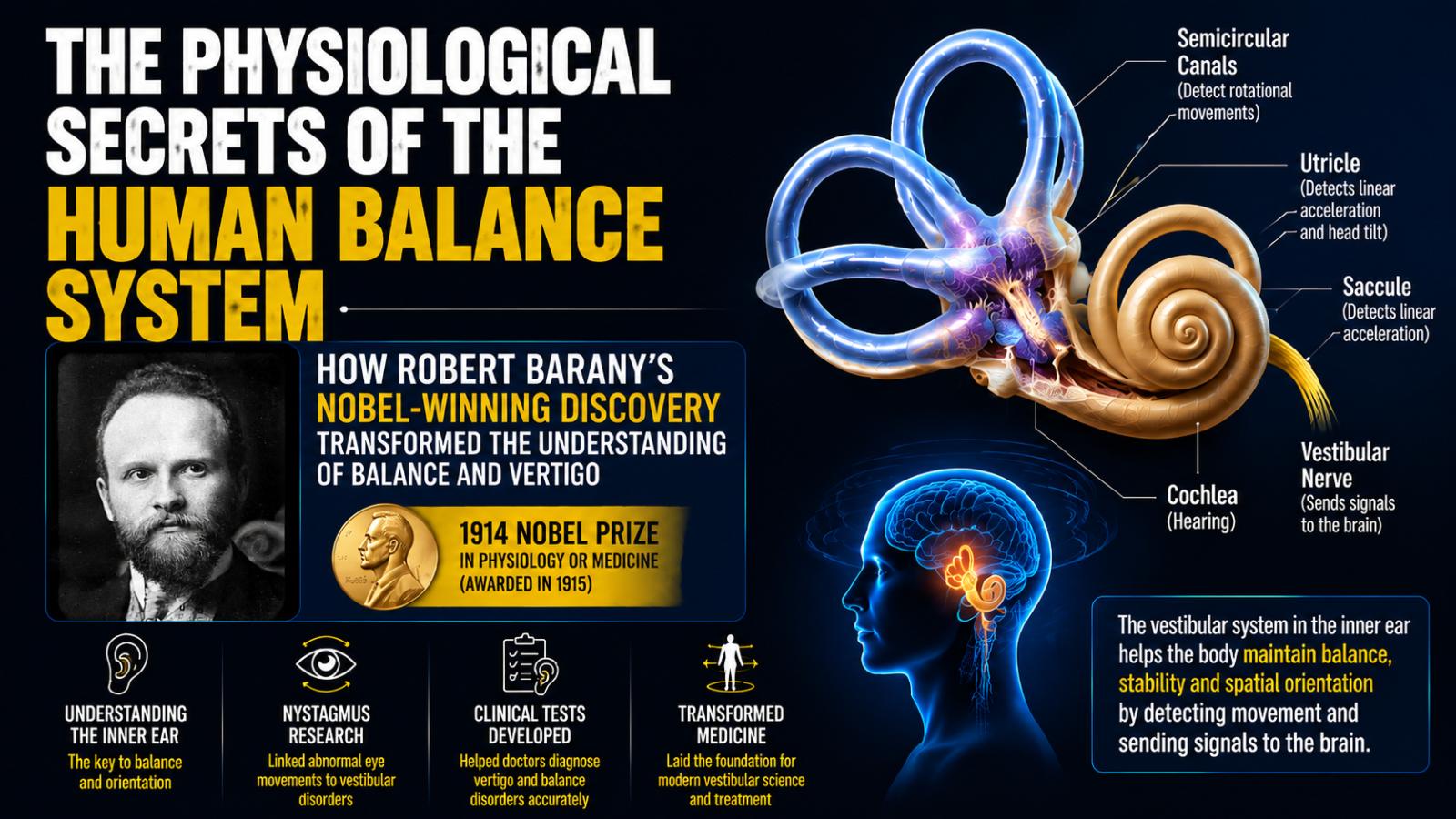
The human ability to maintain balance and spatial orientation is governed by a highly complex system within the inner ear known as the vestibular apparatus. The understanding of this system was fundamentally transformed by Hungarian physician Robert Barany, whose groundbreaking research earned him the 1914 Nobel Prize in Physiology or Medicine (awarded in 1915). His work laid the foundation for modern diagnosis and treatment of vertigo and balance disorders.
Early Medical Challenges in Understanding Balance
At the beginning of the 20th century, doctors frequently encountered patients suffering from dizziness, imbalance, involuntary eye movements, and sensations of spinning. These symptoms were collectively difficult to interpret because their origin was unclear. Physicians struggled to determine whether the cause lay in the inner ear, the brain, or the broader nervous system. Without precise diagnostic tools, treatment remained largely speculative.
Although anatomists had already identified structures within the inner ear related to equilibrium, the functional role of these structures was still not fully understood. This gap in knowledge created a major barrier in neurology and otology at the time.
Robert Barany’s Breakthrough in Vestibular Science
Robert Barany’s research focused on understanding how the inner ear contributes to balance and spatial awareness. He demonstrated that the semicircular canals of the vestibular system play a critical role in detecting head movement and maintaining equilibrium.
One of his most important contributions was linking abnormal eye movements (nystagmus) to disturbances in the vestibular system. He also developed clinical methods to test the function of the inner ear, allowing physicians to distinguish between neurological and vestibular causes of dizziness for the first time.
His work provided a scientific framework for diagnosing vertigo and related disorders, turning a previously ambiguous set of symptoms into a medically understood condition.
Nobel Prize Recognition and Scientific Impact
For his pioneering discoveries on the physiology and pathology of the vestibular apparatus, Robert Barany was awarded the Nobel Prize in Physiology or Medicine in 1914, with the award officially presented in 1915 due to administrative scheduling by the Nobel Committee.
His research marked a turning point in medical science, particularly in neurology and otology, by establishing a clear link between inner ear function and balance control. It also paved the way for modern vestibular testing methods used in hospitals today.
Legacy in Modern Medicine
Today, Barany’s discoveries remain central to the understanding of balance disorders. Conditions such as vertigo, Meniere’s disease, and vestibular neuritis are diagnosed using principles derived from his early work. Modern imaging techniques and diagnostic tests still build upon the foundational concept that the inner ear is a key regulator of spatial orientation.
The International Barany Society, named in his honor, continues to advance research in neuro-otology and vestibular science, reflecting the lasting global impact of his contributions.
Conclusion
Robert Barany’s work transformed the understanding of human balance from speculation to scientific certainty. By uncovering the role of the vestibular system, he not only solved a major medical mystery of his time but also established a foundation for modern neurological diagnostics. His Nobel-winning discovery continues to influence clinical practice more than a century later, demonstrating the enduring power of fundamental scientific research.