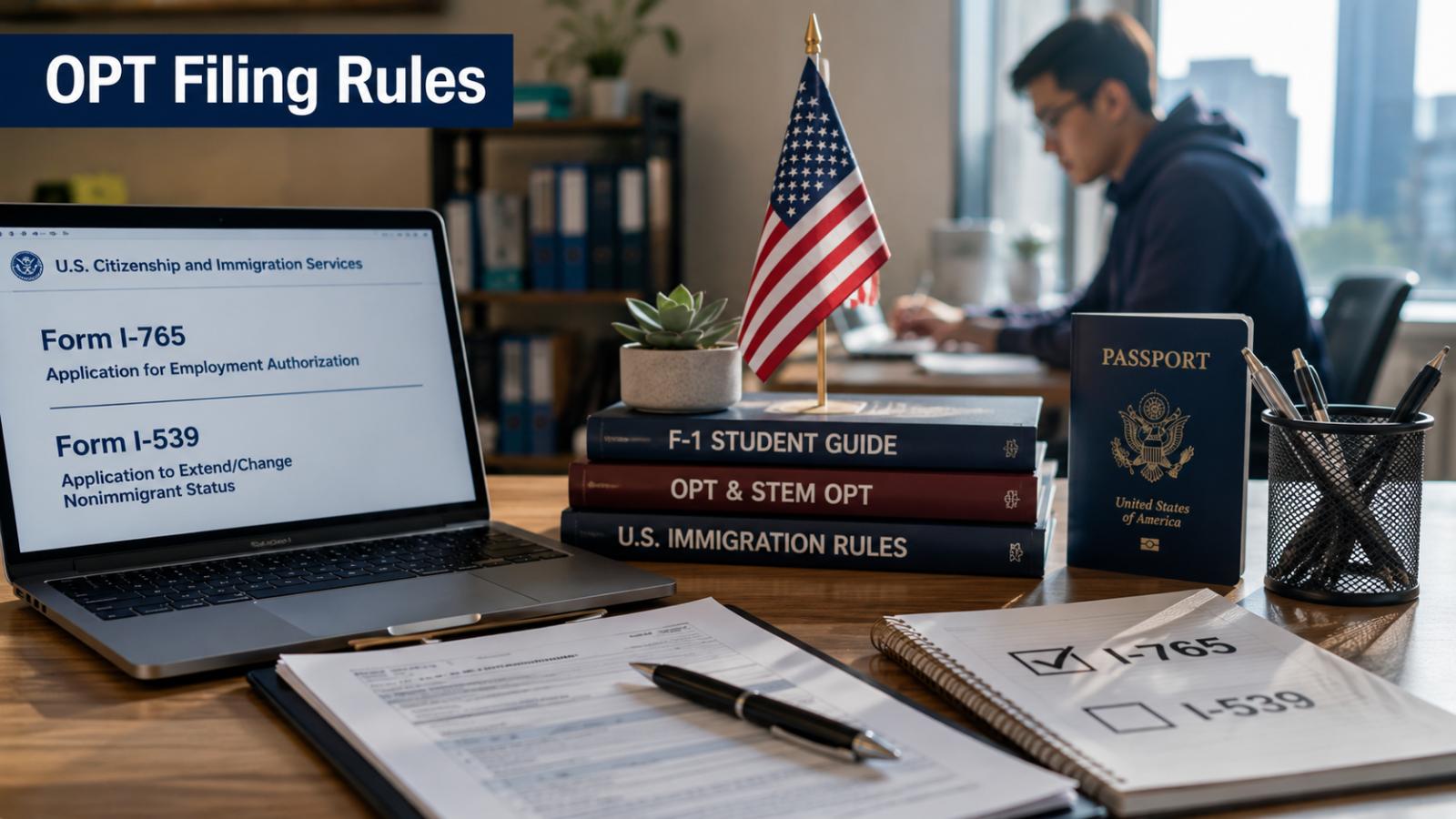
The OPT under new F-1 rule creates a temporary Form I-539 exemption for qualifying students who file Form I-765 by March 18, 2027. Other post-completion OPT and STEM OPT applicants may need separate employment authorization and extension-of-stay filings.
The Department of Homeland Security’s fixed-stay rule changes how some F-1 students will request post-completion Optional Practical Training and STEM OPT. Published on Friday, July 17, 2026, it takes effect on Tuesday, September 15, 2026.
The OPT filing changes are part of the broader DHS policy replacing duration of status with fixed admission periods. Read how the new DHS F-1 fixed-stay rule changes student admission and extension requirements.
Form I-765 remains the employment application
Form I-765 remains the application for employment authorization for post-completion OPT or a STEM OPT extension. Under the new system, it authorizes work, while an extension-of-stay request determines how long a student may remain in F-1 status.
DHS said the filings serve different purposes. Students who need both may submit them concurrently, with the related cases expected to be adjudicated together.
Transition applicants may avoid Form I-539
Check Your F-1 Transition Eligibility
The temporary Form I-539 exemption depends on whether a student qualifies for protection under the DHS transition provisions. Review how the new F-1 transition rules affect students already in the United States .
A temporary exemption applies to qualifying F-1 students admitted for duration of status who are properly maintaining status when the rule begins. A student recommended for post-completion OPT who timely files Form I-765 on or before Thursday, March 18, 2027, does not need Form I-539 for that OPT period.
The exemption also covers a qualifying STEM OPT applicant who files Form I-765 by March 18, 2027, before the current EAD expires. If approved, the student may remain in F-1 status through the EAD expiration date plus 60 days.
When both forms may be required
Students considering international travel should review how departure and reentry may affect OPT, STEM OPT and the student’s Form I-94 date.
Outside the exemption, a student seeking post-completion OPT may need Form I-765 and an extension of stay, generally requested through Form I-539, unless the student obtains a new admission period through U.S. Customs and Border Protection after travel.
A transition student who leaves before filing for OPT or STEM OPT and returns with a fixed admission date must file both forms. In-program OPT is different: DHS said a student whose admission period covers the academic program generally needs only the employment application.
Pending cases and filing checks
A qualifying employment authorization application pending with USCIS on September 15 does not have to be refiled, and a separate extension request is unnecessary unless USCIS asks for one.
Students should compare Form I-20, Form I-94 and EAD dates before filing and confirm the designated school official’s recommendation. The new process separates the admission deadline from employment authorization, making timely filing more important.
Students should also confirm their deadline by reading who receives the new 30-day F-1 grace period and who may retain 60 days.