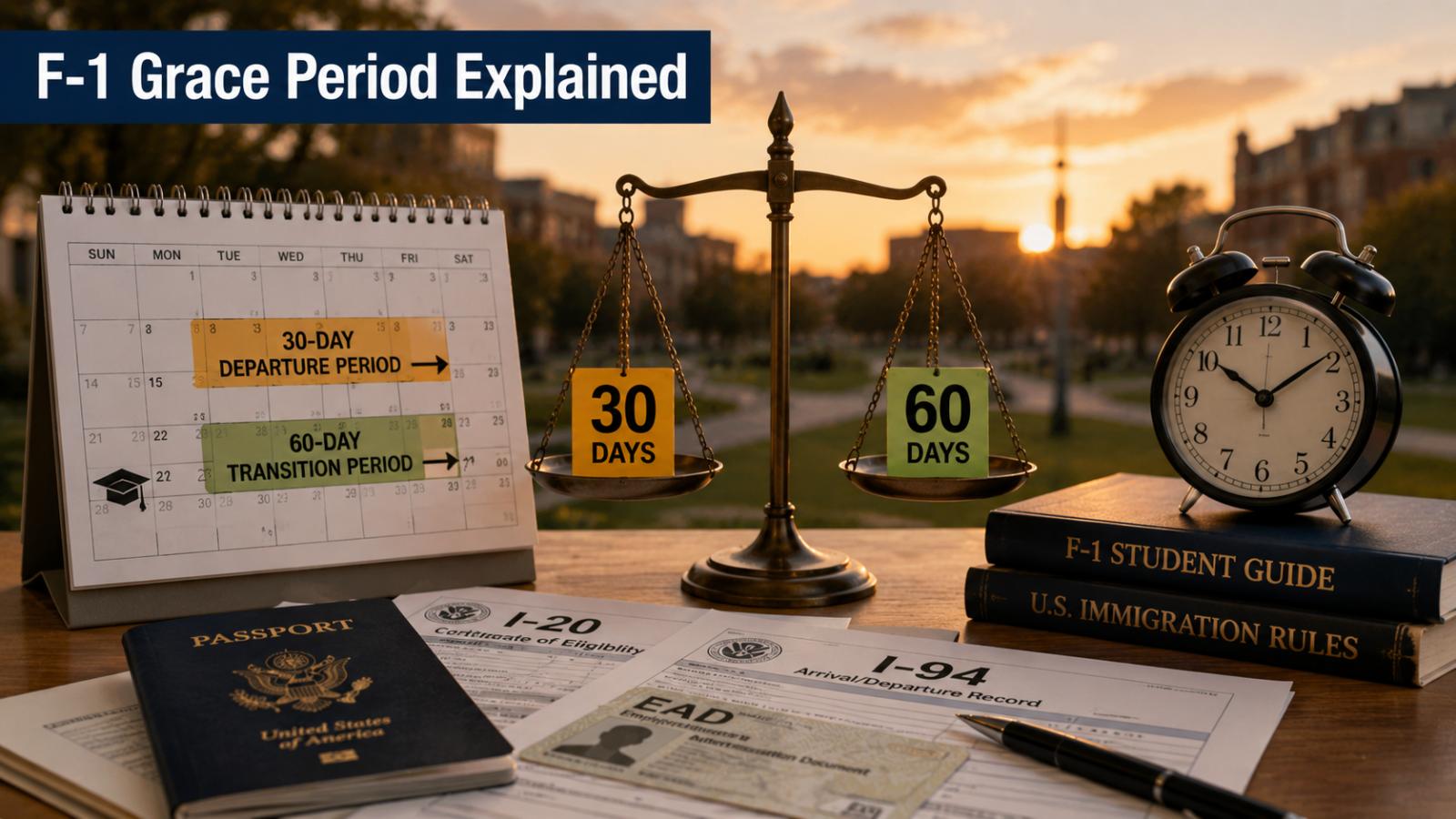
The F-1 grace period will generally fall from 60 days to 30 days under the DHS fixed-stay rule effective September 15, 2026. Qualifying students protected by the transition provisions may retain 60 days after their Form I-20 or EAD end date, subject to the rule’s limits.
The Department of Homeland Security’s final fixed-stay rule will reduce the standard F-1 departure period from 60 days to 30 days for students admitted under the new system. Published on Friday, July 17, 2026, the rule takes effect on Tuesday, September 15, 2026.
Who receives the new 30-day period
The 30-day and 60-day grace-period rules are part of a broader DHS policy replacing F-1 duration of status with fixed admission periods. Read how the new DHS F-1 fixed-stay rule affects international students .
F-1 students admitted for a fixed period will generally receive 30 additional days after completing an academic program or authorized post-completion OPT or STEM OPT. The period will be reflected on Form I-94 or calculated from the EAD expiration date when applicable.
The transition protections are part of the broader DHS policy replacing F-1 duration of status with fixed admission periods. Read how the new DHS F-1 fixed-stay rule affects international students.
The 30 days may be used to prepare for departure or take a timely step to maintain lawful status, including filing an extension-of-stay or change-of-status application. It does not automatically extend permission to work.
Who may retain the 60-day period
Eligibility for the temporary Form I-539 exemption depends on the student’s status when the rule takes effect. Review the F-1 transition rules for students already in the United States.
The transition provisions apply to qualifying students who were admitted for duration of status and are properly maintaining F-1 status in the United States on September 15.
They may generally remain through the later of the program end date on the Form I-20 valid on September 15 or the expiration date on an approved EAD, subject to a four-year transition cap. They then receive a 60-day departure period.
Work and study during the departure period
A student who files an extension during the new 30-day period may continue a full course of study while the request is pending. However, the student may not begin or continue practical training or other employment until USCIS approves the extension and any required employment authorization is issued.
The departure period should not be treated as extra employment time. Existing ICE guidance also says the 60-day period after a program or post-completion OPT is intended for departure or an authorized transition, not continued work.
Students must confirm their own deadline
Travel and reentry may affect which applications an OPT or STEM OPT student must submit. Read when Form I-539 is required under the new F-1 OPT rules.
The applicable deadline depends on whether the student remains protected by the transition rule or receives a fixed admission date. Students should compare their Form I-20, Form I-94 and EAD dates and consult their designated school official before making employment, travel or program-change plans.
The rule creates two timelines during the transition. Students who assume the previous 60-day period applies automatically could miss an extension, change-of-status or departure deadline after the fixed-stay system begins.