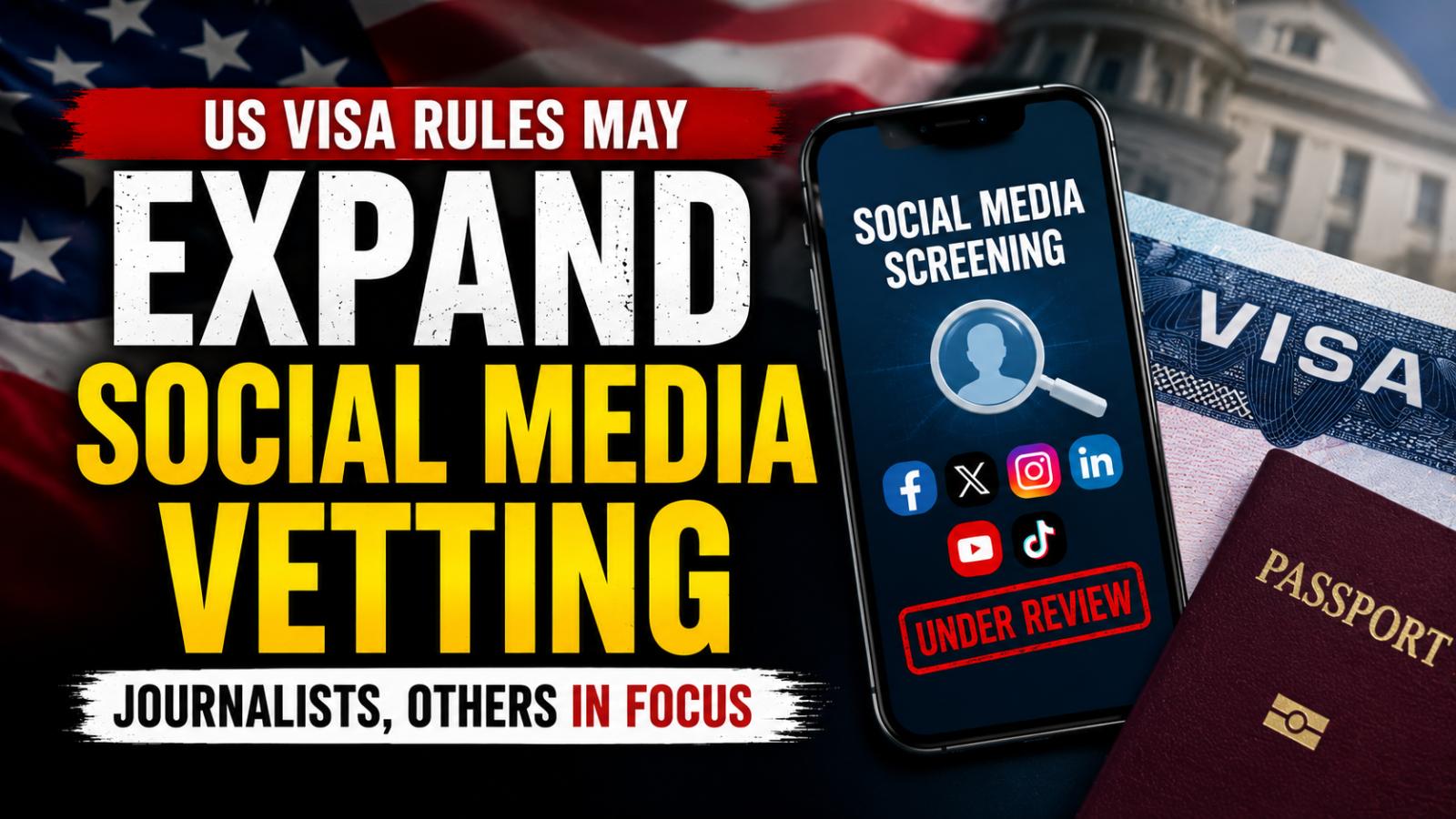
The Trump administration is reportedly considering an expansion of US visa social media vetting that could affect foreign journalists and other applicants. The proposed changes may require covered applicants to make their social media accounts public so US officials can review their online activity during visa screening.
The reported plan would extend an immigration screening practice already applied to several categories of foreign nationals. However, the State Department has not formally announced the broader requirements, making it important for prospective applicants to distinguish the proposal from rules already in force.
US visa social media vetting may expand
The reported proposal is based on an internal State Department memo cited in a US media report that White House Press Secretary Karoline Leavitt later reposted on X.
Under the proposal, certain applicants could be instructed to change social media privacy settings to “public” or “open” while their visa applications are reviewed. Foreign media representatives applying for I visas are reportedly among those who could face expanded scrutiny.
Some Canadian and Mexican applicants who require US visas may also be included, although the precise categories and implementation details have not been formally released.
The State Department did not confirm the reported expansion. A spokesperson said the department continuously reviews screening and vetting procedures worldwide to protect US national security and public safety.
Social media checks already apply to visa applicants
Social media screening itself is not new to the US visa system. Visa application forms have required many applicants to provide social media identifiers used during the previous five years since 2019.
The Trump administration has since expanded online screening for some applicants. In June 2025, the State Department announced that F, M and J visa applicants would undergo online presence reviews and instructed them to adjust social media privacy settings to public. (state.gov)
The department said the additional screening helps consular officers determine whether applicants qualify for visas under US law and whether their admission could present national security or public safety concerns.
Journalist visas could face additional scrutiny
The reported expansion is particularly significant for foreign journalists, who generally use I visas when entering the United States temporarily to work for qualifying foreign media organisations.
If implemented, the proposal could add online presence reviews to an already more restrictive environment for foreign media workers. The administration has also changed the rules governing how long certain nonimmigrants may remain in the country.
The Department of Homeland Security finalised a rule in July 2026 replacing the traditional “duration of status” framework for F, J and I nonimmigrants with fixed admission periods. (federalregister.gov)
Under that framework, foreign journalists are generally admitted for up to 240 days, while qualifying Chinese journalists face shorter limits. Extensions may be requested through US Citizenship and Immigration Services.
Trump visa rules put online activity under focus
The possible expansion fits the administration's broader effort to increase scrutiny across legal immigration channels. Secretary of State Marco Rubio has repeatedly stressed that US visas are privileges rather than guaranteed rights.
For applicants, expanded social media vetting could make online activity a more important part of the visa review process. Posts, affiliations and other publicly visible information could receive greater scrutiny alongside conventional application documents and security checks.
Applicants should not, however, assume that every foreign journalist or Canadian and Mexican applicant must immediately unlock private accounts based solely on the reported memo. Until the State Department publishes formal instructions identifying the affected visa classes, effective date and procedures, those details remain proposals rather than confirmed requirements.
The practical takeaway is straightforward: social media screening is already part of US visa vetting, but the reported expansion to additional groups should be treated as developing policy until the State Department formally announces it.