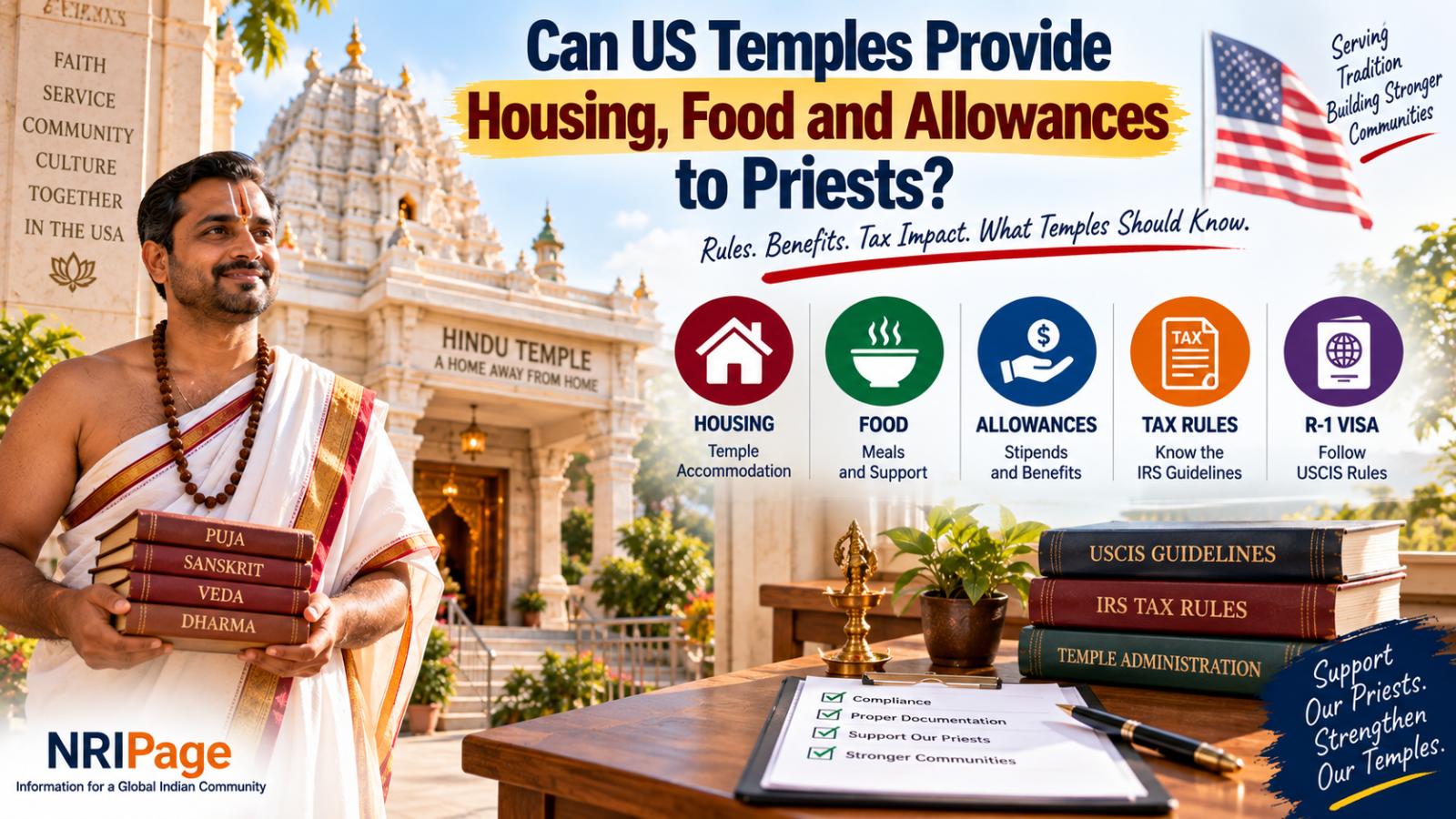
US temples can provide priests with housing, room and board, stipends and other support. For R-1 workers, USCIS requires the compensation arrangement to be documented, while IRS rules determine whether housing and other benefits are excluded from income or taxable.
Hindu temples in the United States may provide priests with accommodation, food, stipends and other living support instead of—or in addition to—a conventional salary. For priests in R-1 religious worker status, however, these benefits should be part of a documented compensation arrangement.
Housing and food can count as R-1 compensation
Federal R-1 regulations recognize both salaried and non-salaried compensation. USCIS specifically accepts verifiable evidence that a religious organization will provide room and board, along with budgets, leases and other documentation showing how the worker will be supported.
This means a temple does not necessarily have to compensate an R-1 priest entirely through wages. Housing and other in-kind support can form part of the approved arrangement.
Temples must document the arrangement
For an R-1 petition, the organization must explain how it intends to compensate the religious worker, including monetary or in-kind support. USCIS may expect evidence such as prior compensation records, budgets, leases, tax records or proof that room and board will be provided.
For R-1 extensions involving non-salaried compensation, USCIS guidance also identifies stipends, room and board and other financial support as evidence that may need to be documented.
Are priest housing allowances tax-free?
Potentially—but only under specific IRS rules.
An ordained, commissioned or licensed minister performing qualifying ministerial services may be able to exclude a properly designated housing allowance from federal income tax. The employing organization must designate the allowance before it is paid, and the exclusion is limited by the amount actually used for housing, fair rental value and reasonable compensation rules.
However, a qualifying housing allowance or temple-provided residence is generally still included when calculating self-employment tax for ministerial services.
Food and other benefits also need tax review
IRS Publication 517 includes the value of certain employer-provided meals and lodging when calculating a minister's net earnings from self-employment. It also treats housing, allowances and other forms of support differently depending on the circumstances.
For temples, the key is to document exactly what the priest receives—salary, housing, meals, stipend or other benefits—and ensure the immigration petition and tax reporting accurately reflect the arrangement.
Reviewed against USCIS and IRS guidance on September 19, 2026. This article provides general information and is not individualized immigration or tax advice.