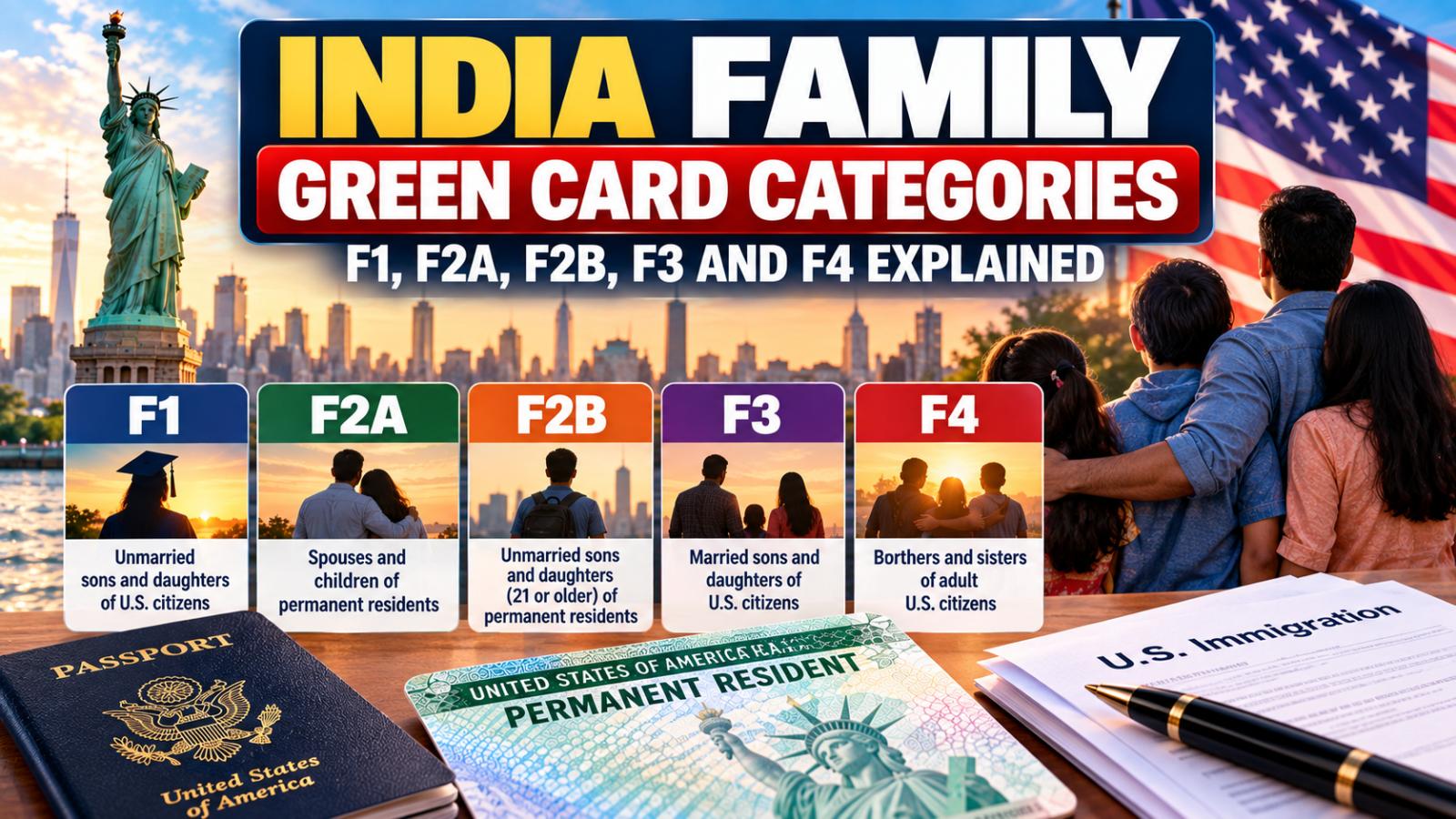
India family green card applicants may fall under F1, F2A, F2B, F3 or F4 depending on their relationship to a U.S. citizen or permanent resident. Each category has separate annual limits, priority dates and Visa Bulletin cutoffs.
The U.S. family-sponsored green card system divides certain relatives into preference categories known as F1, F2A, F2B, F3 and F4. For applicants chargeable to India, these categories can have very different Visa Bulletin cut-off dates because demand exceeds the available annual visa numbers.
What do F1, F2A, F2B, F3 and F4 mean?
F1 covers unmarried sons and daughters of U.S. citizens.
F2A covers spouses and children of lawful permanent residents.
F2B covers unmarried sons and daughters age 21 or older of lawful permanent residents.
F3 covers married sons and daughters of U.S. citizens.
F4 covers brothers and sisters of adult U.S. citizens.
These are family-preference categories subject to annual numerical limits.
How does the priority date work?
A priority date establishes an applicant’s place in the family-sponsored immigrant visa queue.
Applicants compare that date with the applicable India cut-off in the State Department’s monthly Visa Bulletin. A visa number can generally be authorized only when the priority date is earlier than the listed Final Action Date.