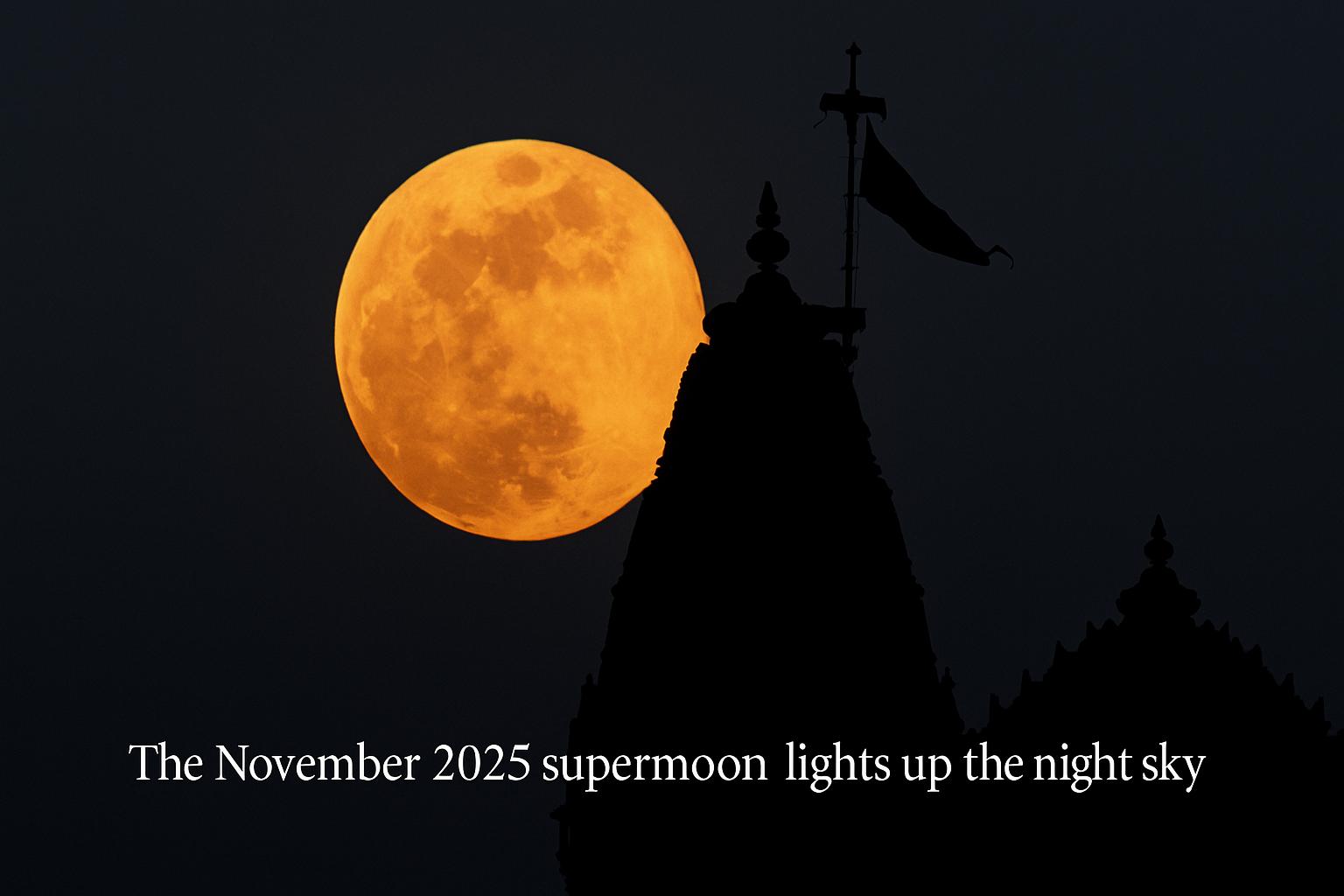
The night sky turned into a spectacular display on Wednesday as the November 2025 supermoon — also known as the Beaver Moon — rose in its full brilliance, becoming the largest and brightest full moon of the year. This remarkable celestial event, visible across much of the world, drew stargazers and sky enthusiasts to open fields, terraces, and observatories to witness its glowing beauty.
The November supermoon is the second in a sequence of three supermoons occurring in 2025, and it stands out as the closest full moon to Earth this year. Because of this close proximity, it appeared noticeably larger and brighter than an average full moon, transforming the night into a scene of silvery light and long, faint shadows.
A supermoon occurs when a full moon coincides with the Moon’s perigee — the point in its elliptical orbit where it is nearest to Earth. The Moon’s distance from Earth changes throughout its orbit, and when these two events align, the result is a visual spectacle. At perigee, the full moon can appear up to 14 percent larger and 30 percent brighter than a typical full moon, a difference that, while subtle to the eye, creates a distinctly luminous effect across the landscape.
During this event, the Moon came within approximately 357,000 kilometers (about 222,000 miles) of Earth — around 17,000 miles closer than usual. The closer proximity enhanced its brightness, causing it to cast soft shadows and bathe the surroundings in a serene, pearly glow. Observers in regions with clear skies could clearly see the Moon’s surface details, including its craters and highlands, even without telescopes.
The November supermoon is traditionally referred to as the “Beaver Moon.” The name has roots in Native American and early European seasonal traditions, where full moons were named to reflect natural cycles and activities tied to the time of year. The Beaver Moon marked the period when beavers were busy building their dams ahead of the freezing winter months, and when trappers would set their last rounds of traps before rivers turned to ice.
The Beaver Moon, therefore, holds both cultural and natural significance, serving as a seasonal marker for indigenous communities and settlers who observed the rhythm of nature long before the era of modern astronomy.
Experts say that anyone wishing to view a supermoon at its most dramatic should look toward the eastern horizon during moonrise or shortly after sunset, ideally from locations far from urban light pollution. Parks, coastal areas, and open fields provide the best viewing conditions. Although no telescope is needed to enjoy the phenomenon, binoculars can enhance the experience by revealing more intricate surface details such as lunar maria — the dark plains formed by ancient volcanic eruptions.
Across the globe, people in North America, Europe, Asia, and parts of Africa were treated to clear views of the glowing lunar orb. However, visibility varied depending on local weather and pollution levels. In India, especially in northern cities like Delhi, the experience was partly affected by seasonal smog and haze that often blanket the skyline during winter months. Despite these conditions, many observers were still able to catch glimpses of the magnificent moon as it climbed higher into the night sky.
Astronomers describe the supermoon as an important reminder of the dynamic and ever-changing relationship between Earth and its satellite. The Moon’s orbit is not a perfect circle, and this subtle variation results in moments like these — when the Moon comes closest to our planet, creating a natural display of wonder visible to nearly everyone on Earth.
While the difference in apparent size may be difficult to measure with the naked eye, the heightened brightness and vivid presence of a supermoon are unmistakable. Its glow has long inspired myths, art, and poetry, symbolizing renewal, reflection, and the rhythm of the cosmos.
The November 2025 supermoon serves as both a scientific marvel and a poetic spectacle — a moment that bridges natural history, astronomy, and cultural tradition. It connects observers across continents under one luminous sky, reminding humanity of its shared curiosity and awe for the universe.
The next and final supermoon of 2025 is expected to occur in December, offering another opportunity for skywatchers to look upward and experience one of nature’s most timeless displays. Until then, the memory of the radiant Beaver Moon will continue to shine in the minds of those who watched it light up the November night.