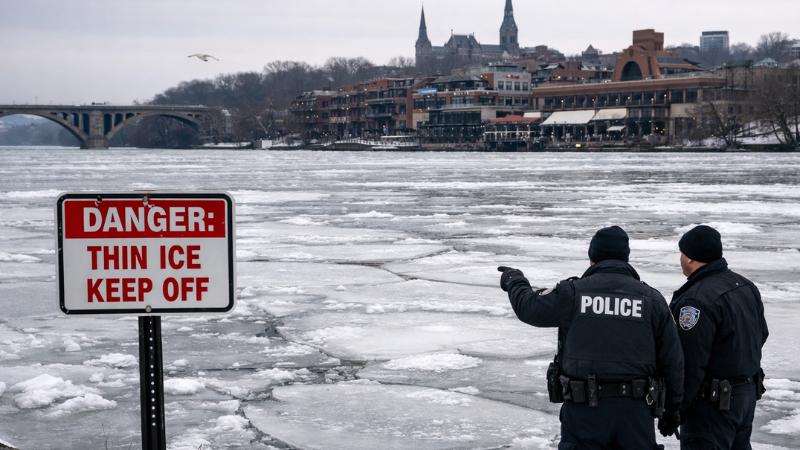
WASHINGTON — A prolonged stretch of frigid temperatures has gripped the Washington, D.C., region, leaving portions of the Potomac River covered in ice and prompting renewed safety warnings from local authorities who say the frozen surface is far more dangerous than it appears.
Officials report that the recent cold snap has caused sections of the river near the Georgetown waterfront to freeze over, creating the illusion of a solid walking surface. Police say they have already received reports of individuals attempting to step onto the ice, raising concerns about potentially life-threatening consequences.
The Metropolitan Police Department and harbor authorities are urging residents to stay clear of any iced-over waterways, stressing that the region rarely experiences the sustained hard freeze required to form ice thick enough to safely support people. What may look stable from shore can be thin, cracked or uneven, particularly on rivers where currents and changing water levels weaken the surface from below.
D.C. Harbormaster Lt. Andrew Horos addressed the community in a public message, emphasizing that venturing onto the frozen river is not only extremely dangerous but also prohibited. He warned that the ice can fail without warning, leading to sudden falls into near-freezing water.
Experts note that ice formed during fluctuating temperatures is significantly weaker than ice produced during continuous, deep freezes. Moving water, such as rivers, streams and stormwater channels, is especially hazardous because the ice thickness can vary widely from one step to the next. Additionally, ice deteriorates much faster than it forms, meaning conditions can change rapidly even after several days of cold weather.
Authorities also highlighted the severe medical risks associated with falling into icy water. According to safety officials, moderate to severe hypothermia can set in within minutes, sharply reducing the chances of survival. The window for a successful rescue can close in less than 10 minutes as body temperatures drop and mobility declines.
Emergency responders advise anyone who witnesses a person or animal breaking through the ice to call 911 immediately and avoid stepping onto the surface to attempt a rescue. Instead, bystanders should try to assist from a safe distance by extending an object such as a rope, pole or flotation device.
With freezing weather expected to continue, officials say the safest choice is simple: admire the winter scenery from shore and keep off the ice entirely to prevent avoidable tragedies.