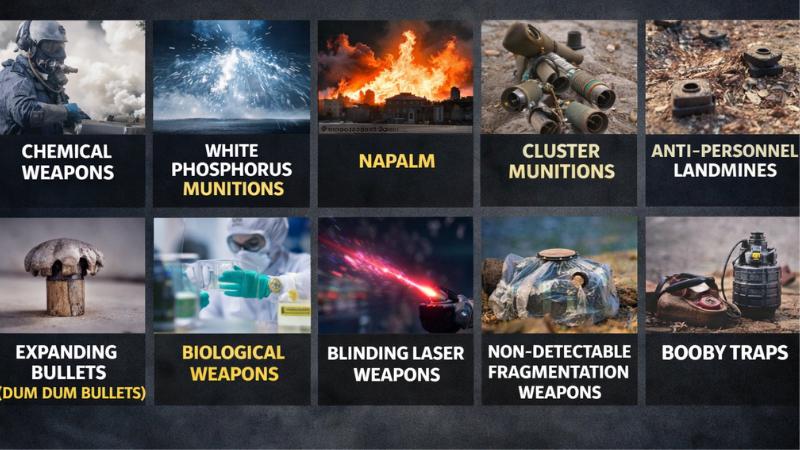
War brings immense suffering, and some weapons cause such devastation that their use has been heavily restricted or banned under international law. One such weapon, white phosphorus, recently drew international condemnation when Israel was accused of using it in civilian areas of Lebanon. Like white phosphorus, several other weapons have been banned for their harmful impact on both combatants and civilians.
Here are 10 weapons that are either restricted or outright banned due to the immense suffering they cause:
- Chemical Weapons
Chemical weapons, such as nerve agents like sarin and mustard gas, are designed to cause harm through toxic chemicals. The use of these weapons, which caused widespread casualties during World War I, is prohibited under the Chemical Weapons Convention (1993). - White Phosphorus Munitions
While not banned entirely, the use of white phosphorus as an incendiary weapon in areas with civilians is prohibited by international law. This substance can cause horrific burns and is difficult to extinguish. - Napalm
Napalm, a gelled gasoline mixture, sticks to surfaces and burns for prolonged periods. Although not explicitly banned, it is prohibited for use against civilian targets and in proximity to civilian areas under the Convention on Certain Conventional Weapons (1980). - Cluster Munitions
These weapons release submunitions that can explode long after conflict ends, posing a significant risk to civilians. The Convention on Cluster Munitions (2008) bans their use due to the danger they pose. - Anti-Personnel Landmines
Designed to injure rather than kill, anti-personnel landmines are banned under the Ottawa Treaty (1997) due to their lasting threat to civilian populations, even after a conflict has ended. - Expanding Bullets (Dum Dum Bullets)
These bullets expand on impact, causing more damage to the human body. Their use in warfare against human targets was banned in 1899 under The Hague Convention. - Biological Weapons
These weapons use pathogens or toxins to harm humans, animals, or plants. The Biological Weapons Convention (1972) prohibits their development, production, and use. - Blinding Laser Weapons
Weapons designed to cause permanent blindness through laser technology are banned under the 1995 Protocol IV of the Convention on Certain Conventional Weapons. - Non-Detectable Fragmentation Weapons
These weapons use materials like glass and plastic that are difficult to detect with conventional X-ray methods, making them especially dangerous. They are banned under the Convention on Certain Conventional Weapons. - Booby Traps
Booby traps, designed to detonate when disturbed, are restricted by international law, particularly when disguised as everyday objects like toys or food, as they pose a high risk to civilians.
These weapons not only cause significant harm during warfare but also pose lasting threats long after conflicts end. International laws aim to reduce such suffering and protect civilians from indiscriminate violence, highlighting the importance of ethical conduct in warfare.