Plot
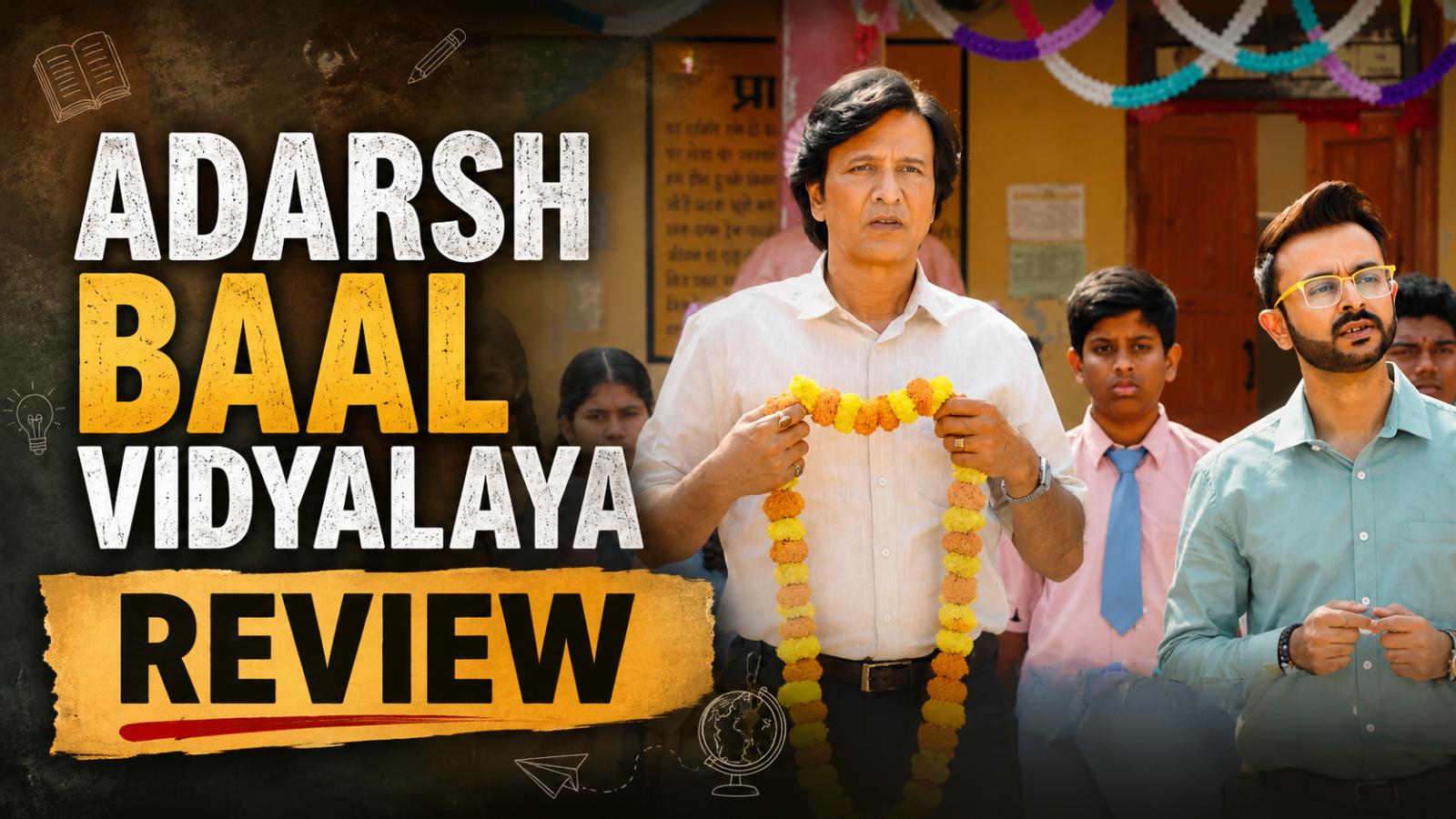
Set in the fictional town of Tinki Toli near Delhi, Adarsh Baal Vidyalaya centres on a neglected government school that is ideal only in name. Its classrooms are deteriorating, local residents use the campus for personal purposes, and political interference has weakened the institution further.
The school is headed by Gyaneshwar Tripathi, a warm but imperfect principal who is more comfortable playing cricket with students than confronting the system. His attitude changes when he learns that principals of the city’s best-performing government schools will be selected for a leadership programme at Cambridge.
Tripathi is initially motivated by the opportunity to take his wife Sushma abroad after years of her quietly supporting him. To improve the school’s performance, he brings together an eccentric group of underpaid teachers, each managing personal struggles alongside professional responsibilities.
The series follows their small attempts to help students while addressing teacher shortages, poor infrastructure, examination pressure, gender discrimination, sex education, child marriage, dowry, internet fame and the obsession with marks.
Overview
Created by former TVF collaborators Biswapati Sarkar and Sameer Saxena under Posham Pa, Adarsh Baal Vidyalaya is a seven-episode slice-of-life comedy-drama that premiered on Prime Video on July 24, 2026.
The series carries the familiar emotional tone of Panchayat, Kota Factory, Aspirants and Gram Chikitsalaya. It uses humour, everyday conversations and small heartbreaks to examine the condition of government schools without turning the narrative into an aggressive social lecture.
Its central message is that meaningful education depends not only on infrastructure or examination results but also on teachers who are willing to understand and encourage children.
Performances
Kay Kay Menon delivers a warm, sincere and controlled performance as principal Gyaneshwar Tripathi. He makes the character’s laziness, affection, ambition and growing sense of responsibility feel natural. His emotional scenes, particularly those involving a former student, are among the strongest moments of the series.
Naveen Kasturia balances humour and vulnerability as school counsellor Mukul. His character’s relationship with his teenage daughter adds emotional depth, especially as he struggles with loneliness, parenthood and the possibility of rebuilding his personal life.
Prasanna Bisht is convincing as newly appointed mathematics teacher Kanchan, who is forced to teach physics because of the school’s staff shortage. She effectively portrays a young educator who wants to become a genuine mentor rather than simply complete the syllabus.
Abhimanyu Singh stands out as Hindi teacher Hansraj. He receives several humorous lines but never becomes a one-dimensional comic character. His secret side business also reflects the financial pressure faced by poorly paid teachers.
Archana Puran Singh is effective in a restrained role, while Deven Bhojani brings humour and political arrogance to MLA Goldy. Prachi Shah provides emotional stability as Tripathi’s supportive wife, Sushma.
Technical Aspects
The makers create a believable government-school environment rather than presenting a polished or exaggerated version of one. The damaged classrooms, overcrowded spaces, staff room conversations and misuse of school property strengthen the series’ realism.
The production design supports the storytelling by making Adarsh Baal Vidyalaya feel like an institution that has been neglected for years. The school itself gradually becomes an important character representing both institutional failure and the possibility of change.
The direction remains grounded and avoids dramatic speeches or miraculous transformations. Problems are addressed through small victories, awkward conversations and the daily efforts of teachers and students.
The supplied review does not name the cinematographer, production designer or costume designer, so their individual contributions cannot be assessed separately.
Music
The supplied material does not identify the composer, songs or background-score team.
The review suggests that the series depends more on conversations, humour and performances than on heavily dramatic music. A notable classroom sequence uses a song to help explain menstruation and sex education, turning an uncomfortable lesson into an accessible and memorable moment.
Editing
The seven-episode structure allows multiple teachers, students and social issues to receive attention. However, the pacing is one of the series’ weaker areas.
Several stretches reportedly move slowly, with limited plot development. The creators deliberately avoid dramatic highs and remain committed to everyday realism, but this approach occasionally makes the narrative feel longer than necessary.
A tighter edit and shorter runtime could have made the emotional moments more effective without weakening the slice-of-life tone.
Positives
- Kay Kay Menon’s warm and layered central performance
- Strong ensemble cast with believable staff-room chemistry
- Organic humour that emerges naturally from the characters
- Timely examination of India’s government-school system
- Sensitive treatment of sex education and menstruation
- Meaningful commentary on marks, weak students and teacher shortages
- Emotional parent-child track involving Mukul and his daughter
- Social issues presented without becoming excessively preachy
- Realistic portrayal of underpaid teachers and political interference
Negatives
- Seven episodes feel longer than required
- The screenplay occasionally loses momentum
- Some stretches contain very little narrative movement
- The familiar TVF-style treatment may feel predictable
- Several important issues are introduced without deeper exploration
- The absence of dramatic highs may test impatient viewers
Analysis
Adarsh Baal Vidyalaya succeeds because it does not portray its teachers as flawless saviours. They are tired, financially insecure, confused and sometimes indifferent, but they still attempt to make small differences in their students’ lives.
The Cambridge programme provides Tripathi with an initial personal motivation, but his journey gradually becomes connected with the school’s larger needs. His transformation is believable because it happens through everyday experiences rather than through a sudden inspirational speech.
The series is particularly effective when examining how education systems prioritise statistics over learning. Academically weak children are treated as threats to a school’s pass percentage, while even talented students can lose recognition because of careless administrative mistakes.
The episode involving Purva, whose achievement is wrongly credited to Purav, exposes how easily institutions dismiss girls’ accomplishments. Similarly, the track about menstruation and sex education highlights how teachers themselves often lack the confidence or tools to discuss essential subjects.
The show also questions the narrow definition of success that pushes every student toward medicine or engineering. Its argument is not that marks are irrelevant, but that children require encouragement, emotional support and opportunities suited to their individual abilities.
Although its pacing is uneven, the series remains emotionally effective because its humour and social commentary are rooted in recognisable people. It neither romanticises government schools nor claims that committed teachers alone can repair systemic failures.
Bottomline: Warm Lesson
Rating: 3.5/5