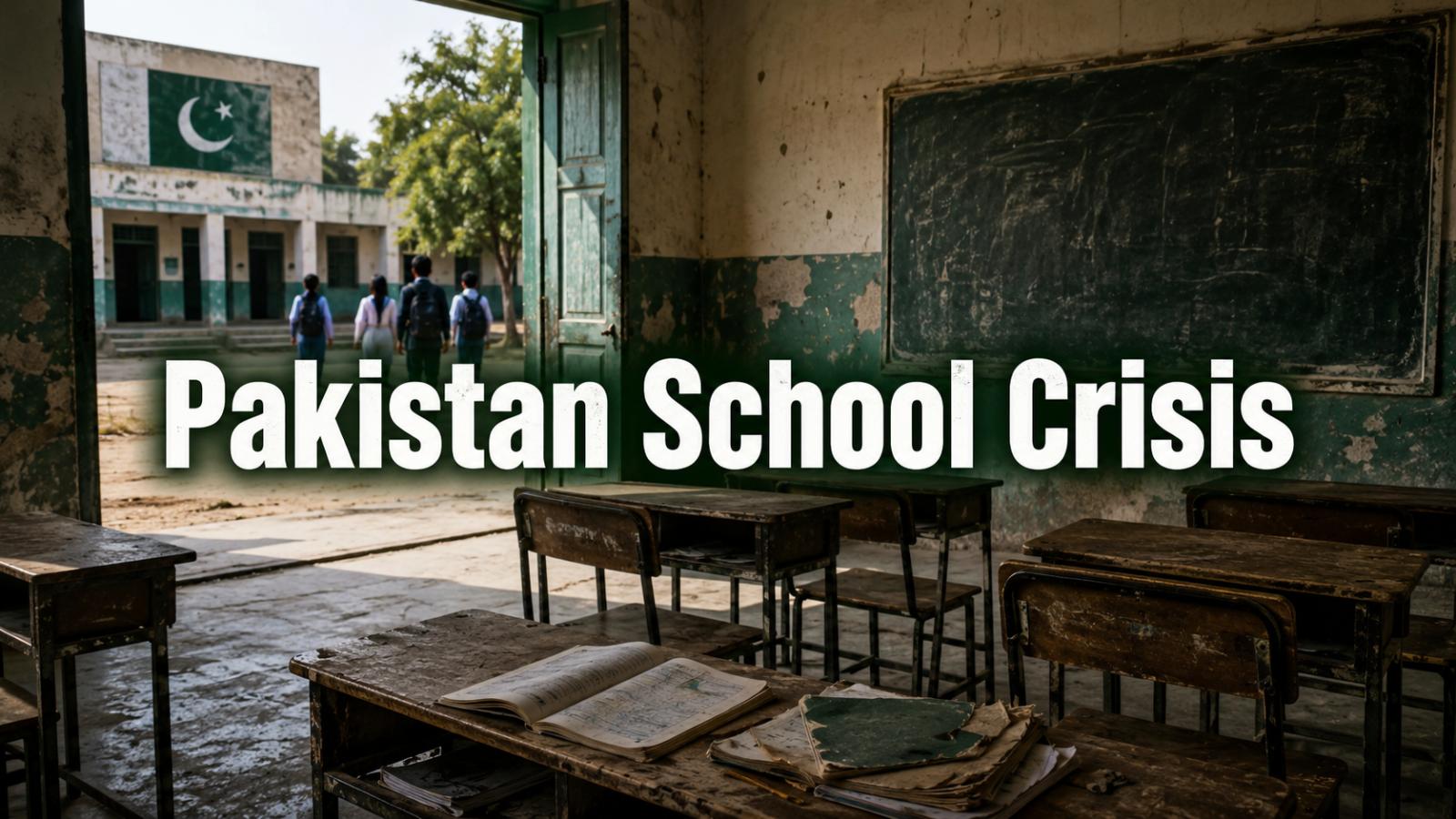
Pakistan’s school crisis continues to raise serious concern as millions of children remain outside classrooms despite the country declaring a National Education Emergency two years ago. Estimates suggest that around 25.1 million to 26 million children are still out of school, showing that the challenge is not limited to policy announcements. The larger problem lies in weak implementation, poor funding, lack of local accountability and gaps between provincial planning and ground realities.
Education emergency yet to show results
A policy review by the Civil Services Academy has pointed to weak governance, poor coordination and limited district-level responsibility as key reasons behind the slow progress. Pakistan has introduced several education plans over the years, but many schools still struggle with basic needs such as trained teachers, classrooms, safe buildings, toilets, transport and proper learning material.
Education experts have also raised concern over low public spending. Education economist Dr Faisal Bari has warned that Pakistan’s education spending has fallen below 1% of GDP, far below the 4% benchmark often recommended by international agencies. This funding gap directly affects public school quality, rural school access, teacher training and efforts to reduce the dropout rate.
Provinces face different challenges
Punjab has the largest number of out-of-school children, with estimates ranging from 9.6 million to 10.4 million. The dropout problem is especially severe in poorer districts of South Punjab, where limited access to schools and weak family income often force children to leave education early. Rajanpur, for example, has reported an out-of-school rate of nearly 48%, showing the sharp divide between developed and underdeveloped areas.
Sindh faces another serious challenge, with about 7.4 million children out of school. Many students leave after primary education because secondary schools are not easily available. Flood damage has also affected several school buildings, making learning more difficult for children from low-income families. In Sindh and Balochistan, nearly 81% to 90% of education budgets are spent on salaries, leaving very little for classrooms, repairs, books, labs, digital tools or teacher development.
Girls and disabled children remain at higher risk
Khyber-Pakhtunkhwa has around 4.9 million children out of school, with difficult geography, security concerns and shortage of female teachers adding to the problem. Balochistan faces an even deeper crisis because many schools are either too far away or not functioning. Out of 15,270 schools in the province, 3,617 have been reported as non-functional or ghost schools. Girls are the worst affected in Balochistan, making up nearly 78% of the out-of-school population.
The crisis is also more serious for children with disabilities. Dr Abdul Hameed has noted that nearly 30% of out-of-school children may have some form of disability. This highlights a major gap in inclusive education, as many public schools are not prepared with trained staff, accessible buildings or learning support for disabled children.
What reforms are needed now
Experts say Pakistan needs more than emergency slogans to fix the education crisis. The country must track every child, improve school quality, strengthen district education authorities and ensure that funds are used for real improvements. A NADRA-linked student registry using B-Form data has been recommended to identify children who are missing from the system and bring them back into schools.
Targeted support for female teachers in remote areas, more secondary schools, transparent monitoring of ghost schools and better funding for damaged school buildings are also essential. Without serious investment and honest accountability, Pakistan’s education emergency risks remaining only a promise while millions of children continue to lose their future.