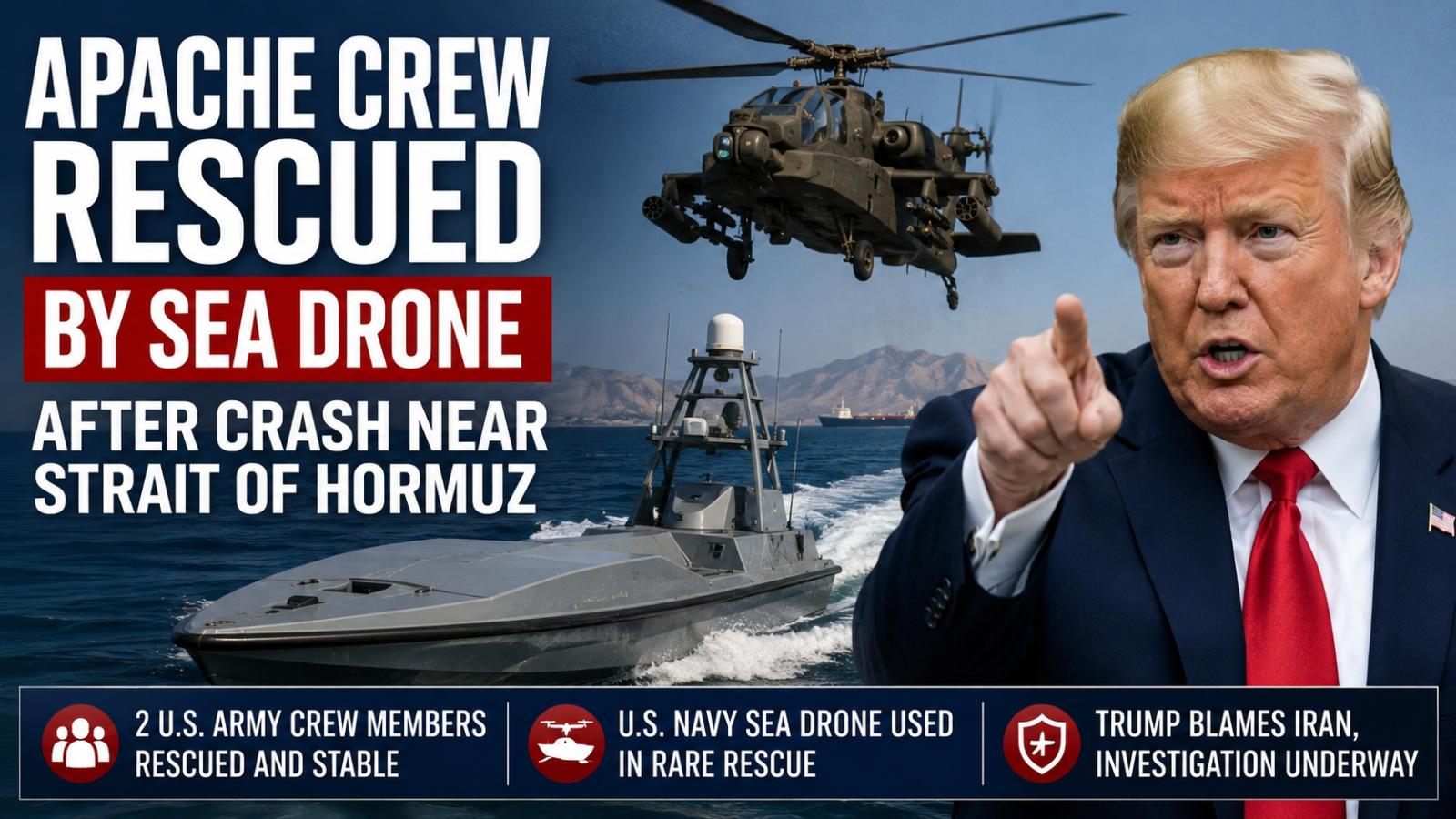
Two U.S. Army Apache crew members were rescued by a Navy sea drone after their helicopter went down near the Strait of Hormuz, a key global shipping route, U.S. officials said.
The incident occurred near the coast of Oman early Tuesday, June 9, 2026, local time, while the AH-64 Apache was operating in regional waters. Both crew members were recovered and were reported to be stable and uninjured.
U.S. Navy Sea Drone Used in Rare Rescue Operation
The rescue drew attention because a U.S. Navy unmanned surface vessel was used to retrieve the crew. The drone boat moved the service members to a safer location on the water before they were airlifted for further care.
The operation highlights the growing role of unmanned naval systems in the Middle East, where U.S. forces have been using drones and surveillance platforms to monitor maritime security threats.
Trump Blames Iran, But Crash Cause Remains Under Review
President Donald Trump said Tuesday that Iran was responsible for bringing down the Apache helicopter and said the United States “must” respond. However, U.S. Central Command did not immediately provide a confirmed cause for the crash, and the details remained under investigation.
That distinction is important because the incident comes during a tense period involving Iran, Israel and U.S. forces in the region. Any confirmed attack on a U.S. military aircraft near the Strait of Hormuz could increase pressure on Washington to respond.
Why the Strait of Hormuz Matters
The Strait of Hormuz is one of the world’s most important maritime corridors for oil and commercial shipping. Military incidents in or near the waterway can quickly raise concerns about energy prices, shipping security and wider instability across the Middle East.
For U.S. readers, the key question is whether this remains a military accident under investigation or becomes a confirmed hostile act. That answer could shape the next phase of U.S. policy in the Gulf.