Trump AI Truth Social Posts Spark Online Attention
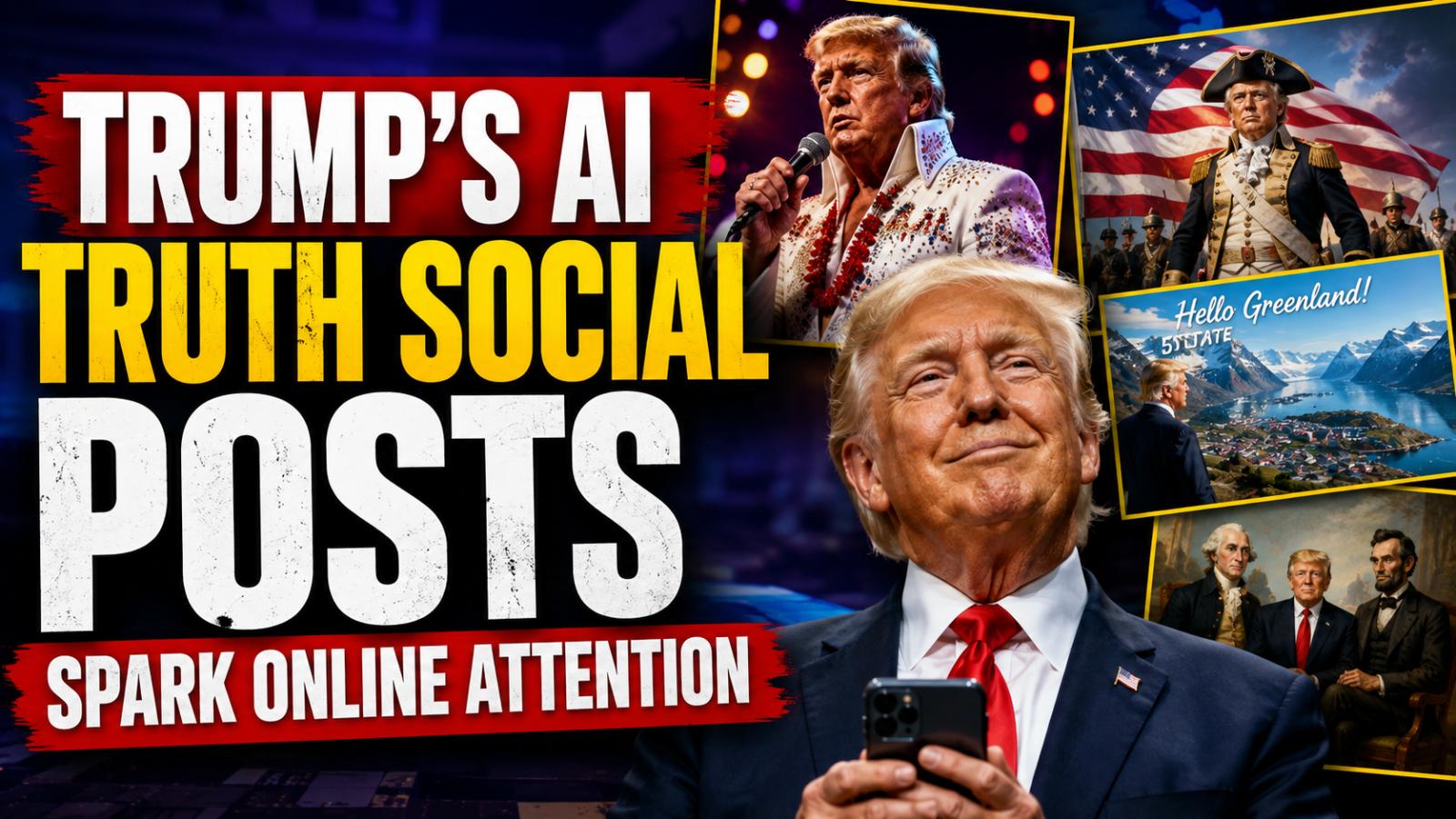
Trump AI Truth Social posts featuring Elvis Presley, American historical figures, Greenland and Venezuela attracted widespread attention over the weekend. The images blended political messaging, fantasy and personal branding while reviving debate over AI-generated content in public communication.
Truth Social Images Draw Attention
US President Donald Trump filled his Truth Social account over the weekend with a series of AI-generated and digitally altered images that presented him in historical, musical and geopolitical settings. The posts offered little explanation, relying instead on dramatic visuals designed for rapid sharing and online engagement.
One widely discussed image portrayed Trump as Elvis Presley. Wearing a white stage jumpsuit and holding a microphone under concert lights, the president appeared styled after the late music icon. Trump shared the artwork without a detailed caption, allowing followers to interpret the comparison and its focus on celebrity branding.
The posting spree formed part of a broader pattern in which Trump uses artificial intelligence imagery, memes and exaggerated visual scenarios to dominate online discussion. Recent reporting described dozens of posts appearing on his account during the weekend, many of them centred on heroic or larger-than-life versions of the president.
Trump Washington Image
Another AI-generated scene placed Trump in an eighteenth-century military uniform while leading soldiers under an American flag. The artwork resembled depictions of Revolutionary War commanders and appeared designed to connect his political identity with traditional images of national leadership.
Trump also shared an artificial image showing himself seated alongside George Washington and Abraham Lincoln. The scene placed the three figures together as though they belonged to the same historical moment, reinforcing a self-promotional theme that presented Trump among the country’s most recognisable presidents.
The images should not be treated as authentic photographs or historical records. They are political and promotional artwork, and readers may not always recognise their artificial origin when posts lack clear labels. That creates a growing challenge for social platforms, news organisations and voters trying to distinguish satire, persuasion and factual material.
Hello Greenland Post
Greenland appeared again in Trump’s online messaging through an image captioned “Hello Greenland.” The artwork showed him looking across the territory and revived attention around his repeated statements about bringing the strategically important Arctic island under greater US control.
Greenland and Denmark have consistently rejected suggestions that the territory could simply become part of the United States. Trump has nevertheless continued to use altered maps and AI imagery to promote the idea, often combining geopolitical claims with humour, provocation and internet spectacle.
Similar altered imagery involving Greenland, Canada and Venezuela has previously triggered diplomatic criticism and public responses defending national sovereignty.
Venezuela 51st State Image
Trump also shared artwork showing Venezuela covered with American flags and described as the “51st State.” The image continued his habit of using fictional territorial maps to signal political ambitions or provoke reactions without presenting a formal policy announcement.
Other posts targeted domestic political opponents and promoted Trump’s preferred image as a powerful, historic and culturally dominant figure. Together, the uploads demonstrated how AI allows political leaders to create memorable visual messages quickly, even when the scenarios are impossible or deliberately exaggerated.
The posts generated attention because they combined familiar figures, territorial disputes and personal mythology in a format built for social-media circulation. They also showed the opportunity cost of spectacle-driven political communication: dramatic images may dominate public attention while offering little clarity about actual policy.