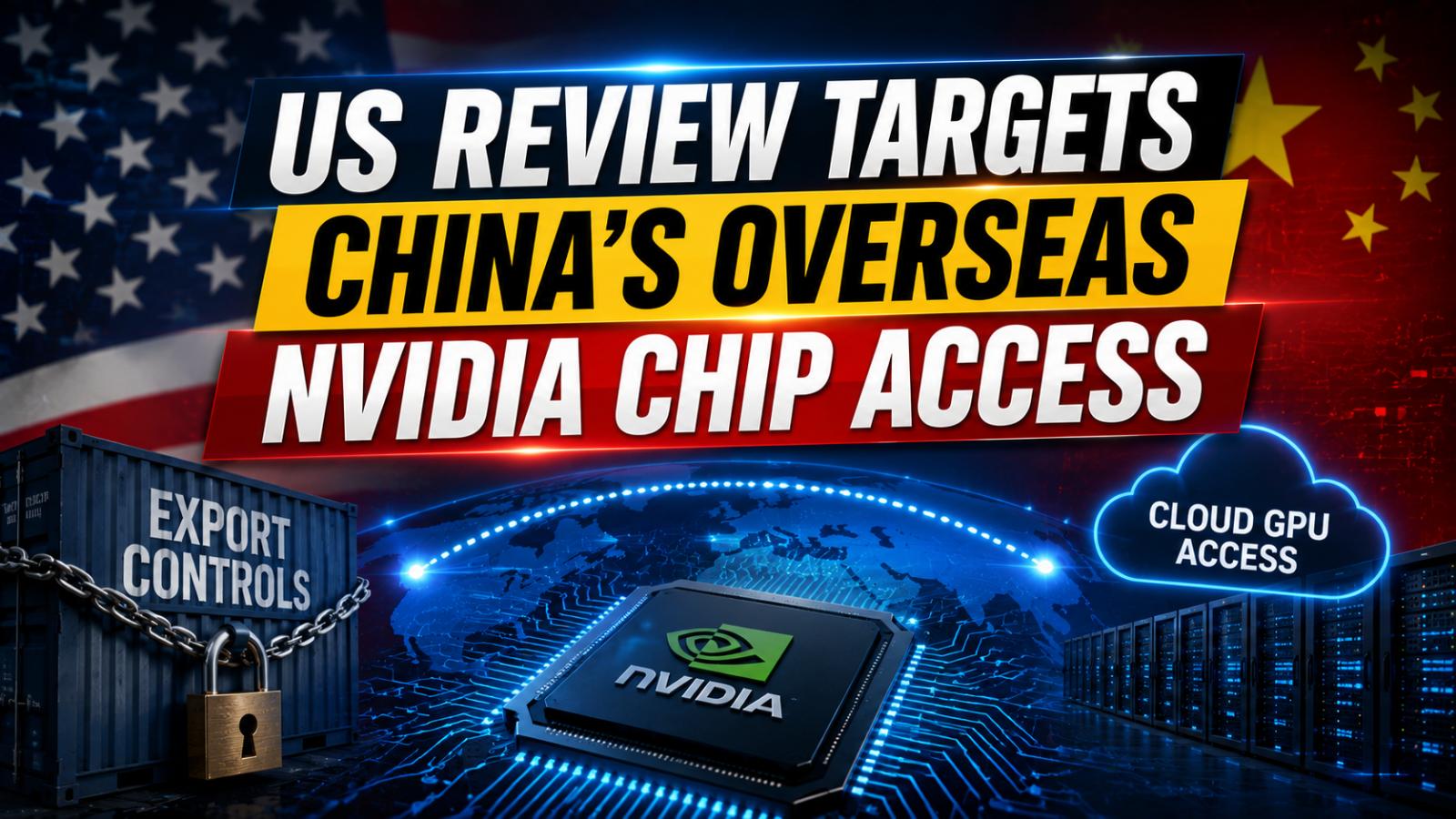
The United States is examining how Chinese artificial intelligence companies gain access to advanced Nvidia chips outside China, putting a new focus on cloud GPU use and overseas data centres. The US AI chip review highlights a growing challenge for export controls built mainly around physical hardware shipments.
China GPU use shifts beyond physical chip exports
The Bureau of Industry and Security is reviewing how Chinese AI companies acquire or remotely access advanced Nvidia computing capacity overseas. Reports on the review indicate that officials are studying both physical diversion of restricted hardware and arrangements in which Chinese firms rent computing power from data centres located in other countries.
The distinction matters because traditional export controls are easier to apply when a restricted chip physically crosses a border. Remote access creates a more difficult enforcement question because the processor can remain inside an overseas data centre while a customer accesses its computing power through the internet.
BIS has already warned companies about the risks of allowing advanced US AI chips to support training or inference for Chinese AI models and has issued guidance focused on diversion and supply-chain risks.
BIS chip review examines offshore compute access
The current BIS chip review comes as Chinese laboratories continue to demonstrate increasingly large and capable AI systems despite years of US semiconductor restrictions.
Moonshot AI's Kimi K3 illustrates the scale involved. The company describes Kimi K3 as a 2.8-trillion-parameter mixture-of-experts model with a one-million-token context window and released its full model weights in July.
Alibaba's Qwen team has also introduced Qwen3.8-Max, which it says scales to 2.4 trillion parameters and targets coding, research and long-duration agentic work.
ByteDance is separately reported to be developing a model with as many as 10 trillion parameters, although the company has not publicly confirmed the reported specifications.
Those developments do not by themselves prove violations of US export rules. They do, however, intensify questions about where Chinese AI developers obtain the computing capacity required to train frontier-scale systems.
Cloud GPU use exposes an export-control gap
Cloud GPU use creates a regulatory problem that physical export rules were not originally designed to solve. A company can potentially rent servers containing advanced processors in another country without buying those chips or transporting them into China.
Previous reporting has documented Chinese engineers using rented Nvidia hardware in overseas data centres, including facilities in Southeast Asia. That illustrates how compute can increasingly function as an international service rather than a product that must physically cross a customs checkpoint.
Any attempt to restrict that model could require cloud operators to conduct stronger customer checks, monitor ownership structures and determine whether remote computing services fall within future export-control requirements.
Nvidia access remains central to US-China AI competition
Nvidia remains caught between national-security restrictions and commercial demand for its processors. The company has previously argued that limiting access to American chips can encourage Chinese customers to accelerate development of domestic alternatives. Nvidia has also repeatedly developed products designed to comply with changing US export requirements.
US policy has continued to evolve. In January 2026, BIS revised its licensing approach for certain semiconductor exports to China, allowing applications involving Nvidia H200, AMD MI325X and comparable chips to receive case-by-case review when specified security conditions are met.
The latest review therefore signals a broader shift in the technology contest. Washington is no longer looking only at who can buy an advanced AI chip. It is increasingly confronting the harder question of who can use one remotely.
That difference could shape the next phase of US-China AI controls. Restricting shipments is difficult but measurable. Regulating global access to computing power would require oversight of cloud infrastructure, customers and data-centre relationships across multiple jurisdictions, making enforcement far more complicated.