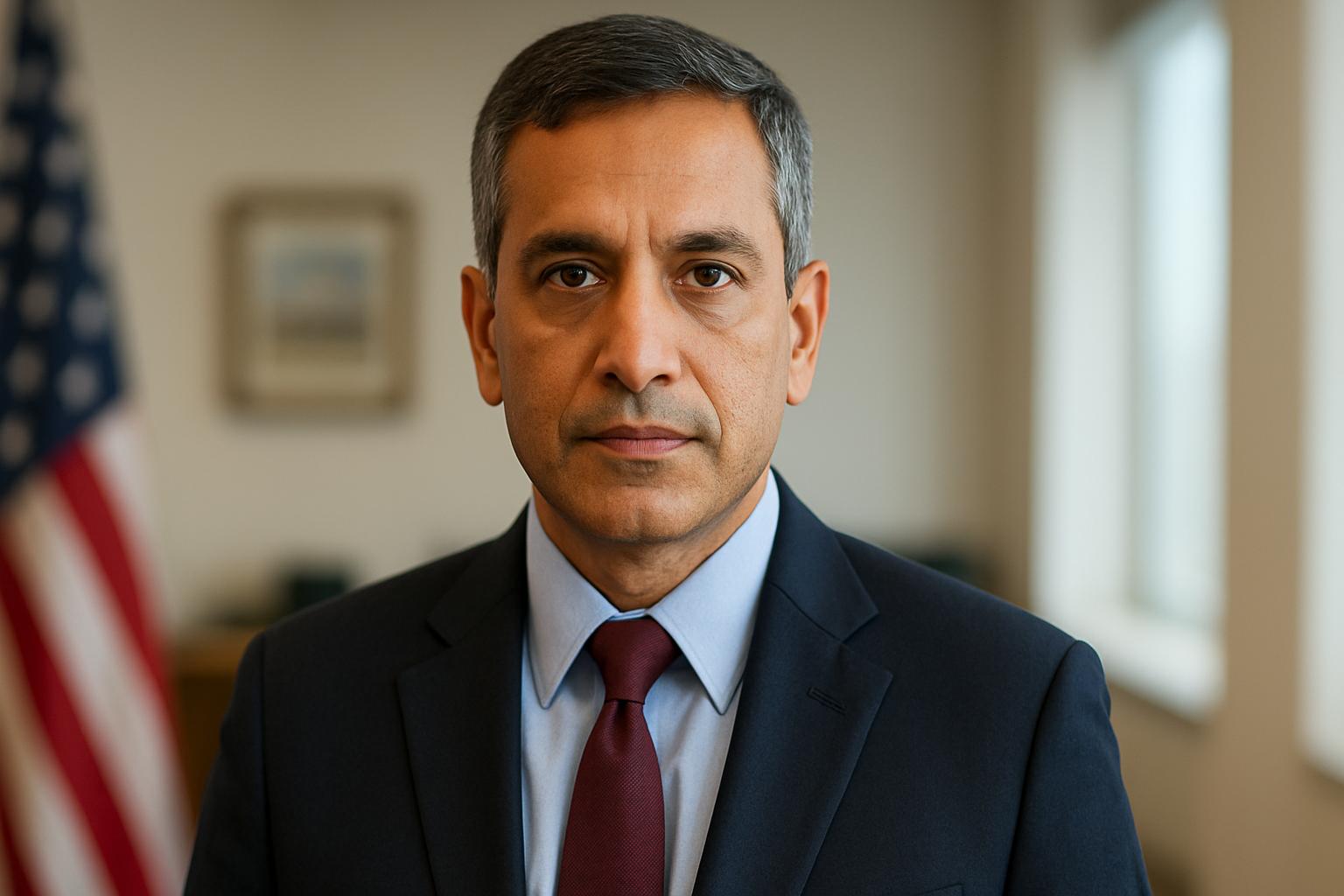
Paul Kapur, a noted American academic and expert on South Asian security, has been appointed as the new Assistant Secretary of State for South and Central Asia in the United States government. Known for his hardline stance against Pakistan’s military establishment, Kapur’s appointment marks a significant shift in Washington’s regional approach, especially amid renewed tensions in South Asia. His selection comes as the US seeks to redefine its engagement with both India and Pakistan while maintaining strategic balance in the Indo-Pacific region.
Kapur’s scholarly work and public statements over the years have consistently reflected a deep skepticism toward Pakistan’s security doctrine and its handling of terrorism. In his widely cited book Dangerous Deterrent (2007), he argued that Pakistan’s nuclear weapons, rather than serving as a deterrent, have emboldened its military to pursue an aggressive and revisionist strategy. He maintained that the doctrine of “minimum credible deterrence” was less about defense and more a cover for offensive maneuvers, contributing to instability across the subcontinent.
According to Kapur, Pakistan’s military has historically used its nuclear arsenal as a shield behind which it sponsors terrorist activities, particularly in Kashmir. He has often referred to Pakistan’s military establishment as a “revisionist actor,” claiming it thrives on perpetual conflict and undermines peace efforts in the region. Kapur has also been vocal about the dangers posed by Pakistan’s “first-use” nuclear policy, describing it as a trigger for potential escalation that threatens South Asia’s stability.
In a 2019 testimony before the US Congress, Kapur warned that Pakistan’s military was employing terror groups to challenge India’s sovereignty. He urged Washington to make all aid conditional on Pakistan dismantling such networks, calling the country’s intelligence agency, the ISI, a “state within a state” that perpetuates global jihadism. He further argued that continued US assistance without accountability amounted to “strategic malpractice,” as it indirectly supported terrorism under the guise of maintaining stability.
Kapur’s stance has remained firm across various platforms. In a 2021 policy essay, he described Pakistan as a “nuclear-armed failing state,” accusing its military elites of creating cycles of instability to sustain their political dominance. His comments in the 2023–24 War on the Rocks podcast echoed similar views, as he condemned Pakistan’s denial of involvement in cross-border attacks and called for greater international pressure to curb its military’s influence.
Beyond criticism, Kapur has often praised India’s democratic resilience and strategic restraint. He contrasts India’s nuclear doctrine, which emphasizes no-first-use and controlled deterrence, with Pakistan’s rapid weapons expansion and tactical arsenal. He has cautioned that Pakistan’s “full-spectrum deterrence” approach is reckless, heightening the risk of miscalculation and conflict in the region.
On social media, Kapur has repeatedly criticized Pakistan’s internal political structure, calling its democracy a “façade controlled by the military.” He has linked the country’s domestic instability to its external aggression, arguing that internal unrest and militant sponsorship are part of the same cycle that undermines regional peace.
Paul Kapur brings a rich background to his new role. He is a Professor of National Security Affairs at the US Naval Postgraduate School and a Senior Fellow at the Center for a New American Security. He is also affiliated with the Stimson Center as a non-resident fellow. Born in New Delhi to an Indian father and an American mother, Kapur studied at Amherst College before completing his PhD in Political Science. His research and writing have shaped policy debates on South Asia for nearly two decades, particularly in the fields of nuclear deterrence, terrorism, and regional diplomacy.
As he steps into his new role at the State Department, observers believe Kapur’s appointment signals a more assertive American stance toward Islamabad. His record suggests a policy framework that prioritizes counterterrorism cooperation with India and holds Pakistan accountable for its actions. Analysts say this could reshape the contours of US engagement in South Asia, steering Washington closer to New Delhi on strategic, defense, and technology fronts while maintaining diplomatic pressure on Pakistan’s military establishment.