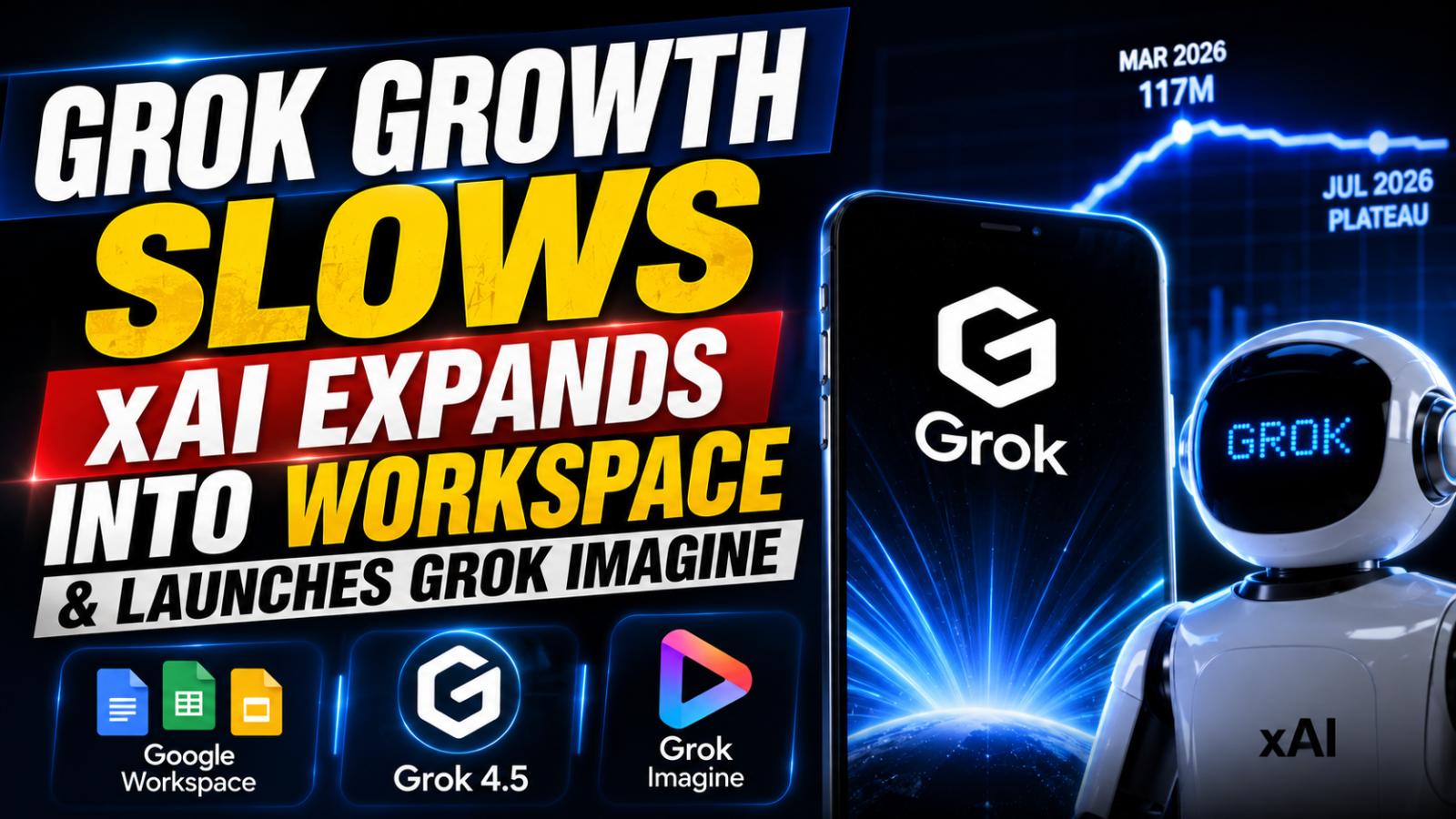
Grok user growth accelerated sharply in early 2026, reaching about 117 million monthly active users by March. As traffic momentum later cooled, xAI began expanding beyond model benchmarks through Grok 4.5, Google Workspace tools and Grok Imagine.
Grok user growth loses early momentum
Grok’s audience expanded from roughly 35 million monthly active users in December 2025 to about 117 million by March 2026, according to figures attributed to SpaceX’s public filing. The increase reflected Grok’s availability across X, its standalone website and mobile applications rather than growth from one product alone.
Later traffic indicators suggest that the pace became less dramatic. Third-party estimates recorded about 244.8 million visits to Grok’s website in May, down more than 12% from the previous month. Separate app-market data indicated that Grok’s US chatbot share surged earlier in the year before settling at a lower level during spring. These figures point to slower momentum, but they do not prove that Grok’s full monthly active user count stopped growing.
That distinction matters because web traffic, app market share and monthly active users measure different parts of the product. Grok can lose website visits while still gaining users through X, mobile apps or workplace integrations.
Related AI Coverage
Grok's expansion comes as AI companies compete on pricing, model quality, regulation and global adoption. Read our coverage of Claude Opus 5 pricing and features, Kimi K3's open-weight release, Chinese AI models gaining ground with US companies, Anthropic's SpaceX compute partnership, and the EU AI Act transparency rules.
Grok 4.5 strengthens xAI’s model offering
xAI released Grok 4.5 through its API on July 8 and published its broader product announcement on July 16. The company describes it as its strongest model for coding, agentic work and professional knowledge tasks, with pricing of $2 per million input tokens and $6 per million output tokens.
Artificial Analysis gives Grok 4.5 a score of 54 on its Intelligence Index. That places it among frontier-level systems, although models such as GPT-5.6 Sol have recorded higher scores in the same independent evaluation. Benchmark positions can change as new models arrive and testing methods evolve, so xAI cannot depend on rankings alone to maintain consumer growth.
The larger challenge is turning model capability into regular use. A powerful model may attract attention at launch, but sustained growth usually depends on whether people use it repeatedly for work, communication, research or creative tasks.
Workspace AI opens a new distribution channel
xAI has expanded Grok into Google Workspace through a free official add-on for Docs, Sheets and Slides. Users can install it once and access Grok within all three applications, according to xAI’s product announcement and the Google Workspace Marketplace listing.
Inside Sheets, Grok can help analyze data, create formulas and build charts. In Docs, it can draft, rewrite and polish content. The Slides integration can help develop presentations and insert generated images without requiring users to leave their active files.
This approach places Grok inside tools that businesses, students and professionals already use. It also puts xAI’s assistant directly inside Google’s productivity ecosystem, where it competes with Gemini while benefiting from Google Workspace’s large installed base.
Grok Imagine expands creative AI tools
Grok Imagine gives xAI another route beyond text-based assistance. Grok’s official product pages and mobile listings now promote image and video generation as part of the assistant’s core experience. Elon Musk has also shared Grok Imagine clips publicly and promoted plans for longer AI-generated video projects.
Creative tools can increase engagement because users may return more often to generate visual content than they do for occasional factual questions. However, the long-term impact will depend on output quality, reliability, safety controls and whether xAI can convert curiosity into repeated use.
xAI expansion tests Grok’s staying power
Grok’s early rise gave xAI a large audience, but the next stage will be more difficult. The product now competes with ChatGPT, Gemini, Claude and lower-cost Chinese models across consumer, enterprise and developer markets.
The Google Workspace add-on, Grok 4.5 and Grok Imagine show that xAI is responding by expanding distribution rather than waiting for another launch-driven surge. That strategy could restart growth by making Grok useful in more daily workflows.
The real test is retention. If users continue opening Grok after the novelty fades, xAI will have built a durable AI platform. If activity remains tied mainly to launches and social-media attention, the company may need a stronger product advantage to justify continued spending on models and infrastructure.