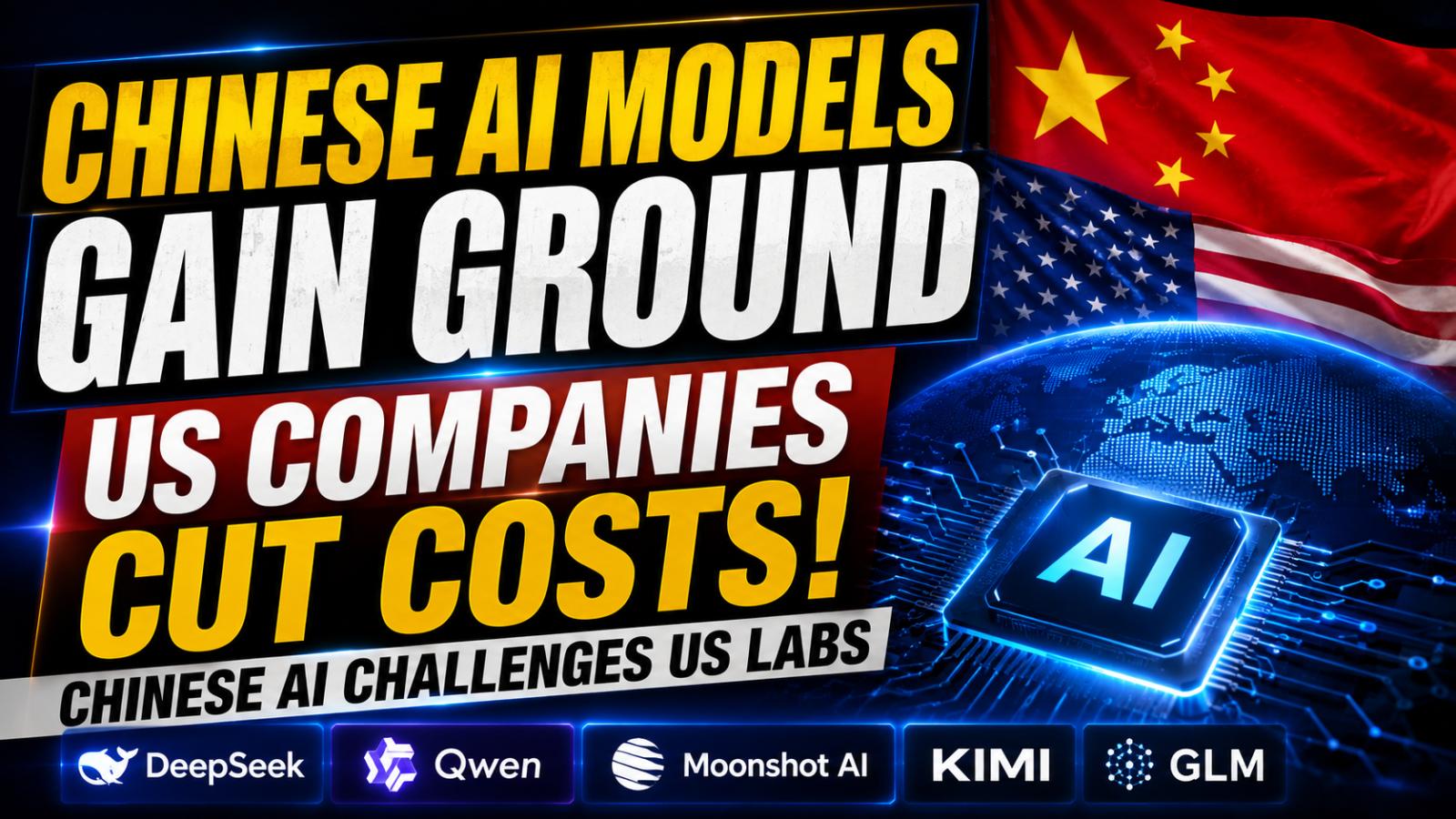
Chinese AI models are gaining ground in the United States as competitive performance, lower prices and open access attract developers and major companies. Qwen, Kimi, GLM and DeepSeek are no longer viewed only as cheaper alternatives; they are becoming part of real production systems.
Chinese AI models climb usage rankings
The US-China AI race was once framed around whether Chinese laboratories could close the gap with American frontier developers. By mid-July 2026, usage trends suggested that the market had become far more competitive.
At one point during the month, models from Tencent, Xiaomi, DeepSeek, MiniMax, Moonshot AI and Z.ai occupied six of the 10 most-used positions on OpenRouter, including the top five. OpenRouter is a platform through which developers access models from different providers, so the ranking reflects developer activity rather than a definitive measure of intelligence.
China’s broader AI market now includes Alibaba’s Qwen, Moonshot’s Kimi, DeepSeek, ByteDance’s Doubao, Zhipu AI’s GLM and Baidu’s ERNIE. These companies compete across reasoning, coding, multimodal tasks and enterprise deployment instead of following one national leader.
```htmlRelated AI Coverage
Chinese AI models are gaining users as the global market shifts on pricing, regulation and computing power. Read more about Kimi K3’s open-weight release, Claude Opus 5 pricing and features, the Anthropic–SpaceX computing agreement, and the EU AI Act transparency rules.
AI price war changes buying decisions
Price has become one of the strongest advantages for Chinese AI models. Many are distributed through open or open-weight releases, while their hosted services often charge less than leading American platforms.
This difference matters because businesses run millions or billions of tokens through AI systems. A model that performs slightly below the market leader may still be more attractive when it costs far less and handles the required task reliably.
Chinese providers are therefore competing on a combination of capability, affordability and deployment freedom. Recent industry analysis shows that US developers increasingly view models from Moonshot, Alibaba, Z.ai and DeepSeek as practical tools rather than experimental alternatives.
Qwen adoption reaches Airbnb operations
Airbnb CEO Brian Chesky has said the company relies heavily on Alibaba’s Qwen models in its AI-powered customer-service system. Airbnb uses several AI models, but Chesky described Qwen as effective, fast and affordable.
The company reported that its AI customer-service agent helped reduce average resolution times from nearly three hours to seconds in supported cases. That does not mean Qwen alone delivered the improvement, since Airbnb’s system combines multiple models and internal tools. Still, its use by a major US travel company demonstrates growing enterprise confidence in Chinese technology.
Kimi coding supports Cursor Composer
Chinese AI models are also influencing American software-development products. Cursor’s technical report for Composer 2 states that the coding model began with continued pretraining on Moonshot AI’s open Kimi K2.5 base model before Cursor applied its own training and reinforcement-learning process.
That distinction is important. Composer 2 is not simply a renamed Kimi model; Cursor developed a specialized coding system using Kimi K2.5 as its foundation and added training designed for agentic software engineering.
The example highlights the wider commercial value of open-weight releases. A US company can start with a Chinese foundation model and build a product tailored to its own users instead of training an entire model from the beginning.
GLM savings highlight growing pressure
Coinbase CEO Brian Armstrong said the company reduced its AI spending by moving more employee usage toward lower-cost models, including Kimi and Z.ai’s GLM systems. Reports describing the change said the company cut related spending by about half while continuing to give engineers access to several AI tools.
The shift does not prove that Chinese models have surpassed every American frontier system. Leading US models may still perform better across some complex or general-purpose tasks. However, businesses usually choose technology based on cost, reliability, speed and task-specific results rather than nationality or headline benchmark scores.
Washington’s scrutiny adds political risk to that calculation. US officials have accused Moonshot of using unauthorized model distillation while developing Kimi K3, an allegation Moonshot denies. Officials have also discussed sanctions if intellectual-property violations are established, but the public claims have not yet produced a final legal finding.
The AI race has therefore moved beyond a simple question of which country owns the strongest model. Chinese laboratories now influence pricing, open-model development and enterprise purchasing decisions. For American AI companies, the challenge is no longer merely preventing China from catching up. It is proving that premium prices remain justified as capable, cheaper alternatives win real users.