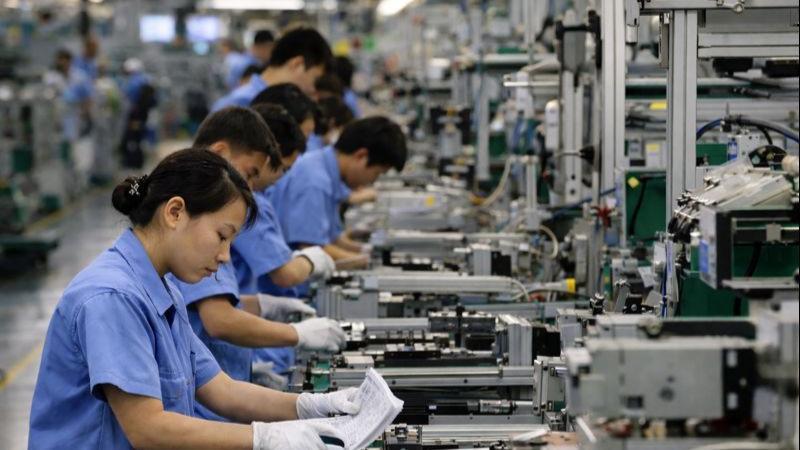
China’s manufacturing success was attributed to cheap labour. That perception has now changed completely. Factory wages in China have climbed close to eight dollars per hour, far higher than those in Vietnam, Malaysia, Thailand, and India. By cost logic alone, China should have lost its position as the world’s manufacturing hub. Instead, it continues to dominate global production, contributing nearly 28 percent of worldwide manufacturing output. The reason lies not in wages, but in productivity, efficiency, and a deeply integrated industrial ecosystem.
While workers in lower-cost countries earn less, they also produce less in the same time. Chinese factories consistently deliver higher output per worker, better quality consistency, and faster execution. For global companies, total production cost matters more than hourly wages. A cheaper workforce that delivers slower results often ends up being more expensive. China’s heavy investment in automation, robotics, digital systems, and skilled training has ensured that its factories operate with speed and precision that few nations can match.
China’s biggest advantage is not labour but integration. Raw material suppliers, component makers, assembly plants, logistics hubs, and ports operate in close geographic coordination. This allows rapid sourcing, fast scaling, and immediate problem solving. Shifting even one segment of this chain to another country often disrupts production timelines, quality, and costs. Rebuilding such an ecosystem elsewhere would require decades of investment, infrastructure, and supplier relationships. For most manufacturers, the hidden costs of relocation outweigh savings from cheaper wages.
China has also improved ease of doing business through regulatory reforms, faster trade processes, and reliable utilities. Its domestic market, logistics strength, and innovation culture further enhance its appeal. Products can be designed, tested, modified, and mass-produced within weeks. Very few countries offer this level of industrial diversity and coordination. While risks such as intellectual property concerns and rising compliance costs remain, China’s manufacturing maturity continues to make it difficult to replace.
China’s dominance today is not built on cheap labour, but on productivity, scale, and industrial depth. Lower-cost nations may attract limited assembly work, but replacing China entirely would require rebuilding an ecosystem that took decades to form. That is why, even with rising wages, China remains the world’s factory.