High-level diplomatic engagement in New Delhi
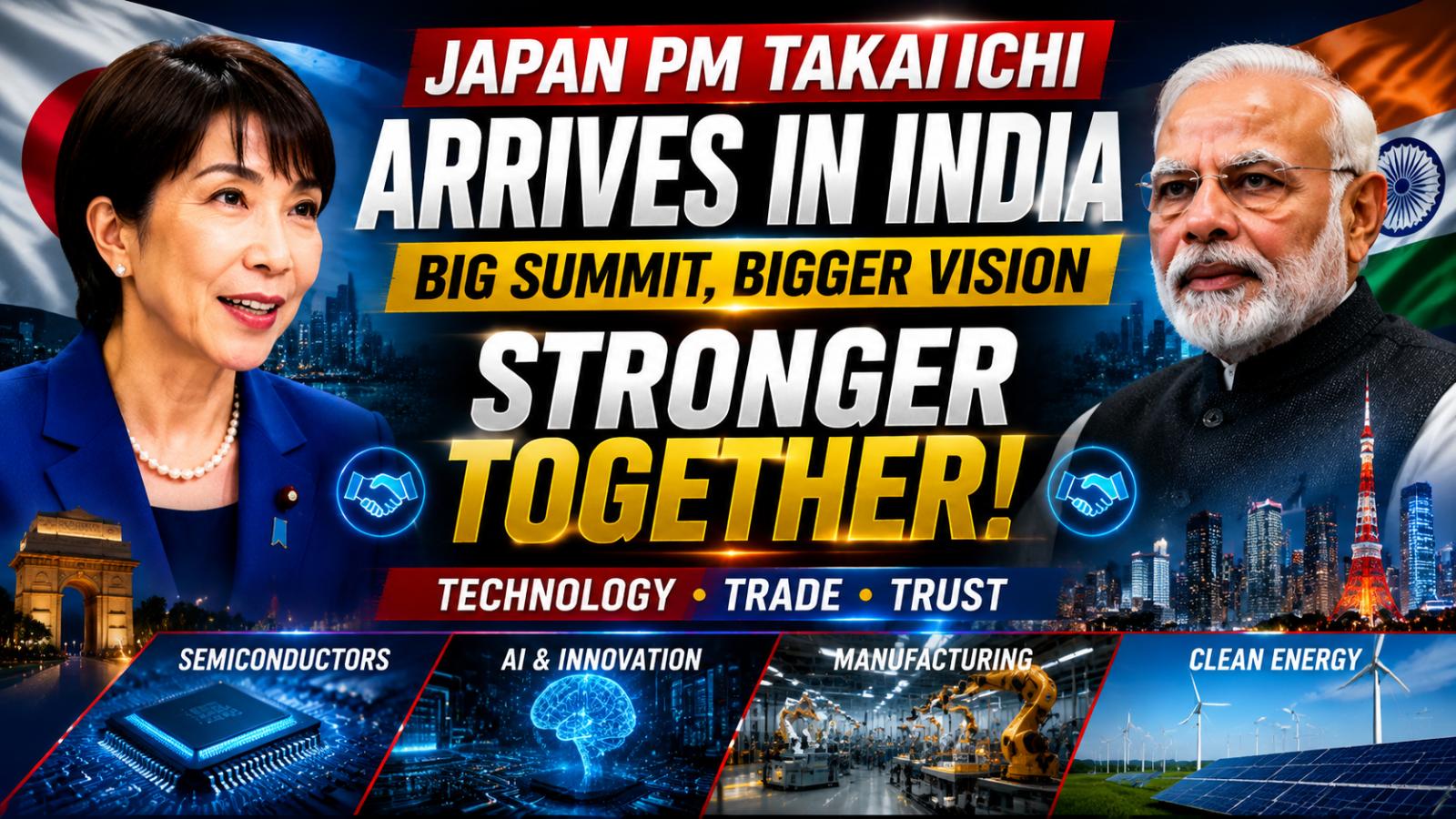
Japanese Prime Minister Sanae Takaichi will arrive in India on July 1,2026 for the 16th India-Japan Annual Summit at the invitation of Prime Minister Narendra Modi. The visit marks her first official trip to India since taking office in 2025 and comes at a time when both nations are seeking to strengthen strategic and economic alignment in a rapidly changing global environment.
The summit follows Prime Minister Modi’s visit to Tokyo last year for the 15th edition of the bilateral meeting, reinforcing the continuity of high-level engagement between the two countries. Both sides are expected to review progress in key sectors while setting a roadmap for deeper cooperation in technology, manufacturing and economic security.
Focus on economic and industrial partnership
India and Japan are looking to expand their economic partnership as global supply chains undergo significant restructuring. Japan brings advanced capabilities in robotics, precision engineering, semiconductors and green technologies, while India contributes a large consumer market, strong engineering talent and a rapidly expanding manufacturing ecosystem.
Japan’s demographic challenges, including an ageing workforce, are pushing companies to seek reliable production bases abroad. India’s growing industrial ambition and policy focus on manufacturing make it a natural partner in this transition. For India, collaboration with Japan supports its long-term goal of becoming a global production hub while maintaining high growth momentum driven by domestic demand.
Strategic sectors shaping future cooperation
The summit is expected to prioritise semiconductors, artificial intelligence, critical minerals, renewable energy, defence cooperation and infrastructure development. Semiconductor collaboration is likely to receive special attention as both countries aim to reduce dependence on concentrated global supply chains. Japan’s strength in chip equipment and materials complements India’s expanding manufacturing incentives and technical workforce.
Artificial intelligence is also emerging as a key area of cooperation, with both countries exploring opportunities in innovation, standards development and digital governance. In addition, clean energy technologies, including hydrogen and electric mobility, are expected to feature in discussions as both sides work toward long-term sustainability goals.
Strong corporate participation and investment outlook
A major highlight of the visit is the presence of a high-level business delegation accompanying the Japanese Prime Minister. More than 50 companies and organisations will participate, including Suzuki Motor Corporation, Itochu Corporation, Toyota Tsusho and firms from semiconductor, infrastructure and green technology sectors.
Suzuki’s involvement is significant due to its long-standing operations in India through its partnership in the automotive sector. Japanese firms are also exploring India as a manufacturing base for hybrid and electric vehicles aimed at export markets in Africa and Southeast Asia.
Expanding infrastructure and technology cooperation
Infrastructure continues to be a cornerstone of bilateral cooperation, with Japanese companies supporting major transport and industrial projects in India. Advanced initiatives such as high-voltage transmission systems for renewable energy highlight the growing technical depth of the partnership.
The summit is expected to conclude with several memorandums of understanding aimed at expanding investment, technology sharing and industrial collaboration. As both governments align policy priorities, the visit is likely to strengthen one of the Indo-Pacific region’s most important strategic and economic partnerships.