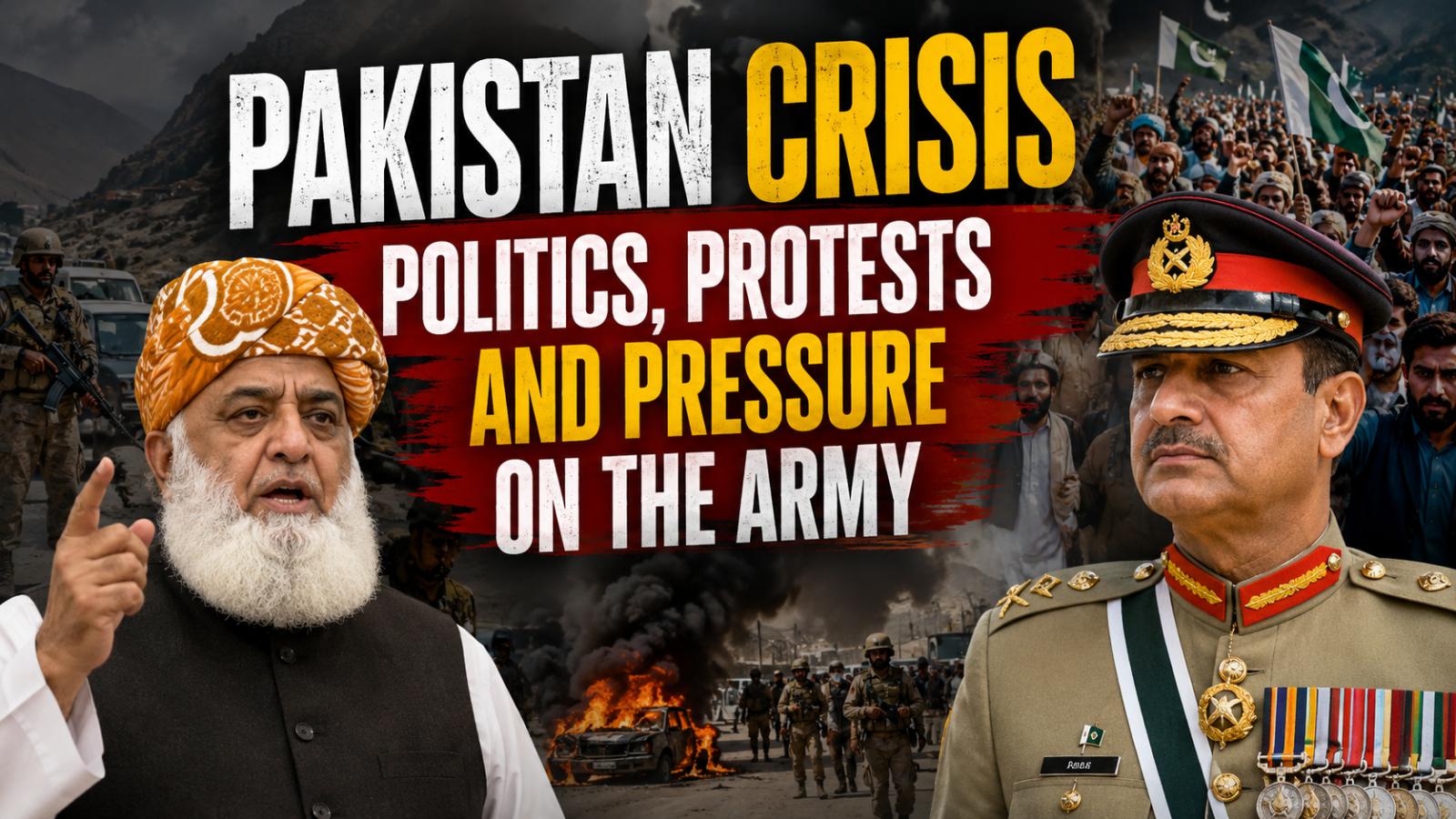
Pakistan’s worsening security crisis has triggered unusually sharp criticism of the military from Jamiat Ulema-e-Islam chief Maulana Fazlur Rehman. His remarks came as authorities confronted deadly militant attacks in Balochistan and renewed protests in Pakistan-administered Kashmir.
Fazlur Rehman questions Pakistan Army’s political role
Speaking at a public gathering in Punjab, Fazlur Rehman claimed that government authority had weakened across parts of Balochistan and the Pashtun belt. He said protecting the country was the responsibility of the armed forces rather than unarmed citizens.
Rehman also criticised what he described as military involvement in politics. He challenged serving officers interested in political power to leave the armed forces and contest elections, arguing that an electoral test would reveal their actual public support.
His comments were directed at Pakistan’s military establishment but did not provide independent evidence that the government had completely lost control of Balochistan. The remarks should therefore be understood as a political leader’s assessment rather than an official determination.
Balochistan violence raises security concerns
The criticism followed a series of militant attacks in Balochistan in early July. Pakistan’s military said insurgents killed 18 police officers who had been abducted after an attack on a police post. Eleven soldiers were also killed in a separate highway ambush. Officials said the attacks formed part of three major incidents that killed 42 people, most of them police and military personnel.
Security forces subsequently launched a large counter-insurgency operation involving the army, police and Frontier Corps. Pakistani officials said the number of militants killed in the operation had reached 114 by July 14. The figure came from security authorities and has not been independently verified.
Prime Minister Shehbaz Sharif travelled to Quetta and chaired a security meeting attended by senior civil and military officials, including Field Marshal Asim Munir and Balochistan Chief Minister Sarfraz Bugti. Sharif promised to continue operations against militant groups and accused fighters of using Afghan territory for cross-border attacks. Afghanistan has repeatedly denied sheltering groups attacking Pakistan.
Pakistan-administered Kashmir protests continue
Pakistan’s leadership is also facing unrest in Pakistan-administered Kashmir, where the Joint Awami Action Committee has led demonstrations over political representation, economic problems and civil rights.
The current dispute includes opposition to 12 legislative seats reserved for Kashmiri refugees living in Pakistan. Protests and security crackdowns in June reportedly left at least 24 people dead, including civilians and police officers, while hundreds were detained.
JAAC representatives announced plans for a long march from Rawalakot towards Muzaffarabad on July 15 if their demands were not addressed. The regional government has offered negotiations but maintains that some demands involving constitutionally protected seats require legislative or constitutional action.
Political criticism adds pressure on Asim Munir
Rehman’s intervention adds a political dimension to Pakistan’s security problems. His criticism suggests growing opposition concern over military influence, militant violence and the government’s ability to restore public confidence.
However, claims that Pakistan is close to breaking apart go beyond the available verified evidence. The country is facing serious and simultaneous pressures, but the eventual impact will depend on the security response, political dialogue and whether authorities address the grievances driving protests in Balochistan, the Pashtun belt and Pakistan-administered Kashmir.