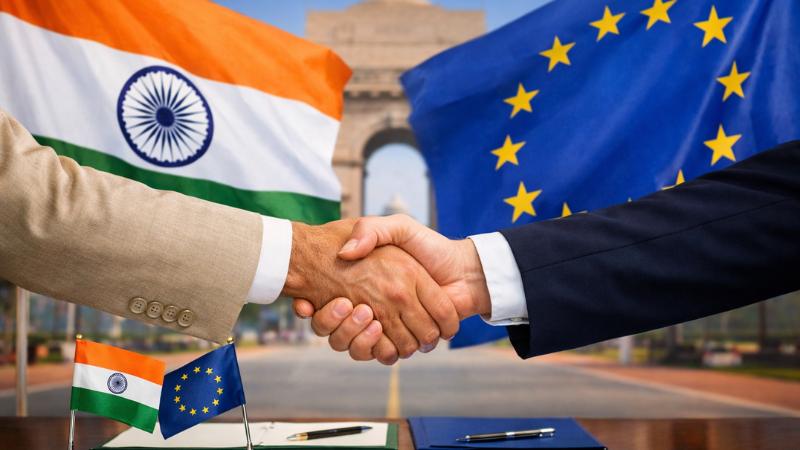
India and the European Union are set to announce the conclusion of negotiations on a long-awaited free trade agreement during a high-level summit in New Delhi on January 27. Senior leaders from both sides are expected to participate in the meeting, which will focus on trade liberalisation, security cooperation and mobility arrangements for students and professionals. The conclusion of the talks marks a significant moment in bilateral relations, reflecting renewed political momentum after years of intermittent progress.
Officials involved in the process have indicated that the agreement is designed to be balanced and forward-looking, aligning with the long-term economic interests of both partners. While the pact is expected to boost trade volumes, policymakers see it as a qualitative shift in India–EU engagement, strengthening cooperation across manufacturing, services, technology and sustainable development. The timing is notable, as global trade flows continue to face uncertainty amid rising tariff barriers and geopolitical tensions.
Economic experts have described the agreement as a landmark step that could reshape commercial ties between the two economies. They point to strong complementarities, with India offering a large and growing market and the European Union bringing advanced technology, investment capacity and diversified demand. The efficient exchange of goods and services under the agreement is expected to enhance supply chains and open new opportunities for businesses on both sides.
From India’s perspective, the trade pact reflects a strategic effort to deepen integration with major global partners while safeguarding domestic priorities. Officials confirmed that negotiations have been completed and that the agreement is undergoing final legal review. The remaining procedural steps are expected to be completed soon, paving the way for formal signing and implementation.
The announcement has drawn international attention, including criticism from some quarters in the United States. A senior US official recently expressed concern over the deal, linking it to broader disputes over energy trade and tariffs. The remarks underscored differing approaches to trade policy and highlighted how the India–EU agreement fits into a complex global economic landscape shaped by competing interests and sanctions regimes.
The summit in New Delhi is also expected to mark progress beyond trade. Leaders are likely to finalise a Security and Defence Partnership aimed at enhancing strategic coordination, as well as a framework to facilitate mobility for Indian students and professionals seeking opportunities in Europe. These initiatives reflect a broader effort to strengthen people-to-people ties and cooperation in emerging areas of mutual interest.
Negotiations for an India–EU free trade agreement first began in 2007 but were suspended in 2013 due to differences over ambition and market access. The process was revived in 2022, following renewed political commitment on both sides to address outstanding issues and adapt the talks to changing global conditions.
The European Union remains India’s largest trading partner, accounting for a significant share of the country’s total trade in goods and services. With the conclusion of the free trade negotiations, both sides are positioning the agreement as a cornerstone of their economic relationship, one that could provide stability and growth amid an evolving global trade environment.


 Joyful
0%
Joyful
0%
 Cool
0%
Cool
0%
 Thrilled
0%
Thrilled
0%
 Upset
0%
Upset
0%
 Unhappy
0%
Unhappy
0%