The United States Supreme Court on Friday struck down a series of broad tariffs imposed by President Donald Trump, ruling that the administration had exceeded its authority under federal law. In a closely watched 6–3 decision, the court determined that the International Emergency Economic Powers Act does not authorize the president to unilaterally impose sweeping duties on foreign imports, a finding that could have significant implications for future trade policy and executive power.
The ruling addressed the legal limits of presidential authority under the IEEPA, a statute historically used to regulate economic activity during national emergencies. Writing for the majority, the court concluded that the law does not grant the executive branch the expansive tariff powers claimed by the administration. The decision effectively invalidates the contested measures and reinforces congressional oversight over major trade actions.
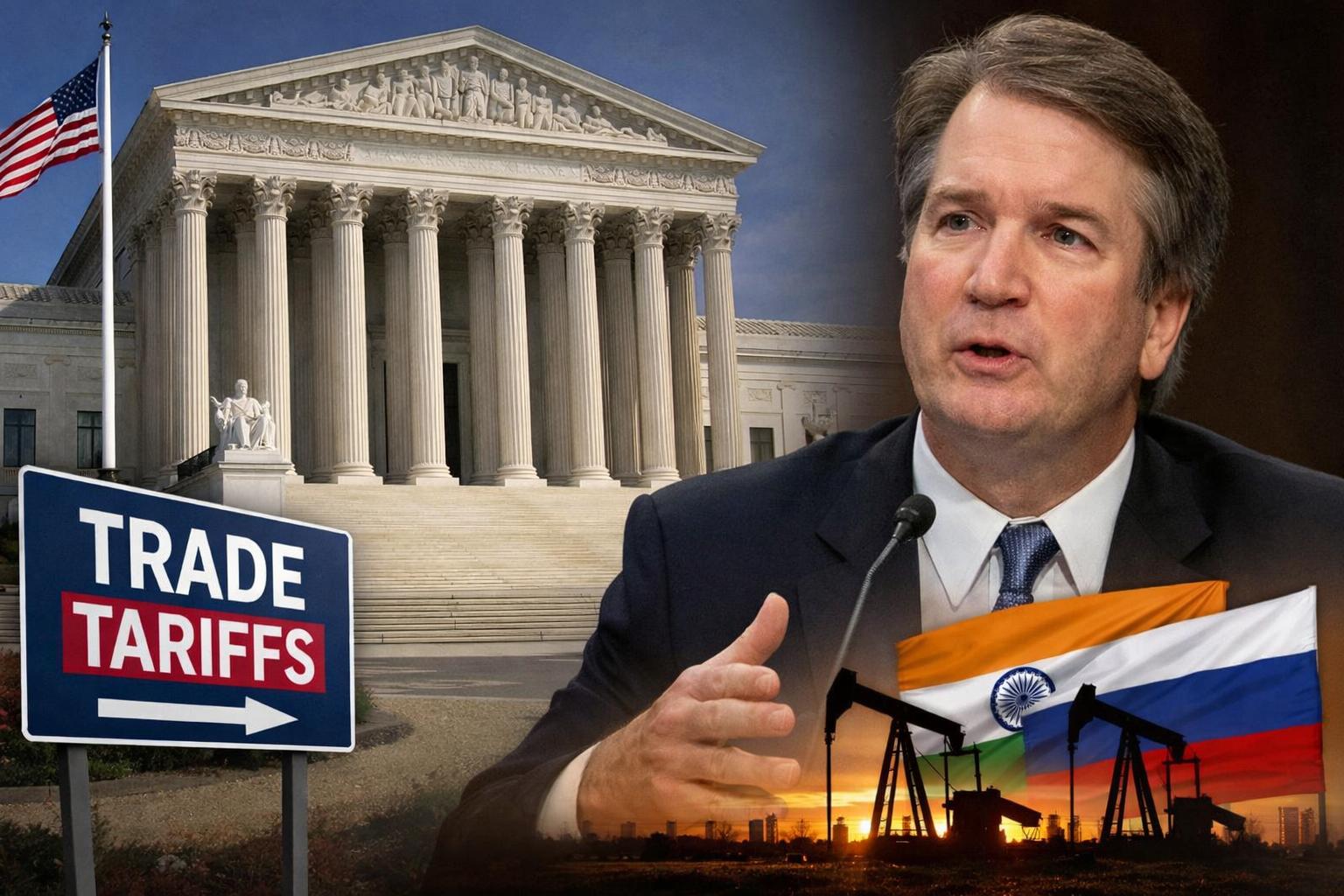
In his dissent, Justice Brett Kavanaugh pointed to the administration’s use of tariffs as a tool of foreign policy leverage, including duties imposed on India over its purchases of Russian oil. He argued that the tariffs were part of sensitive international negotiations and should be viewed within the broader context of the president’s conduct of foreign affairs.
Kavanaugh noted that the government had maintained the tariffs helped secure trade concessions from major partners such as China, the United Kingdom and Japan. According to the administration’s position, the measures were intended to open foreign markets to American businesses and support trade agreements valued in the trillions of dollars.
The dissent specifically referenced the August 2025 decision to impose a 25 percent tariff on India for what the administration described as direct or indirect imports of Russian Federation oil. At the time, the White House framed the move as part of broader efforts tied to geopolitical negotiations and energy security concerns. The tariffs included a reciprocal component initially set at 25 percent and later reduced to 18 percent.
Kavanaugh further observed that the administration subsequently eased the India-specific penalties in February 2026 after the government reported that New Delhi had committed to halting purchases of Russian oil and to increasing imports of American energy products. He argued that such developments demonstrated the traditional diplomatic use of tariffs as leverage in complex international negotiations.
Despite these arguments, the majority held that statutory limits must guide the exercise of executive power, even in matters touching on foreign affairs and national security. The court emphasized that significant economic measures with wide domestic consequences require clear authorization from Congress.
The decision marks a notable judicial check on presidential trade authority and is likely to influence how future administrations deploy tariffs in pursuit of foreign policy objectives. Legal analysts say the ruling reinforces the principle that emergency economic powers cannot be broadly interpreted to reshape global trade relationships without explicit legislative backing.
While the immediate policy effects remain to be fully assessed, the judgment underscores ongoing tensions between the executive branch’s flexibility in foreign affairs and the constitutional role of Congress in regulating commerce. The case is expected to shape debates over trade strategy, energy diplomacy and the scope of presidential economic powers in the years ahead.


 Joyful
0%
Joyful
0%
 Cool
0%
Cool
0%
 Thrilled
0%
Thrilled
0%
 Upset
0%
Upset
0%
 Unhappy
0%
Unhappy
0%